
CSMP IAS : India's Premier Coaching Institute for IAS / PCS
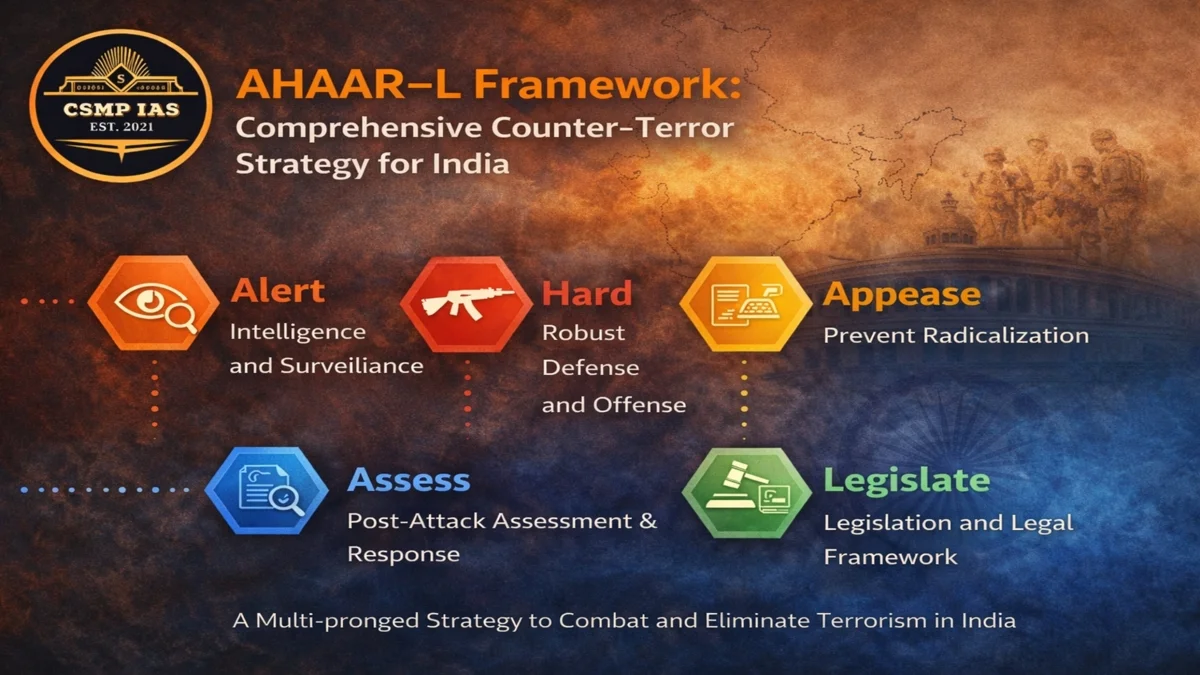
AHAAR–L Framework: Comprehensive Counter-Terror Strategy for India
(GS-III | Internal Security | Advanced Analytical Notes) : Although AHAAR is not an officially codified doctrine, it can be conceptualised as a multi-dimensional counter-terror framework integrating intelligence, security, finance, socio-political measures, diplomacy, and legal safeguards.
Table of Contents
I. Context: Nature of Terrorism in India
India faces complex, evolving threats:
- Cross-border terrorism (state-sponsored)
- Left Wing Extremism
- Urban sleeper cells
- Lone-wolf attacks
- Digital radicalisation
Example: Post-2008 Mumbai attacks reforms exposed gaps in intelligence coordination and response time.
II. AHAAR–L Pillars
A – Anticipatory Intelligence & Analytics
- NATGRID-type integration & Multi-Agency Centre (MAC)
- AI-based predictive policing
- OSINT + cyber surveillance
- Community intelligence networks
Analytical Insight: Shift from reactive → anticipatory security
Challenges:
- Privacy concerns
- Encryption barriers
- Centre-state coordination gaps
H – Homeland Security & Hard Power
- Police modernisation (SMART policing)
- Coastal security architecture
- Border tech (CIBMS, drones)
- Special forces (NSG hubs)
Relevance: 26/11 highlighted need for rapid-response capability
Issues:
- Low conviction rates
- Misuse allegations
- Procedural delays
A – Anti-Terror Financing & Economic Disruption
- FIU-IND monitoring
- Hawala crackdown
- Crypto tracking
- Asset freezing
Linked to: Financial Action Task Force
Insight: “Terror networks survive on shadow financing”
Emerging threats:
- Crowdfunding misuse
- NGOs as fronts
A – Addressing Radicalisation & Socio-Political Drivers
- De-radicalisation programs
- Counter-narratives (digital platforms)
- Skill development in vulnerable regions
- Reintegration of ex-militants
Link with:
- Aspirational Districts Programme
- Governance deficits
Keyword: Security–development nexus
R – Regional & Global Cooperation
- Intelligence-sharing agreements
- Extradition treaties
- FATF diplomacy
- Multilateral pressure
Platform: United Nations Security Council
Insight: Terrorism is transnational; response must be cooperative”
L – Legal Architecture & Liberty Balance (Value Addition)
- Strengthening legal framework
- Judicial oversight
- Due process safeguards
- Data protection norms
Key Provisions:
- Unlawful Activities (Prevention) Act
- Article 21 of Indian Constitution
Core Debate: Security vs Civil Liberties
UPSC Insight: “National security must operate within constitutional morality”
III. Emerging Threat Landscape
- Cyber terrorism
- AI-driven misinformation
- Drone-based attacks
- Hybrid warfare
- Lone-wolf radicalisation
Concept: Network-centric & technology-enabled terrorism
IV. Case Study Integration (High Value)
- 26/11 Mumbai Attacks → Intelligence + response gaps
- ISIS-inspired modules in India → Digital radicalisation
- FATF grey-list pressure → Diplomatic tool against terror states
V. Diagram (Use in Mains Answers)
AHAAR–L MODEL
————————–
Intelligence → Security
↓ ↓
Financing → Radicalisation
↓ ↓
Global Cooperation
↓
Legal Safeguards
VI. Critical Evaluation
| Strengths | Weaknesses |
| Multi-dimensional challenges | Coordination |
| Preventive focus concerns | Privacy concerns |
| Global alignment Over-securitisation risk | |
| Financial disruption allegations | Legal misuse |
VII. Way Forward
- Institutionalised Intelligence Fusion Centre
- Police reforms (as per 2nd ARC)
- Strengthening forensic & cyber capabilities
- Periodic review of anti-terror laws
- Community policing models
- Tech-driven surveillance with safeguards
VIII. Conclusion
AHAAR–L represents a “whole-of-government and whole-of-society approach” to counter-terrorism.
India’s response must move beyond coercive force to include:
- Intelligence precision
- Financial disruption
- Socio-political integration
- Global cooperation
- Constitutional balance
Final line for answers: “Effective counter-terrorism lies not in eliminating threats alone, but in building resilient, lawful, and inclusive security systems.”
UPSC Practice Questions
Prelims Question
With reference to India’s counter-terror framework and global mechanisms, consider the following statements:
1.The Unlawful Activities (Prevention) Act empowers the Central Government to designate both organisations and individuals as terrorists, but such designation is subject to judicial confirmation within a prescribed time.
2.The Financial Action Task Force has a legally binding mandate under international law to impose sanctions on countries that fail to curb terror financing.
3.The National Investigation Agency can take suo motu cognisance of terror-related offences without prior approval of the Central Government under certain circumstances.
4.India’s obligations under the United Nations Security Council resolutions require automatic domestic criminalisation of all entities listed under UN terror sanctions lists without legislative backing.
Which of the statements given above are correct?
(a) 1 and 3 only
(b) 2 and 4 only
(c) 1 only
(d) 1, 2 and 3 only
Correct Answer: (c) 1 only
Mains Questions
- “Counter-terrorism policy must evolve from hard power to a multi-dimensional framework.” Discuss using the AHAAR model. (250 words)
- Examine the tension between national security and civil liberties in India’s anti-terror legal framework. (250 words)
- Terror financing remains the backbone of extremist networks. Analyse India’s response considering FATF standards. (150 words)
Read more: India – France Special Global Strategic Partnership
