
CSMP IAS : India's Premier Coaching Institute for IAS / PCS
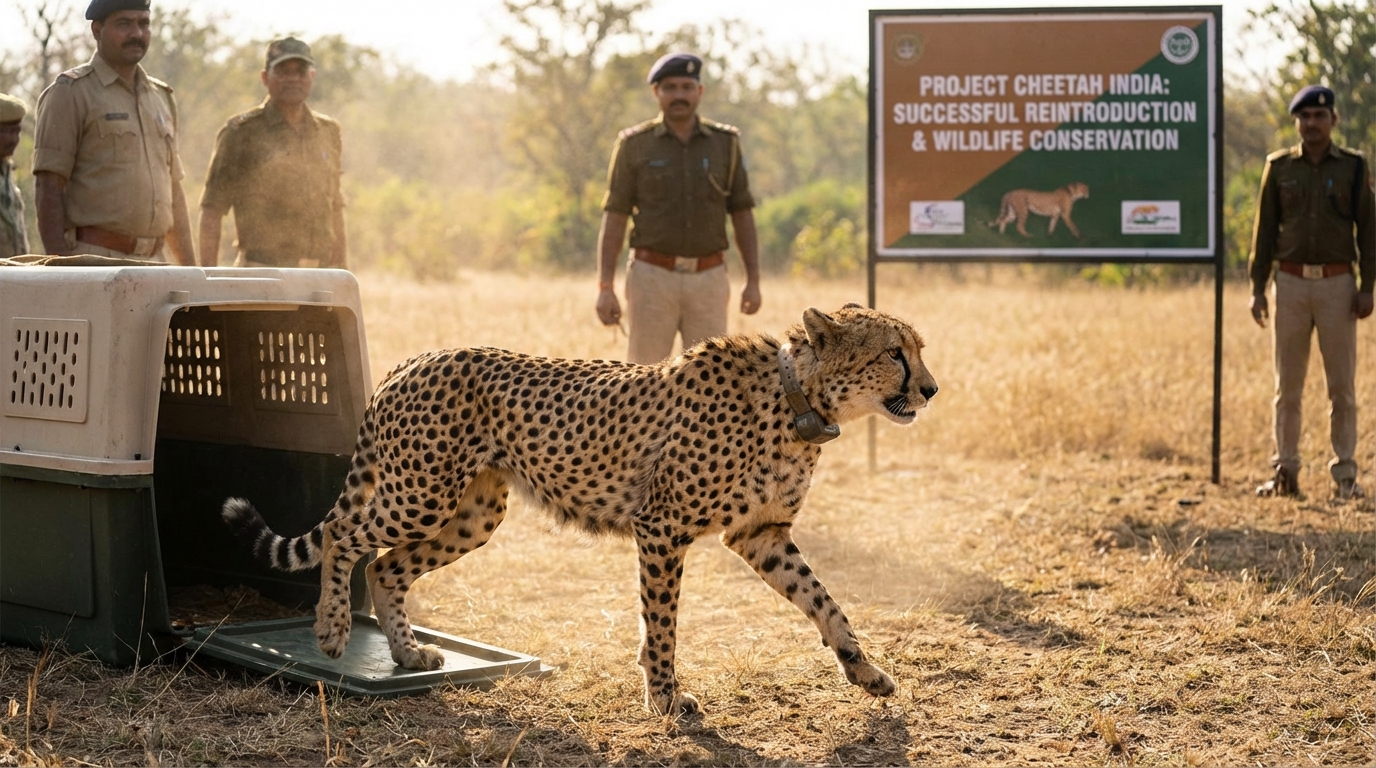
Project Cheetah in India: Successful Reintroduction and Wildlife Conservation
Table of Contents
Project Cheetah in India marks a significant milestone in wildlife conservation, with African cheetahs reintroduced to Kuno National Park and moving naturally across landscapes into Rajasthan. The initiative strengthens biodiversity, promotes ecological balance, and supports the creation of inter-state wildlife corridors, while fostering scientific monitoring, international cooperation, and eco-tourism opportunities.
Why in the News?
- The National Tiger Conservation Authority (NTCA) recently stated that the movement of cheetahs from Kuno National Park to parts of Rajasthan is natural territorial behaviour.
- Media reports since late February showed that two cheetahs travelled about 60–70 km from Kuno to the Mangrol range in Baran district of Rajasthan.
- The cheetahs are now located near the Parvati River, about six km apart on opposite river banks.
- These cheetahs are part of Project Cheetah, which aims to reintroduce cheetahs in India.
What are the Key Highlights?
Movement of Cheetahs Across State Boundaries
- Two cheetahs named KP2 and KP3 moved from Kuno National Park in Madhya Pradesh to Baran district in Rajasthan.
- They travelled around 60 to 70 km.
- The cheetahs were found in:
- Mangrol forest range in Baran.
- Banjh Amli Conservation Reserve.
- Both animals are currently located near the Parvati River.
First Generation of Cheetahs Born in India
- KP2 and KP3 belong to the first generation of cubs born in India.
- Their parents were African cheetahs brought to India in 2022.
Monitoring of Cheetahs
- The animals are radio-collared.
- They are being tracked through satellite monitoring.
- A joint inter-State team is monitoring them.
- Field teams are deployed from the Kishanganj and Anta forest ranges.
Natural Territorial Behaviour
- According to the NTCA, cheetahs often move across large landscapes.
- Such long-distance dispersal is a natural behaviour for the species.
Proposed Inter-State Wildlife Corridor
- The movement supports the idea of creating the Kuno–Gandhi Sagar wildlife corridor.
- The proposed corridor will cover about 17,000 square kilometres.
- It will span:
- Seven districts of Rajasthan
- Eight districts of Madhya Pradesh
Arrival of New Cheetahs from Botswana
- On February 28, nine cheetahs arrived from Botswana under Project Cheetah.
- These included:
- Six females
- Three males
- They were transported by an Indian Air Force cargo aircraft to Gwalior Air Force Station.
- Later, they were taken by helicopter to Kuno National Park.
International Cooperation in Cheetah Translocation
- Botswana became the third African country to send cheetahs to India.
- Earlier cheetahs were brought from:
- Namibia
- South Africa
Status of the Cheetah Population in India
- Since 2022:
- 29 adult cheetahs have been brought from Africa.
- Mortality:
- Nine adult cheetahs have died.
- Births in India:
- 28 cubs have been born.
- Around 12 cubs have died.
- Some cheetahs are also kept in Gandhi Sagar Wildlife Sanctuary.
Historical Context
- Cheetahs became extinct in India in 1952.
- Project Cheetah aims to reintroduce the species into the country.
What are the Significance?
Restoration of a Lost Species
- Project Cheetah aims to bring back a species that became extinct in India.
- This is an important step for biodiversity conservation.
Strengthening Wildlife Corridors
- The movement of cheetahs across landscapes supports the creation of large wildlife corridors.
- Such corridors allow animals to move freely between habitats.
Scientific Wildlife Monitoring
- The use of satellite tracking and radio collars helps scientists monitor animal behaviour.
- This improves wildlife research and management.
Boost to Ecological Balance
- As a top predator, the cheetah plays an important role in controlling herbivore populations.
- This helps maintain healthy ecosystems.
Promotion of Conservation Awareness
- Project Cheetah has increased public awareness about wildlife conservation.
- It has also strengthened international cooperation in conservation efforts.
Economic Opportunities Through Eco-Tourism
- The presence of cheetahs can promote wildlife tourism.
- This can generate income and employment in local areas.
Challenges
High Mortality of Cheetahs
- Several adult cheetahs and cubs have died since the project started.
- This raises concerns about adaptation and survival in the new habitat.
Habitat Limitations
- Suitable habitats for cheetahs are limited and fragmented in India.
Human–Wildlife Conflict
- As cheetahs move outside protected areas, they may come close to human settlements.
Ecological Concerns
- Some experts have questioned whether African cheetahs can fully adapt to Indian ecosystems.
Management Across State Boundaries
- Cheetahs moving across states require coordination between different State governments and forest departments.
Way Forward
Expanding Protected Wildlife Corridors
- The proposed Kuno–Gandhi Sagar corridor should be developed to allow safe movement of cheetahs.
Strengthening Habitat Management
- Forest departments should improve:
- Prey availability
- Habitat quality
- Water resources
Enhancing Scientific Monitoring
- Continued use of technology such as GPS collars and satellite tracking will help track animal health and movement.
Improving Inter-State Coordination
- Strong cooperation between Madhya Pradesh and Rajasthan forest authorities is necessary.
Increasing Community Participation
- Local communities should be involved in conservation efforts.
- Awareness programmes can help reduce human–wildlife conflicts.
Careful Expansion of the Project
- Future translocations should be done carefully based on scientific studies and ecological assessments.
Conclusion
The reintroduction of cheetahs represents an ambitious conservation effort that requires long-term planning, scientific management, and cooperation among multiple stakeholders. With careful monitoring and habitat protection, this initiative can contribute to strengthening India’s biodiversity conservation efforts.
Relevant Articles:
Affordable Cancer Medicines in India: Customs Duty Exemption Reduces Treatment Costs
India–Canada Economic Partnership 2026
Viksit Bharat Rural Employment Mission: Transforming India’s Rural Jobs Landscape
Read Also:
India’s AI Self-Reliance: Sarvam AI Launches Open-Source Large Language Models
Great Nicobar Project: Development, Ecology, and the Question of Justice
Loggerhead Turtle Climate Impact: Alarming Study Reveals Survival Threat