
CSMP IAS : India's Premier Coaching Institute for IAS / PCS
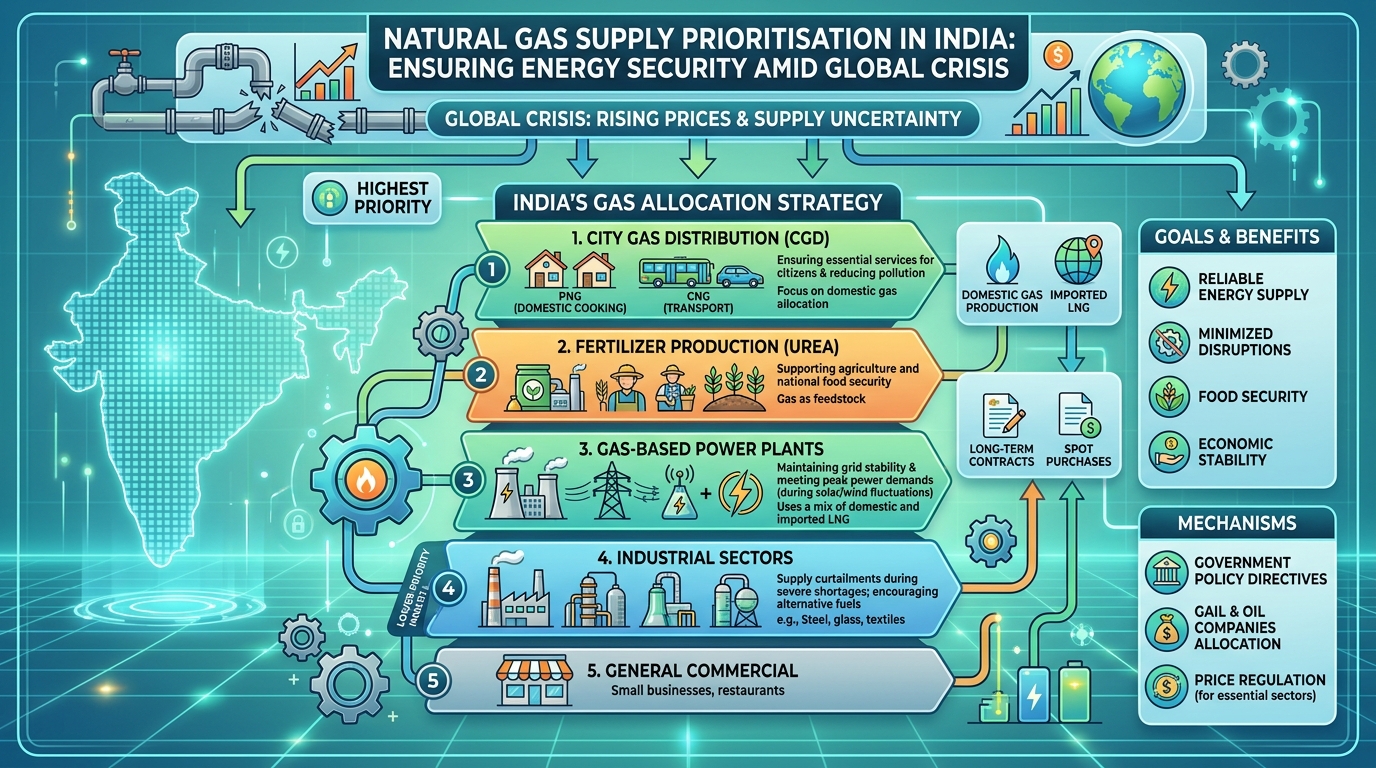
Natural Gas Supply Prioritisation in India: Ensuring Energy Security Amid Global Crisis
Table of Contents
The Government of India has invoked the Essential Commodities Act, 1955 to prioritise natural gas supply to critical sectors amid disruptions in LNG shipments through the Strait of Hormuz. This tiered allocation ensures uninterrupted domestic PNG and LPG supply, supports CNG for transportation, stabilises fertilizer production, and maintains industrial operations. By implementing this strategic prioritisation, India demonstrates proactive energy management and safeguards households, agriculture, and industry during
Why in the News?
- The Government of India has invoked the Essential Commodities Act, 1955 to prioritise the supply of natural gas to important sectors of the economy.
- This decision was taken by the Ministry of Petroleum and Natural Gas through a gazette notification dated March 9, 2026.
- The step was taken because of disruptions in Liquefied Natural Gas (LNG) shipments passing through the Strait of Hormuz due to tensions and conflict in West Asia.
- Around 30% of India’s natural gas imports pass through the Strait of Hormuz, which makes the situation critical for India’s energy supply.
- The government has therefore created a tiered priority system to distribute natural gas among different sectors.
What are the Key Highlights?
- Invocation of Emergency Law
- The government used the Essential Commodities Act, 1955 to control and prioritise natural gas supply.
- This law allows the government to regulate the production, supply, and distribution of essential goods during emergencies.
- Reason for the Decision
- LNG shipments through the Strait of Hormuz have been disrupted.
- Suppliers have invoked force majeure, which means they cannot fulfil contracts due to unexpected events such as war.
- India’s Natural Gas Situation
- India consumes about 195 million metric standard cubic metres per day (MMSCMD) of natural gas.
- India imports about half of its natural gas requirement.
- Priority Allocation System
- The government introduced a tiered structure to allocate gas to different sectors.
- Highest Priority Sectors (100% supply)
- Domestic Piped Natural Gas (PNG) supply.
- Compressed Natural Gas (CNG) used as vehicle fuel.
- Liquefied Petroleum Gas (LPG) production.
- Supply will be maintained at 100% of the average consumption of the previous six months, subject to availability.
- Second Priority Sector
- Fertilizer plants will receive 70% of their average gas consumption from the last six months.
- Industrial and Manufacturing Sectors
- Industries connected to the natural gas grid will receive 80% of their normal gas requirement.
- City Gas Distribution (CGD) companies must also ensure the same supply level to industrial and commercial consumers.
- Reduction in Supply to Certain Companies
- Gas supply may be reduced or partially curtailed to companies such as:
- ONGC Petro additions Limited
- GAIL Pata Petrochemical plant
- Reliance Industries O2C (Oil to Chemicals) business
- Gas supply may be reduced or partially curtailed to companies such as:
- Impact on Oil Refineries
- Oil refineries will reduce gas consumption to about 65% of their average consumption over the past six months.
- Government Focus on Agriculture
- The Ministry of Chemicals and Fertilizers welcomed the decision.
- The move aims to ensure that fertilizer production continues smoothly for the upcoming Kharif sowing season.
- High-Level Government Meeting
- Senior officials from the Ministry of Petroleum and Natural Gas and fertilizer companies met to review preparedness and challenges.
What are the Significance?
Ensuring Energy Security
- The priority system helps maintain stable supply of natural gas to essential sectors.
- It prevents sudden shortages in critical areas such as cooking fuel and transportation.
Protection of Household Energy Needs
- Domestic PNG and LPG production have been given top priority.
- This ensures that households continue to receive cooking gas without major disruptions.
Supporting Public Transportation
- CNG used in vehicles has been placed in the highest priority category.
- This ensures that public transport systems and CNG vehicles continue operating normally.
Securing Fertilizer Production
- Fertilizer plants depend heavily on natural gas.
- By ensuring 70% supply, the government aims to prevent fertilizer shortages.
- This helps farmers during the Kharif cropping season.
Stabilising Industrial Production
- Industries and manufacturing units will still receive 80% of their gas needs.
- This prevents a major slowdown in industrial activity.
Crisis Management During Global Conflict
- The decision shows how India can quickly respond to international supply disruptions.
- The disruption at the Strait of Hormuz demonstrates how geopolitical tensions affect energy supply.
Balanced Distribution of Limited Resources
- The tiered allocation system distributes limited natural gas supplies based on national priorities.
- Essential sectors receive more supply, while less critical sectors receive reduced allocation.
Challenges
Heavy Dependence on Energy Imports
- India imports about 50% of its natural gas requirement.
- Supply disruptions abroad can easily affect the domestic economy.
Vulnerability to Geopolitical Conflicts
- A large portion of India’s energy imports pass through the Strait of Hormuz.
- Conflicts in West Asia can therefore directly threaten India’s energy security.
Impact on Industrial Sector
- Industries receiving only 80% supply may face:
- Production slowdowns
- Higher operational costs
Reduced Supply to Petrochemical Sector
- Companies like ONGC Petro additions Limited, GAIL, and Reliance Industries may face reduced production capacity.
Pressure on Refineries
- Oil refineries operating at 65% gas supply may face operational challenges.
Rising Energy Prices
- Global conflicts can increase oil and gas prices.
- This can lead to higher import bills and inflation.
Way Forward
Diversifying Energy Import Sources
- India should import natural gas from multiple regions.
- This will reduce dependence on a single route like the Strait of Hormuz.
Expanding Domestic Gas Production
- Increasing domestic exploration and production can improve energy self-sufficiency.
Building Strategic Gas Reserves
- India can create strategic reserves of natural gas to manage emergency supply disruptions.
Promoting Renewable Energy
- Increasing the share of solar, wind, and other renewable energy sources will reduce reliance on imported fossil fuels.
Improving Energy Efficiency
- Industries and households can adopt energy-efficient technologies.
- This will reduce total energy demand.
Strengthening Energy Diplomacy
- India should strengthen energy partnerships with multiple countries.
- Long-term contracts can help ensure stable supply during global crises.
Conclusion
The recent policy decision shows the importance of careful resource management during uncertain global situations. By prioritising critical sectors and planning for disruptions, governments can reduce the impact of international crises on domestic economic and social stability while preparing the economy for future energy challenges.
Relevant Articles:
Designer Proteins in Bacteria: Breakthrough in AI-Driven Protein Engineering
Empowering Women in AI Learning in India: Closing the Digital Gender Gap
Musi Riverfront Development in Hyderabad: Urban Renewal Amid Controversy
Read Also:
IRIS Dena Incident and The Shaping of AI Geopolitics
West Asia Crisis 2026: Iran-Israel-US Conflict and Strategic Implications for India
Project Cheetah in India: Successful Reintroduction and Wildlife Conservation