
CSMP IAS : India's Premier Coaching Institute for IAS / PCS
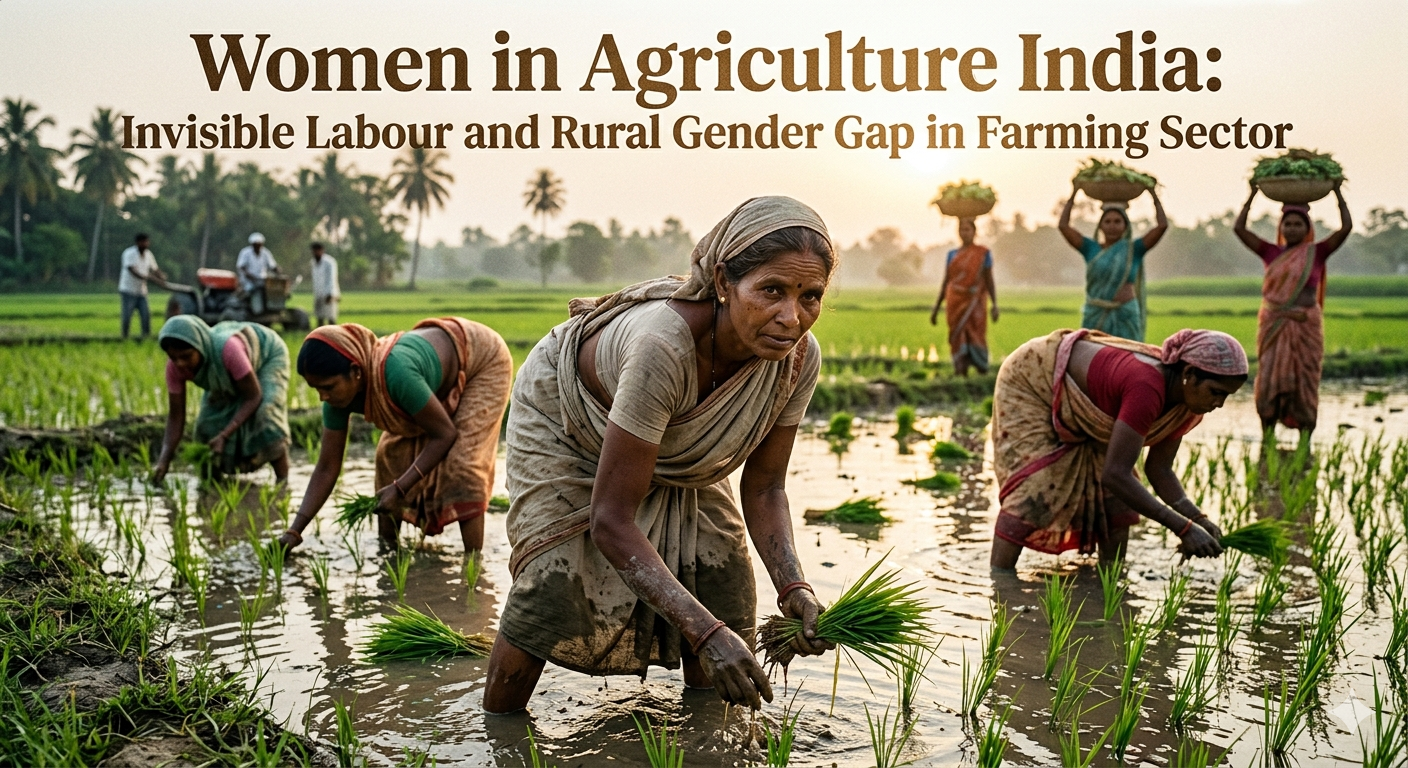
Women in Agriculture: Invisible Labour and Rural Gender Gap in Farming Sector
Table of Contents
Women in Agriculture India play a crucial role in sustaining rural livelihoods, yet their contribution remains largely invisible due to poor data capture, unpaid labour, and persistent gender wage gaps. Despite increasing workforce participation, women continue to face limited land ownership, low wages, and lack of formal recognition in the agricultural economy.
Why in the News?
- The issue of women’s role in agriculture has gained attention around International Women’s Day 2026.
- Studies and surveys show that women sustain India’s farming economy, but their work is often unpaid, poorly recorded, and poorly paid.
- Despite a rise in women’s work participation in rural areas, many women remain invisible in official labour statistics.
What are the Key Highlights?
- Difficulty in counting women workers
- Official labour surveys such as the Periodic Labour Force Survey fail to capture women’s work accurately.
- Women often perform multiple tasks in a day, such as:
- Child care
- Feeding animals
- Working on farms
- Because this work is unpaid, seasonal, or done at home, many women do not report themselves as “workers”.
- Rise in women’s work participation
- Rural female workforce participation increased from 35% in 2011–12 to 46.5% in 2023–24.
- However, this level is still lower than the global average of 57–63% according to the International Labour Organization.
- Increase in self-employment
- A large number of women workers are classified as self-employed.
- Share of self-employed rural women workers:
- 60% in 2011–12
- 73% in 2023–24
- This rise mainly reflects lack of wage employment opportunities.
- Women’s presence in agriculture
- In 2023–24, about 117.6 million women were working in agriculture.
- This includes:
- 95.1 million self-employed women
- 21.7 million hired workers
- 0.8 million regular workers
- The male workforce in agriculture was 127.5 million.
- Women in Agriculture and crop cultivation
- Village studies by the Foundation for Agrarian Studies show:
- Women provide about one-third of family labour in agriculture.
- In some villages of Tamil Nadu, women contributed more than half of the total labour.
- Village studies by the Foundation for Agrarian Studies show:
- Women’s role in livestock rearing
- Livestock is one of the fastest growing sectors in agriculture.
- Women perform most tasks such as:
- Feeding animals
- Cleaning sheds
- Milking cattle
- Around 40 million rural households own milch animals, meaning millions of women are engaged in livestock work.
- Women in agricultural wage labour
- Mechanisation has reduced the demand for labour in agriculture.
- Women’s share in hired agricultural labour varies widely.
- In many villages, women workers still form more than one-third of hired labour.
- Low wages for women workers
- Women agricultural labourers earned less than ₹300 per day in many villages.
- According to the Labour Bureau, the average daily wage for women agricultural workers in November 2025 was ₹384.
- Wages differ across states.
- The highest wages were in Kerala at about ₹646 per day.
- Large gender wage gap
- In some areas, women earn less than half of male wages.
- In other regions, wages are lower overall but the gender gap is slightly smaller.
- Low earnings from livestock and farming
- Earnings from livestock work can be around ₹100 per day, which is much lower than agricultural wages.
- Income from crop production is also low.
- In some villages, total annual farm income is less than ₹16,000–₹24,000.
- Limited land ownership
- Only about 10% of rural women own land.
- Lack of land ownership limits their economic independence.
What is the Significance?
Women are the Backbone of Agriculture
- Women now form around half of India’s agricultural workforce.
- Many farming activities depend heavily on women’s labour.
- Without women workers, farm production would decline significantly.
Contribution to Food Security
- Women contribute to:
- Crop cultivation
- Livestock rearing
- Poultry and dairy production
- Their work helps maintain stable food production in rural India.
Support to Rural Household Economy
- Women’s labour increases household income and livelihood security.
- Their work in livestock and farming supports daily household consumption.
Growth of Allied Agricultural Activities
- Women play a major role in sectors such as:
- Dairy
- Poultry
- Small livestock farming
- These sectors are important for rural economic diversification.
Importance for Gender Equality
- Recognising women farmers is essential for:
- Equal wages
- Social protection
- Economic empowerment
- Proper recognition can improve women’s rights and status in society.
Challenges
Invisibility of Women’s Work
- Much of women’s agricultural work is unpaid and informal.
- Official surveys fail to capture:
- Family labour
- Seasonal work
- Household-based farming activities.
High Dependence on Self-Employment
- Most women are self-employed farmers or helpers.
- This indicates lack of stable wage employment.
Gender Wage Gap
- Women workers often receive lower wages than men for the same work.
- Wage inequality remains widespread in agriculture.
Low Earnings and Income Insecurity
- Earnings from:
- Crop production
- Livestock work
- are very low and unstable.
Limited Land Ownership
- Only a small percentage of women own agricultural land.
- Without land ownership, women have:
- Less decision-making power
- Limited access to credit and government schemes.
Decline in Agricultural Labour Demand
- Mechanisation has reduced demand for labour.
- Women workers are often the first to lose employment opportunities.
Way Forward
Improve Data Collection
- Labour surveys should be improved to capture unpaid and informal work.
- Gender-disaggregated data should be collected for:
- Family labour
- Livestock work
- Farm management activities.
Recognise Women as Farmers
- Women must be officially recognised as farmers, not only as helpers.
- This will help them access:
- Government schemes
- Training programs
- Agricultural subsidies.
Ensure Equal Wages
- Governments must enforce equal pay for equal work.
- Monitoring of agricultural wage payments should be strengthened.
Expand Rural Employment Opportunities
- More non-farm and rural employment opportunities should be created.
- This will reduce excessive dependence on agriculture.
Increase Women’s Land Ownership
- Policies should encourage joint land titles and inheritance rights for women.
- Land ownership improves:
- Financial security
- Access to institutional credit.
Provide Skill Development and Support
- Women farmers should receive training in:
- Modern farming techniques
- Dairy and livestock management
- Market access and value addition.
Conclusion
Women play a central role in India’s rural economy and agriculture, yet their labour remains undervalued and poorly recognised. Improving data collection, ensuring fair wages, expanding rights to land and resources, and strengthening institutional support are essential steps to create a more inclusive and sustainable agricultural system. Recognising and empowering women farmers will strengthen rural livelihoods and contribute to long-term agricultural development.
Recent Articles:
Global AI Rivalry: Security Risks and Strategic Threats in Artificial Intelligence
Natural Gas Supply Prioritisation in India: Ensuring Energy Security Amid Global Crisis
Designer Proteins in Bacteria: Breakthrough in AI-Driven Protein Engineering
Read Also:
Empowering Women in AI Learning in India: Closing the Digital Gender Gap
Musi Riverfront Development in Hyderabad: Urban Renewal Amid Controversy
IRIS Dena Incident and The Shaping of AI Geopolitics
Empowering Women Farmers in Agriculture – PIB