CSMP IAS : India's Premier Coaching Institute for IAS / PCS
Four-Year Undergraduate Programme India: Higher Education Reform and Academic Flexibility Debate
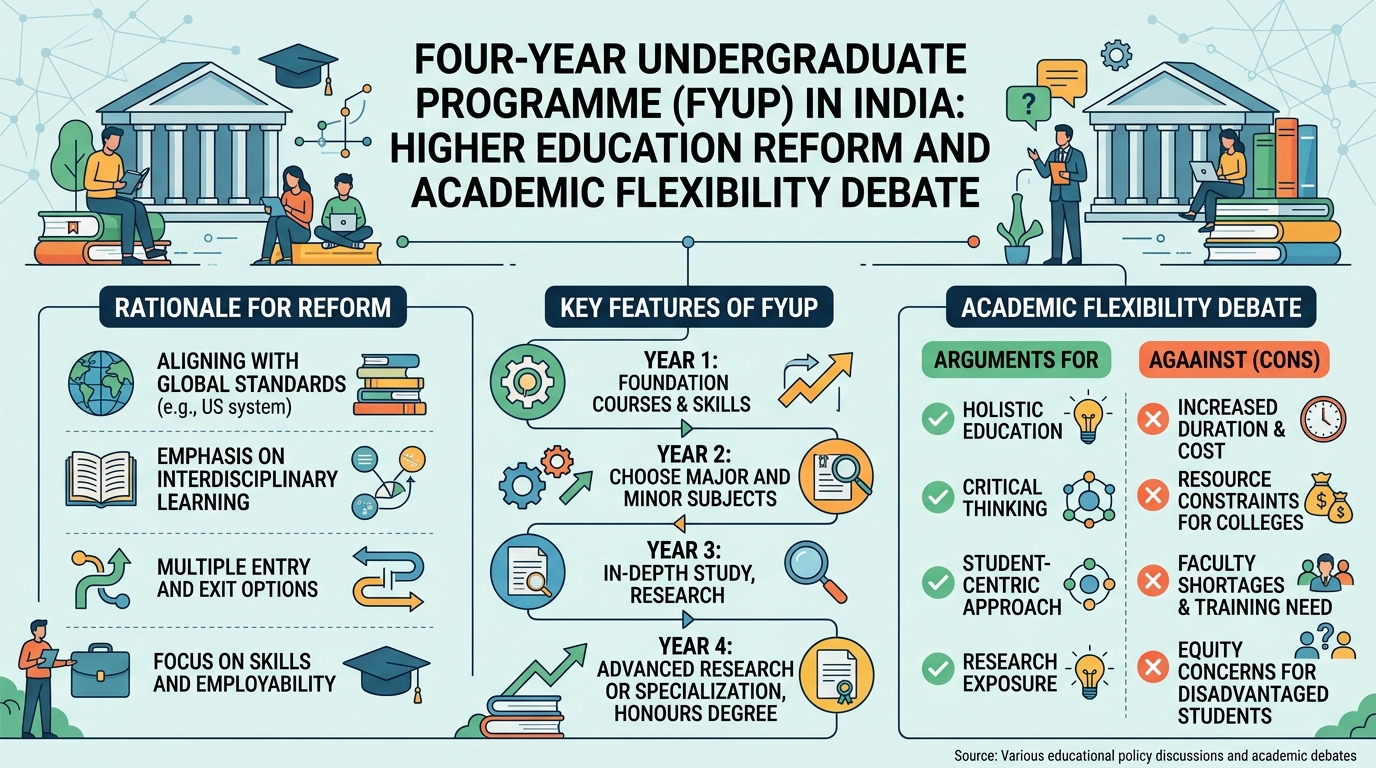
Four-Year Undergraduate Programme India, introduced under the National Education Policy 2020 framework, aims to transform higher education through multidisciplinary learning, choice-based credit systems, and student-centric flexibility. However, its implementation in states like Kerala has raised concerns about limited academic freedom, administrative challenges, and gaps between policy vision and classroom reality.
Table of Contents
Why in the News?
- Education reforms in India are increasingly focusing on “choice” and “flexibility” in higher education.
- The introduction of the Four-Year Undergraduate Programme (FYUGP) in 2024 in Kerala has revived debate on whether students truly have academic freedom.
- The reform follows the recommendations of the National Education Policy 2020, which promotes multidisciplinary learning, flexibility in course selection, and student-centric education.
What are the Key Highlights?
- Shift from traditional education model
- Earlier, higher education followed a one-size-fits-all model.
- Students usually studied only one discipline without flexibility.
- Reforms now focus on student interests, abilities, and career goals.
- Promotion of multidisciplinary learning
- Students can now combine different subjects across disciplines.
- For example:
- A science student may study music as a minor subject.
- The aim is to give students a broader understanding of knowledge.
- Introduction of Choice-Based Credit System
- The Choice-Based Credit and Semester System was introduced in Kerala in 2009.
- It was designed to give students flexibility to choose courses and earn credits.
- Limited real choice in practice
- In reality, the number of electives was very limited.
- Departments often decided which electives were available.
- The only real option was the “open course” offered in the fifth semester.
- Launch of the Four-Year Undergraduate Programme
- The Four-Year Undergraduate Programme was introduced in 2024.
- It allows students to:
- Change major subjects
- Select minor subjects
- Study across departments.
- Restrictions within the new system
- University regulations in Kerala did not allow minors from allied disciplines.
- This rule aimed to promote interdisciplinary learning.
- However, it also restricted specialization in related subjects.
- Example of curriculum innovation
- A course titled “Introducing Literature” was introduced at the University of Calicut.
- The course focused on learning how to read literature rather than memorising texts.
- Students analysed unseen passages using different perspectives.
- Skill-based evaluation attempts
- A skill-oriented question paper was introduced for a communication course.
- The goal was to test practical communication skills instead of theoretical knowledge.
- Administrative difficulties
- Even small reforms faced bureaucratic obstacles.
- For example:
- Permission for a separate answer booklet was denied.
- Teacher resistance to new methods
- Some teachers resisted concept-based teaching methods.
- This showed that teacher training was not adequate before implementing reforms.
What is the Significance?
Promoting Student-Centric Education
- Education reforms aim to focus on students’ interests and abilities.
- Students can choose courses that match their talents and career goals.
Encouraging Multidisciplinary Learning
- Studying multiple disciplines helps students understand complex real-world issues.
- It provides broader knowledge and new perspectives.
Improving Skill-Based Education
- Activity-based courses and practical assessments help students develop real-life skills.
- This prepares students better for employment and professional life.
Enhancing Academic Flexibility
- Systems such as Choice-Based Credit and Semester System and Four-Year Undergraduate Programme allow students to:
- Change subjects
- Explore new academic areas
- Build diverse knowledge.
Supporting Modern Education Reforms
- These reforms align with the goals of the National Education Policy 2020.
- The policy aims to create flexible, skill-oriented, and globally competitive education systems.
Challenges
Illusion of Academic Choice
- Many choices exist only on paper.
- In practice, students often have very limited options for electives.
Rigid Academic Structure
- Universities still follow traditional systems of teaching and administration.
- Structural changes needed for flexible learning have not fully happened.
High Teacher Workload
- Teachers already manage large classes and heavy teaching loads.
- This makes it difficult to adopt new teaching methods and courses.
Lack of Teacher Training
- Many teachers are not trained for multidisciplinary and concept-based teaching.
- Resistance from teachers slows the implementation of reforms.
Poor Student–Teacher Ratio
- Large class sizes make interactive and flexible learning difficult.
Bureaucratic Obstacles
- Administrative rules sometimes prevent innovative teaching practices.
Incomplete Infrastructure for Flexibility
- Systems where students move across departments require:
- Flexible schedules
- Strong coordination between departments.
- Many universities are not prepared for such changes.
Way Forward
Provide Extensive Teacher Training
- Teachers should receive training in:
- Multidisciplinary teaching
- Skill-based evaluation
- Concept-based learning.
Reform the Evaluation System
- Exams should test practical knowledge, creativity, and skills.
- Activity-based assessments should be encouraged.
Increase Academic Autonomy
- Teachers and departments should have greater freedom in designing courses and syllabi.
Improve Student–Teacher Ratio
- Universities should recruit more teachers to reduce classroom size.
Strengthen Institutional Infrastructure
- Universities should create systems that allow:
- Easy movement of students between departments
- Better timetable coordination.
Encourage Real Academic Choice
- Institutions must provide a wider range of electives and minors.
- Students should have genuine freedom in course selection.
Conclusion
Higher education reforms aim to create a system that supports curiosity, creativity, and independent learning. For these reforms to succeed, institutions must adapt their structures, teaching practices, and evaluation systems to match the new vision. Only then can universities truly support the diverse talents and ambitions of students.
Relevant Articles:
GDP Base Year Revision India 2022–23: New National Accounts Statistics and Economic Reassessment
Earthquake Zoning Map India: BIS Withdrawal of Revised Seismic Hazard Framework
Women in Agriculture: Invisible Labour and Rural Gender Gap in Farming Sector
Read Also:
Global AI Rivalry: Security Risks and Strategic Threats in Artificial Intelligence
Natural Gas Supply Prioritisation in India: Ensuring Energy Security Amid Global Crisis
Designer Proteins in Bacteria: Breakthrough in AI-Driven Protein Engineering
Higher Education under NEP 2020: Reimagining India’s …