CSMP IAS : India's Premier Coaching Institute for IAS / PCS
Strait of Hormuz Crisis: Global Energy Security and India’s Strategic Response
Table of Contents
The Strait of Hormuz Crisis has once again highlighted the importance of global energy routes and geopolitical stability. Recent statements by Abbas Araghchi regarding control over the Strait of Hormuz have raised concerns about international maritime law, oil supply security, and regional tensions. For India, this situation is highly significant as it directly affects energy imports, foreign policy, and economic stability.
Why in the News?
- A recent statement by Iran’s Foreign Minister has brought global attention to the Strait of Hormuz.
- Iran announced that it allowed ships from certain “friendly countries” such as India, China, Russia, Iraq, and Pakistan to pass through the Strait.
- Iran also claimed that it has established its “sovereignty” over this important waterway.
- The statement came after a period of conflict in the region, during which an Iranian naval vessel was attacked.
- Iran publicly thanked India and Sri Lanka for helping move its ships to safer locations during the crisis.
- At the same time, India is taking steps to secure its energy supplies and is exploring trade in local currencies with West Asian countries.
What are the Key Highlights of Strait of Hormuz Crisis?
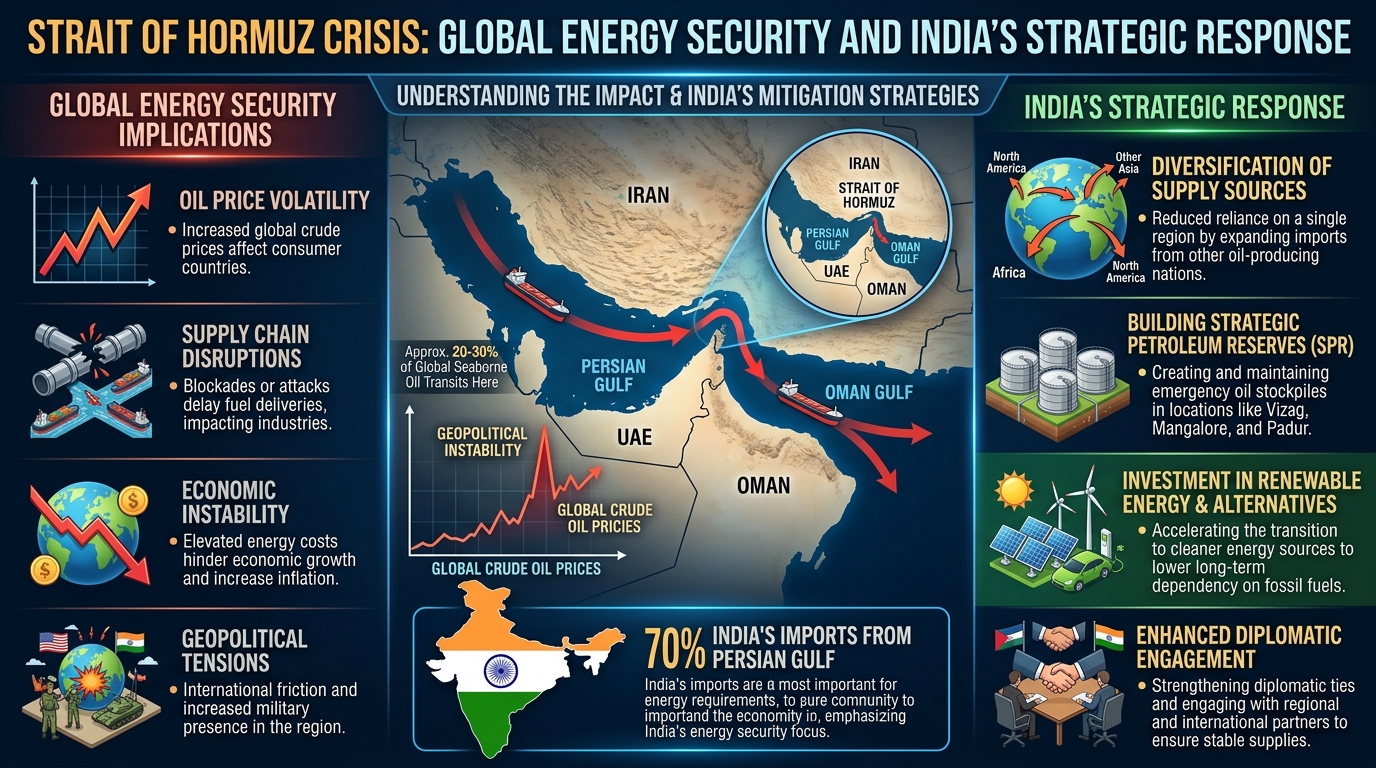
- The Strait of Hormuz connects the Persian Gulf with the Gulf of Oman.
- It is one of the most important sea routes in the world for oil transport.
- Iran stated that:
- It allowed ships of selected countries to pass through the Strait.
- It considers the Strait to be under its sovereignty.
- It may introduce new rules for passage after the conflict.
- During the conflict:
- An Iranian ship named IRIS Dena was attacked.
- India and Sri Lanka helped Iran by moving its ships to safer areas.
- India has ensured:
- At least one month of LPG supply through imports.
- Continuous procurement to avoid shortages.
- India is also:
- Exploring trade with West Asian countries in local currencies instead of the US dollar.
What are the Significance?
Strategic Importance of the Strait of Hormuz
- The Strait is a narrow but very important sea route.
- It carries about 20–25% of the world’s oil supply.
- It is a key link between oil-producing countries and global markets.
- Any disruption in this Strait can affect the global economy.
- Oil prices may rise sharply.
- Supply chains can be disturbed.
Impact on Global Energy Security
- Many countries depend on oil passing through this Strait.
- Countries in Asia, Europe, and beyond rely on this route.
- If tensions increase:
- Oil supply may reduce.
- Prices may increase globally.
- This makes the Strait a critical point for energy security.
Implications for India’s Energy Needs
- India imports a large part of its oil requirements.
- Much of this oil passes through the Strait.
- Any disruption can affect India directly.
- Fuel prices may rise.
- Inflation may increase.
- India’s effort to secure LPG supply shows:
- Preparedness for emergencies.
- Focus on energy stability.
Geopolitical Significance
- The region involves major global powers such as:
- Iran
- United States
- China
- Russia
- Iran’s statement about sovereignty reflects:
- Rising tensions in West Asia.
- Assertion of regional control.
- It also raises questions about international maritime laws.
Legal Significance under International Law
- According to international law (UNCLOS):
- Ships of all countries have the right to pass through international straits.
- This is known as:
- Transit passage.
- Iran’s claim of sovereignty:
- May conflict with this principle.
- Can lead to legal and diplomatic disputes.
India’s Diplomatic Role
- India maintains balanced relations with different countries.
- It has ties with Iran.
- It also has strong relations with the United States.
- By helping Iran during the crisis:
- India showed humanitarian support.
- It strengthened diplomatic goodwill.
- India’s neutral approach helps:
- Maintain stability in its foreign policy.
Importance of Local Currency Trade
- India is exploring trade in local currencies.
- This reduces dependence on the US dollar.
- Benefits include:
- Protection from currency fluctuations.
- Reduced impact of global financial instability.
- This step is important during times of crisis:
- It ensures continuity in trade.
Maritime Security Significance
- The Strait is not just an economic route.
- It is also important for naval and military movement.
- Increased tensions can:
- Lead to military presence.
- Increase chances of conflict.
- Safe passage of ships is essential for:
- Global peace.
- Economic stability.
Role of Regional Cooperation
- India and Sri Lanka helped Iran during the crisis.
- This shows regional cooperation.
- Such cooperation helps:
- Build trust among nations.
- Ensure safety in maritime routes.
What are the Challenges?
Rising Geopolitical Tensions
- Conflicts in West Asia create instability.
- Countries may take strong positions.
- This can lead to:
- Military confrontations.
- Increased uncertainty in the region.
Threat to Energy Supply
- Any blockage or restriction in the Strait can:
- Disrupt oil supply.
- This may result in:
- Higher fuel prices.
- Economic slowdown.
Legal Disputes over Sovereignty
- Iran’s claim of sovereignty may:
- Conflict with international law.
- This can lead to:
- Diplomatic tensions.
- Disputes in international forums.
Dependence on a Single Route
- Many countries rely heavily on this Strait.
- There are limited alternative routes.
- This creates:
- Strategic vulnerability.
Economic Impact on Importing Countries
- Countries like India are highly dependent on imports.
- Rising oil prices affect their economy.
- This can lead to:
- Inflation.
- Fiscal pressure.
Risk to Maritime Security
- Increased military activity can:
- Threaten civilian ships.
- There is also a risk of:
- Accidental conflicts.
- Attacks on vessels.
Currency and Trade Challenges
- Dependence on the US dollar:
- Makes countries vulnerable to exchange rate fluctuations.
- This affects:
- Trade balance.
- Foreign exchange reserves.
What is the Way Forward?
Strengthening Energy Security
- Countries should diversify energy sources.
- Increase use of renewable energy.
- Maintain strategic reserves:
- Store oil for emergency situations.
Promoting Alternative Trade Routes
- Develop new routes for energy transport.
- Reduce dependence on the Strait.
- Invest in infrastructure:
- Pipelines and ports.
Enhancing Diplomatic Engagement
- Countries should engage in dialogue.
- Resolve disputes peacefully.
- Build trust among nations:
- Through cooperation and communication.
Following International Law
- Respect rules under UNCLOS.
- Ensure free movement of ships.
- Avoid unilateral actions:
- That may create conflict.
Expanding Local Currency Trade
- Promote trade in local currencies.
- Reduce dependence on the US dollar.
- Strengthen financial systems:
- To support such trade.
Improving Maritime Security
- Increase cooperation among navies.
- Ensure safe passage of ships.
- Use technology:
- Monitor and protect sea routes.
Building Strategic Partnerships
- Strengthen ties with multiple countries.
- Maintain balanced foreign policy.
- Encourage regional cooperation:
- For stability and development.
Conclusion
The developments around the Strait highlight how closely global politics, energy needs, and economic stability are connected. They show that even a narrow waterway can influence the lives of millions of people across the world. For countries like India, careful planning, balanced diplomacy, and long-term strategies are essential to handle such situations effectively while ensuring national interests and global cooperation.
Recent Articles:
Persian Gulf Ecosystem Crisis: Marine Biodiversity Under Threat and Conservation Efforts
India New Climate Goals 2035: Ambitious NDC Targets for Non-Fossil Energy Expansion
Four-Year Undergraduate Programme India: Higher Education Reform and Academic Flexibility Debate
Read Also:
GDP Base Year Revision India 2022–23: New National Accounts Statistics and Economic Reassessment
Four-Year Undergraduate Programme India: Higher Education Reform and Academic Flexibility Debate
Earthquake Zoning Map India: BIS Withdrawal of Revised Seismic Hazard Framework
India’s Energy Supply Fully Secure; Government Calls Out …