
CSMP IAS : India's Premier Coaching Institute for IAS / PCS
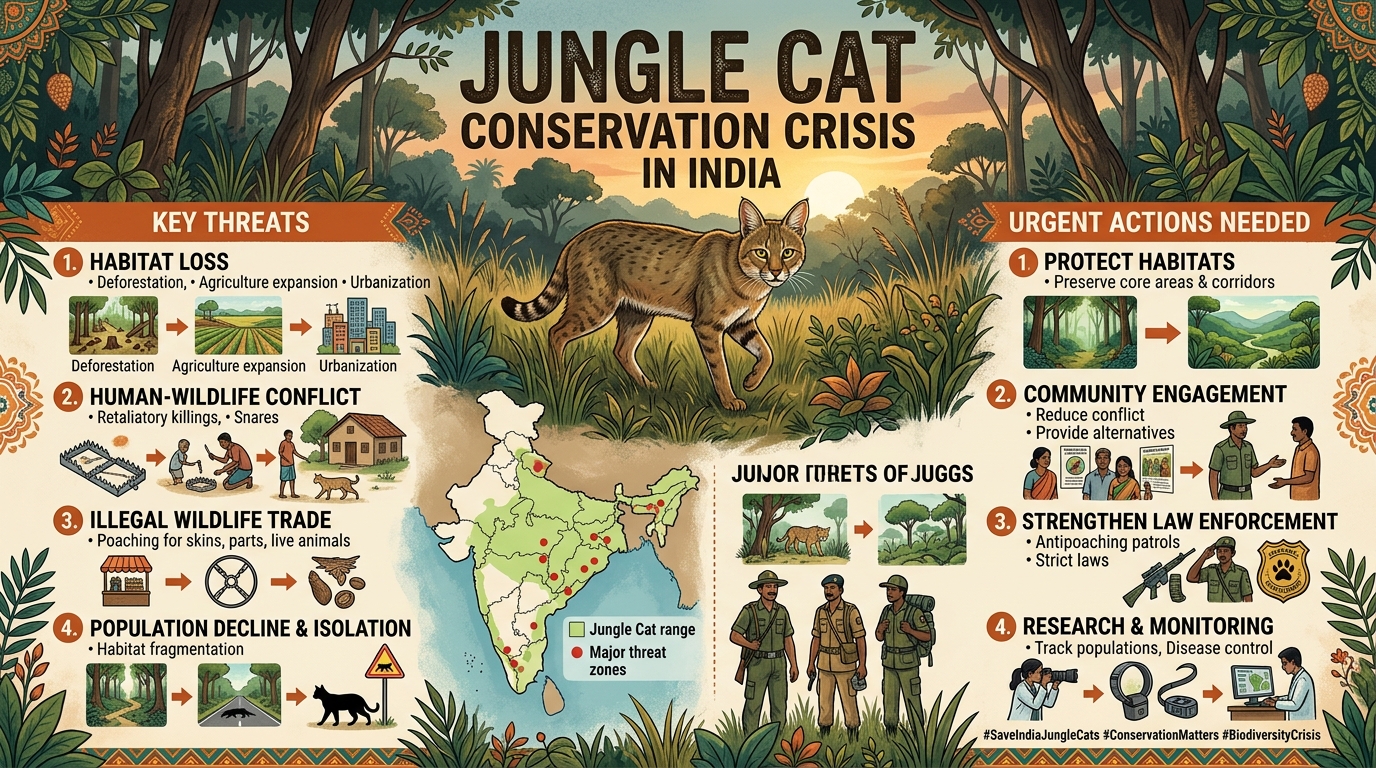
Jungle Cat Conservation Crisis in India
Table of Contents
The jungle cat conservation crisis in India highlights how a species listed as “Least Concern” is actually facing population decline due to habitat loss and lack of attention.
Why in the News?
- A recent scientific study has provided new information about the population and habitat of the Jungle Cat in India.
- The study used a very large dataset collected from across the country.
- The species is listed as “Least Concern” by the International Union for Conservation of Nature.
- This category means the species is not currently at high risk of extinction.
- However, scientists have warned that this classification creates a misunderstanding.
- The population of jungle cats is actually decreasing in many areas.
- In India, the species is protected under the Wildlife Protection Act 1972.
- This means hunting or trading jungle cats is illegal.
- Despite being widespread, jungle cats have received less attention compared to large animals like tigers and leopards.
What are the Key Highlights?
Habitat and Physical Features
- Jungle cats are medium-sized wild cats found in many types of habitats.
- They live in grasslands, wetlands, deserts, and agricultural lands.
- They have distinct physical features.
- They have a white muzzle and yellow eyes.
- Their ears are large with black tufts at the tips.
- Their legs may show faint stripes.
- They avoid dense forests and highly urban areas.
- They prefer open and semi-natural landscapes.
Understanding Agro-Pastoral Landscapes
- Agro-pastoral landscapes are areas where farming and livestock grazing take place together.
- These areas include farms, grasslands, and village surroundings.
- Jungle cats prefer these areas because they provide food and shelter.
- Rodents and small animals are easily available in farms.
- These landscapes are outside protected forests.
- This means conservation must also happen outside national parks.
Population Estimation and Scientific Method
- Scientists estimated the population using advanced methods.
- Camera traps are automatic cameras that capture animal images when they pass.
- These cameras were placed in over 26,000 locations across India.
- Some data came from “bycatch” of tiger surveys.
- Bycatch means accidental data collected while studying another species.
- Radio-collaring was also used.
- A radio collar is a device attached to animals to track their movement.
- Machine learning was used to analyse data.
- Machine learning is a computer method that finds patterns in large data sets.
- The estimated population is over 3 lakh jungle cats.
- The range is between 1.57 lakh and 4.59 lakh individuals.
- States like Madhya Pradesh, Rajasthan, and Odisha have the highest populations.
Habitat Preference and Distribution
- Jungle cats prefer warm and semi-arid climates.
- Semi-arid means areas with low to moderate rainfall.
- They prefer areas with moderate vegetation cover.
- Too dense forests are avoided.
- The study shows more suitable habitats in eastern India than in the dry western region.
Role in Ecosystem
- Jungle cats play an important role in controlling rodent populations.
- Rodents damage crops and spread diseases.
- By hunting rodents, jungle cats help farmers.
- This is an example of ecosystem service.
- Ecosystem service means benefits provided by nature to humans.

What are the Significance?
Importance of Scientific Baseline
- A baseline means initial data used for future comparison.
- This study provides the first large-scale estimate of jungle cat population.
- It helps in planning conservation strategies.
- Future changes can be tracked using this data.
Conservation Beyond Protected Areas
- Most jungle cats live outside protected areas.
- This means conservation must include farms and rural areas.
- Protecting only forests is not enough.
- Open landscapes also need protection.
Understanding Human-Wildlife Interaction
- Human pressure strongly affects jungle cat distribution.
- They tolerate some human presence but avoid crowded areas.
- This shows the need for balanced development.
- Urban expansion should consider wildlife habitats.
Importance of Small Carnivores
- Small cats like jungle cats are often ignored.
- Conservation efforts focus more on large animals like tigers.
- However, small carnivores are equally important.
- They maintain ecological balance at local levels.
Challenges
Habitat Loss and Fragmentation
- Open habitats are being converted into cities and infrastructure.
- Roads and buildings break continuous habitats into smaller parts.
- Fragmentation reduces movement and breeding opportunities.
- This increases the risk of population decline.
Threats from Human Activities
- Poaching remains a threat in some areas.
- Illegal hunting reduces population numbers.
- Road accidents kill animals crossing highways.
- High-speed vehicles increase this risk.
Stray Dog Population
- Stray dogs compete with jungle cats for food.
- They may steal prey, which is called kleptoparasitism.
- They also spread diseases to wildlife.
- This weakens jungle cat populations.
Hybridisation Risk
- Hybridisation means breeding between wild cats and domestic cats.
- This can change the genetic identity of jungle cats.
- Although evidence is limited, it is a potential threat.
Lack of Research and Awareness
- Jungle cats are difficult to study.
- They are nocturnal, meaning active at night.
- They are secretive and avoid humans.
- There is limited funding for small carnivore research.
- Public awareness is also low.
Way Forward
Strengthen Habitat Protection
- Open ecosystems should be recognised in policies.
- Grasslands and farmlands must be conserved.
- Land-use planning should avoid unnecessary habitat destruction.
Develop Wildlife Corridors
- Wildlife corridors are safe pathways for animal movement.
- These should be planned along roads and infrastructure.
- Corridors reduce accidents and habitat fragmentation.
Improve Research and Monitoring
- More studies are needed on jungle cat behaviour and ecology.
- Topics like diet, breeding, and movement patterns should be studied.
- Use of technology like camera traps and satellites should be increased.
Control Stray Dog Population
- Managing stray dog numbers can reduce threats.
- Vaccination and sterilisation programs are important.
Increase Public Awareness
- People should be educated about the importance of small cats.
- Awareness can reduce conflict and support conservation.
- Farmers should be encouraged to protect these animals.
- They benefit agriculture by controlling pests.
Conclusion
Protecting lesser-known species requires a shift in thinking from focusing only on large animals to understanding the value of entire ecosystems. A balanced approach that includes science, community participation, and policy support can ensure that biodiversity is preserved even in human-dominated landscapes.
Relevant Articles:
MGNREGA Wage Crisis and Rural Employment Challenges
Glacier Disaster Risk and Flash Flood Threat in Himalayas
Pulses Policy Reform for Stronger Farmer Income
Read Also:
Water-Centered Climate Adaptation: A Strong Step from COP 30
Global Oil Crisis and Energy Security Challenges for India
SC Status and Religion Debate in India: Supreme Court Clarifies Reservation Rules
Distribution and conservation status of the jungle cat (Felis …
