CSMP IAS : India's Premier Coaching Institute for IAS / PCS
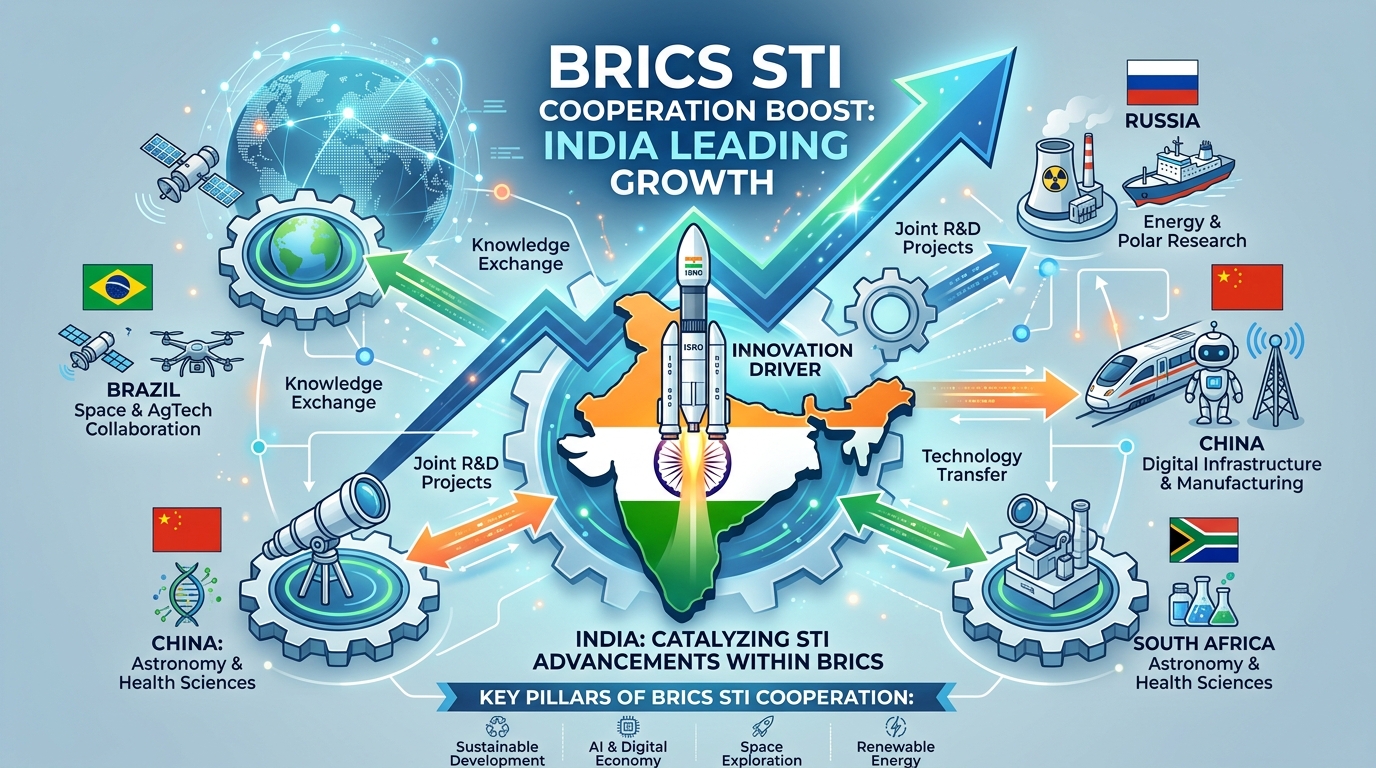
BRICS STI Cooperation Boost: India Leads BRICS Science Technology Innovation Growth
Table of Contents
BRICS STI Cooperation emerging as a powerful platform for cooperation among developing countries. With the expansion to BRICS+ and India’s upcoming presidency in 2026, BRICS Science Technology Innovation is gaining momentum in areas like artificial intelligence, health, and climate research. This collaboration aims to reduce dependence on Western nations, strengthen the Global South, and promote a more balanced and multipolar world order.
Why in the News?
Rising Importance of BRICS in Science and Technology
- The BRICS grouping is gaining importance in global science, technology, and innovation cooperation.
- This importance is increasing because countries want to reduce dependence on Western nations in advanced technologies.
- The expansion of BRICS into BRICS+ has brought more countries from the Global South into this cooperation framework.
India’s Upcoming Presidency in 2026
- India will take over the presidency of BRICS in 2026.
- This has increased attention on India’s role in strengthening scientific partnerships.
- India is expected to promote cooperation in innovation, sustainability, and digital development.
Changing Global Order
- The world is moving from a unipolar system dominated by a few countries to a multipolar system.
- BRICS aims to create a system where power is shared among multiple nations.
- Science and technology cooperation is becoming a key tool in this transformation.
What are the Key Highlights?
What is BRICS?
Meaning and Members
- BRICS is a group of major emerging economies.
- It includes Brazil, Russia, India, China, and South Africa.
- These countries represent a large share of global population, economy, and natural resources.
Objective of BRICS
- The main aim of BRICS is to promote a multipolar world.
- A multipolar world means power is distributed among many countries instead of being controlled by a few.
- It also focuses on cooperation in economic, political, and technological areas.
What is BRICS+ Expansion?
Expansion of Membership
- BRICS+ is the expanded version of BRICS.
- New members include Saudi Arabia, Egypt, United Arab Emirates, Ethiopia, Indonesia, and Iran.
- This expansion increases the representation of developing countries.
Importance of Expansion
- BRICS+ aims to include more countries from the Global South.
- The Global South refers to developing and less developed countries in Asia, Africa, and Latin America.
- This expansion strengthens the voice of these countries in global governance.
What is STI (Science, Technology and Innovation)?
Meaning of Science
- Science refers to the discovery of new knowledge through research and experiments.
- It helps in understanding natural and social phenomena.
Meaning of Technology
- Technology refers to the application of scientific knowledge for practical use.
- It includes machines, tools, and systems used in daily life.
Meaning of Innovation
- Innovation means creating new ideas, products, or methods.
- It focuses on solving real-world problems.
Example of STI
- The development of vaccines during the COVID-19 pandemic is a clear example of STI.
- Scientists discovered the virus, used technology to develop vaccines, and innovated to distribute them quickly.
Importance of STI Cooperation in BRICS
Beginning of Cooperation
- STI cooperation among BRICS countries started formally in 2011.
- A major agreement in 2015 made STI a core area of cooperation.
Nature of Cooperation
- Countries work together in research, innovation, and capacity building.
- Capacity building means improving skills, knowledge, and infrastructure.
Institutional Mechanisms
Meetings and Coordination
- Ministers of Science and Technology from BRICS countries meet every year.
- These meetings help in planning and reviewing cooperation.
Role of National Agencies
- Each country has agencies to manage research projects.
- In India, the Council of Scientific and Industrial Research and the Department of Biotechnology perform this role.
Function of Agencies
- These agencies invite research proposals from scientists.
- They select projects and provide funding and support.
Action Plans and Programs
First Action Plan (2017–2020)
- The first action plan focused on entrepreneurship and startups.
- It encouraged participation of youth and women in innovation.
- It promoted technology transfer and business incubators.
Shift in Focus
- The focus has shifted from basic science to practical applications.
- There is more emphasis on innovation that can solve real-world problems.
Key Initiatives of BRICS STI Cooperation
BRICS Technology Transfer Centre (TTC)
- This center helps in sharing technology among member countries.
- It ensures that innovations reach all partners.
iBRICs Network
- iBRICs promotes innovation through collaboration among researchers and institutions.
BRICS Institute of Future Networks
- This institute focuses on advanced communication technologies like 5G and future internet systems.
Areas of Cooperation
Traditional Areas
- Initially, the focus was on basic scientific research.
Emerging Areas
- Cooperation now includes energy, water, health, and environment sectors.
- It also includes advanced fields like Artificial Intelligence, digital technologies, and space research.
High-End Technologies
- High Performance Computing is used for complex scientific calculations.
- Space research includes satellite development and exploration.
Impact of COVID-19
Increased Health Cooperation
- The pandemic increased cooperation in public health.
- Countries worked together on vaccines and medical technologies.
Focus on Biosecurity
- Biosecurity means protection against biological threats like viruses.
- BRICS countries are working to strengthen systems to prevent future pandemics.
AI Declaration 2025
Importance of Artificial Intelligence
- Artificial Intelligence has become a major focus area in BRICS cooperation.
- AI refers to machines that can perform tasks requiring human intelligence.
Principles of AI Cooperation
- The focus is on fair and inclusive use of AI.
- It aims to ensure that AI benefits all countries equally.
India’s Role in 2026 Presidency
Theme of Presidency
- India’s theme is “Building for Resilience, Innovation, Cooperation and Sustainability”.
- This theme highlights long-term development goals.
Priority Areas
- India will focus on climate change and environmental sustainability.
- It will work on improving public health systems.
- It will address the digital divide, which means unequal access to technology.

Strengthening Global South Cooperation
Collective Voice
- BRICS provides a platform for developing countries to work together.
- It strengthens their collective voice in global discussions.
Reduced Dependence
- It reduces dependence on developed countries for technology and knowledge.
Promoting Multipolar World
Balanced Power Structure
- BRICS supports a world where power is shared among many countries.
- This reduces the dominance of a few powerful nations.
Fair Global Governance
- It promotes fairness in global institutions and decision-making.
Enhancing Scientific Capacity
Knowledge Sharing
- Joint research helps countries learn from each other.
- It improves scientific knowledge and expertise.
Skill Development
- Cooperation helps in training scientists and researchers.
Supporting Economic Development
Innovation and Growth
- Innovation leads to new industries and job creation.
- It improves productivity and economic growth.
Industrial Development
- Technology helps in modernizing industries.
Addressing Global Challenges
Climate Change
- Countries can work together to reduce carbon emissions.
- They can develop clean energy technologies.
Health Crises
- Cooperation helps in managing pandemics and improving healthcare systems.
Resource Management
- Joint efforts can address water and energy shortages.
Encouraging Technology Transfer
Sharing Technology
- Technology transfer means sharing innovations between countries.
- It helps less developed countries grow faster.
Practical Example
- One country may develop a technology which others can use for development.
Improving Global Governance
Influence in Global Rules
- BRICS can influence rules related to finance and technology.
- It provides alternatives to Western-led institutions.
Role of Development Banks
- Institutions like the New Development Bank support infrastructure projects.
Challenges
Low Research Investment (GERD)
Meaning of GERD
- GERD means Gross Expenditure on Research and Development.
- It shows how much a country spends on research.
Current Situation
- Most BRICS countries spend less on research.
- Only China spends significantly higher amounts.
Unequal Development Among Members
Differences in Capacity
- Countries have different levels of economic and scientific development.
- This creates an imbalance in cooperation.
Coordination Issues
- Differences make it difficult to manage joint projects.
Weak Institutional Mechanism
Lack of Permanent Body
- There is no permanent organization to manage cooperation.
- Leadership changes every year.
Impact
- This leads to lack of continuity in policies.
Limited Commercialisation
Gap Between Research and Market
- Many research projects do not become products.
- This reduces practical benefits.
Need for Industry Link
- A strong connection between research and industry is needed.
Slow Progress in Some Areas
High Investment Requirement
- Areas like ocean research need large funding.
- Progress is slow due to limited resources.
Funding Constraints
Limited Financial Resources
- Total funding for research is limited.
- Countries compete for available funds.
Limited Participation of New Members
Low Involvement
- New BRICS+ members are not fully active in projects.
- Participation is still developing.
Lack of Data and Research Framework
Absence of Evaluation System
- There is no proper system to measure the success of cooperation.
- This affects policy decisions.
Way Forward
Establish a Permanent Secretariat
Central Coordination
- BRICS should create a permanent body to manage cooperation.
- This will ensure better coordination and monitoring.
Increase Investment in Research
Higher Spending
- Countries should increase spending on research and development.
- This will improve innovation capacity.
Promote Mega-Science Projects
Large-Scale Collaboration
- Countries should work on large joint projects.
- Examples include space missions and climate research.
Improve Technology Commercialisation
From Lab to Market
- Focus should be on converting research into usable products.
- Support should be given to startups and industries.
Strengthen Participation of New Members
Inclusive Approach
- New members should be encouraged to participate actively.
- Special programs can help build their capabilities.
Develop Paired Cooperation Models
Targeted Collaboration
- Countries can work in smaller groups based on strengths.
- This improves efficiency and results.
Learn from Global Models
Best Practices
- BRICS can learn from successful programs like those of the European Union.
- This will improve funding and project management.
Expand Research to Governance Issues
Policy-Oriented Research
- Research should include the impact of technology on society and laws.
- This helps in global negotiations.
Conclusion
The growing importance of science, technology, and innovation cooperation among emerging economies shows a clear shift in the global development model. As technology becomes central to economic and strategic power, collaboration among developing nations will play a defining role in shaping the future world order. India’s leadership phase provides an opportunity to guide this cooperation towards inclusive growth, sustainable development, and long-term global stability while ensuring that innovation benefits all sections of society.
Relevant Articles:
India West Asia Policy Shift: Strategic Autonomy and Rising Global Role
Jungle Cat Conservation Crisis in India
MGNREGA Wage Crisis and Rural Employment Challenges
Read More:
Glacier Disaster Risk and Flash Flood Threat in Himalayas
Pulses Policy Reform for Stronger Farmer Income
Water-Centered Climate Adaptation: A Strong Step from COP 30
BRICS Rio de Janeiro Declaration
