
CSMP IAS : India's Premier Coaching Institute for IAS / PCS
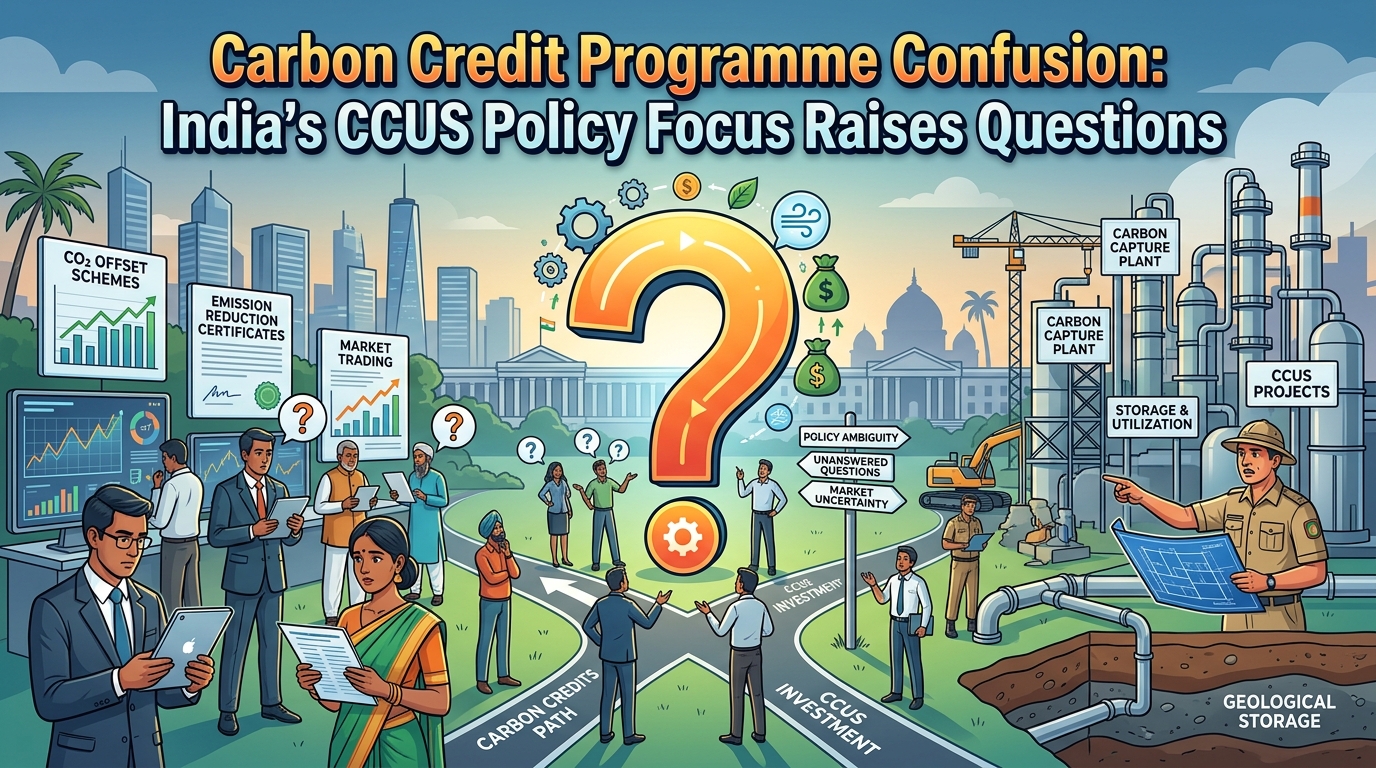
Carbon Credit Programme Confusion: India’s CCUS Policy Focus Raises Questions
Table of Contents
India’s CCUS Policy under the ₹20,000 crore carbon credit programme has sparked confusion over its real purpose. While the scheme focuses on industrial carbon capture, debates continue about its link with farmers and carbon credit opportunities in agriculture.
Why in the News?
- The Union Budget 2026 announced a ₹20,000 crore carbon credit programme.
- This programme is related to climate change and reducing pollution.
- It has created confusion among people, experts, and farmers.
- The confusion is about the main purpose of the scheme.
- Some people believe that the fund is for industries to reduce pollution using new technology.
- Others believe that farmers will earn money through carbon credits by using eco-friendly farming methods.
- The debate is important because it affects two major sectors.
- The industrial sector, which produces large pollution.
- The agricultural sector, which supports millions of farmers.
- Understanding this issue is important for climate policy and economic development.
- India is trying to balance growth with environmental protection.
What are the Key Highlights?
Focus on CCUS for Industries
- The programme is mainly based on CCUS technology.
- CCUS stands for Carbon Capture, Utilization, and Storage.
- It is a process to capture carbon dioxide (CO₂) before it enters the atmosphere.
- CCUS works in three steps.
- Carbon capture means collecting CO₂ from factories or power plants.
- Carbon utilization means using the captured CO₂ in other industries.
- Carbon storage means storing CO₂ underground safely.
- The programme targets “hard-to-abate” industries.
- Hard-to-abate industries are those where reducing emissions is very difficult.
- These industries are essential for economic growth but produce heavy pollution.
- Examples of such industries include:
- Power plants that burn coal for electricity.
- Steel industry which uses coal in production.
- Cement industry which releases CO₂ during chemical processes.
- Oil refineries and chemical industries.
- These industries produce concentrated emissions.
- This means pollution is released from a single point like a chimney.
- This makes it easier to capture carbon using technology.
- The ₹20,000 crore fund will help these industries.
- It will support research and development of CCUS technologies.
- It will help in building infrastructure for carbon capture and storage.
Agriculture Not Included in CCUS
- Agriculture is not part of the CCUS programme.
- This is because farming emissions are very different from industrial emissions.
- Farming emissions are diffuse in nature.
- Diffuse means they are spread over a large area.
- For example, methane is released from rice fields and livestock.
- Agricultural emissions are biological.
- Biological emissions come from natural processes.
- Examples include methane from cows and nitrous oxide from fertilizers.
- These emissions cannot be captured easily.
- There is no single point like a factory chimney.
- Therefore, CCUS technology cannot be applied in farming.
- The policy clearly separates two approaches.
- CCUS is used for industrial emissions.
- CDR (Carbon Dioxide Removal) is used for agriculture and nature-based solutions.
- CDR includes methods like:
- Planting trees to absorb CO₂.
- Improving soil to store carbon.
Rise of Farmer Carbon Credit Narrative
- Many reports suggest that farmers can earn money through carbon credits.
- Carbon credit is a certificate given for reducing or removing one ton of CO₂.
- Farmers can adopt sustainable practices.
- Sustainable practices are methods that protect the environment.
- Examples of such practices include:
- Soil carbon storage, where soil absorbs and stores carbon.
- Agroforestry, where trees are grown along with crops.
- Biochar, which is a form of charcoal used to improve soil and store carbon.
- These ideas are already being tested.
- Some private companies and state governments are running pilot projects.
- However, these activities are not part of the current budget scheme.
Source of Confusion
- The confusion mainly comes from the term “carbon credit programme.”
- This term is commonly used in both industrial and agricultural contexts.
- People linked the programme with existing carbon markets.
- Carbon markets allow buying and selling of carbon credits.
- They also linked it with farming initiatives.
- Some projects already give farmers carbon credits for eco-friendly practices.
- However, the budget scheme is focused on industries.
- It is not directly meant for farmers.
Policy Gap and Opportunity
- Experts say there is a communication gap.
- The government did not clearly explain the purpose of the scheme.
- This created misunderstanding among stakeholders.
- Stakeholders include industries, farmers, and policymakers.
- At the same time, this creates an opportunity.
- India can design a separate policy for carbon farming.
- A carbon farming policy can help farmers earn income.
- It can also help reduce emissions naturally.
Need for Multi-Sectoral Approach
- India needs to address emissions from all sectors.
- Both industry and agriculture contribute to climate change.
- Industrial emissions need technological solutions.
- CCUS can help reduce emissions from factories.
- Agricultural emissions need natural solutions.
- Practices like tree plantation and soil management are important.
- A combined approach is necessary.
- This will help achieve climate goals and economic growth together.

What is the Significance?
Industrial Decarbonisation
- The programme helps reduce emissions from major industries.
- These industries are responsible for a large share of pollution.
- Decarbonisation means reducing carbon emissions.
- It is important to control global warming.
- Example:
- A steel plant using CCUS can reduce its carbon emissions significantly.
Progress Towards Net Zero
- Net zero means balancing emissions with removal of carbon.
- A country reaches net zero when it emits and removes equal carbon.
- CCUS is important for achieving this goal.
- Some industries cannot fully shift to renewable energy.
- Example:
- Cement production releases CO₂ through chemical reactions.
- This cannot be avoided without CCUS.
Technological Advancement
- The programme promotes advanced technology.
- It supports innovation and research.
- It encourages scientists and industries to develop new solutions.
- This can make CCUS cheaper and more efficient.
- Example:
- New methods can convert captured CO₂ into useful products like fuels.
Economic Stability
- The programme supports key industries.
- These industries provide jobs and contribute to GDP.
- It helps them reduce emissions without shutting down.
- This balances economic growth with environmental protection.
- Example:
- A refinery can continue production while reducing pollution using CCUS.
Potential for Farmer Income (Indirect Significance)
- Although farmers are not included, there is future potential.
- Carbon markets can create new income sources for farmers.
- Farmers can benefit from sustainable practices.
- These practices improve soil health and productivity.
- Example:
- A farmer planting trees can earn carbon credits and additional income.
Climate Leadership
- The programme shows India’s commitment to climate action.
- India is taking steps to reduce emissions responsibly.
- It improves India’s image globally.
- It shows leadership in environmental protection.
What are the Challenges?
Policy Confusion
- Lack of clarity has created misunderstanding.
- Many people think farmers will directly benefit.
- This leads to unrealistic expectations.
- Farmers may feel disappointed later.
Exclusion of Agriculture
- Agriculture is not included in the scheme.
- This is a major limitation.
- Farming has high potential for carbon removal.
- Ignoring it reduces overall impact.
High Cost of CCUS
- CCUS technology is expensive.
- It requires large investment and infrastructure.
- It is also energy-intensive.
- This increases operational costs.
Limited Awareness
- Many people do not understand climate technologies.
- There is confusion between CCUS and carbon farming.
- This limits participation and support.
Weak Carbon Market Framework
- India does not have a strong carbon market.
- Carbon trading systems are still developing.
- This limits opportunities for farmers and industries.
Implementation Challenges
- Large projects face many difficulties.
- Technical problems may arise during implementation.
- Infrastructure gaps can slow progress.
- Storage sites and transport systems are needed.
What is the Way Forward?
Clear Policy Communication
- The government should clearly explain policies.
- It should avoid confusing terms.
- Proper communication builds trust.
- It helps stakeholders understand their roles.
Separate Carbon Farming Policy
- A dedicated policy should be created for farmers.
- It should promote carbon credit generation in agriculture.
- This will support rural income and sustainability.
Develop Carbon Markets
- India should build a strong carbon market system.
- It should ensure transparency and fairness.
- Proper pricing will encourage participation.
Support Farmers
- Farmers need training and guidance.
- They should learn sustainable practices.
- Financial support should be provided.
- Incentives can motivate farmers to adopt new methods.
Invest in Technology
- More funding should be given for innovation.
- This will reduce the cost of CCUS.
- Research institutions should be encouraged.
Integrated Climate Strategy
- A combined approach is needed.
- Industrial solutions like CCUS should be used.
- Natural solutions like forestry and agriculture should also be used.
- This will create a balanced climate policy.
Strengthen Institutions
- Strong systems are needed for monitoring emissions.
- Accurate data is important for policy success.
- Carbon credits should be verified properly.
- This ensures trust in the system.
Conclusion
India must move forward with a clear and balanced climate strategy that addresses different sources of emissions in suitable ways. A well-coordinated effort between technology-driven industrial solutions and nature-based agricultural practices will help the country achieve sustainable development while protecting the environment for future generations.
Relevant Articles:
Supreme Court Boosts Maternity Leave Rights and Pushes Paternity Leave Reform in India
BRICS STI Cooperation Boost: India Leads BRICS Science Technology Innovation Growth
India West Asia Policy Shift: Strategic Autonomy and Rising Global Role
Read More:
Jungle Cat Conservation Crisis in India
MGNREGA Wage Crisis and Rural Employment Challenges
Glacier Disaster Risk and Flash Flood Threat in Himalayas
R&D Roadmap to enable India’s Net Zero Targets through …
