
CSMP IAS : India's Premier Coaching Institute for IAS / PCS
CERN Discovery Breakthrough: Xi-cc-plus Particle Expands Understanding of Matter
Table of Contents
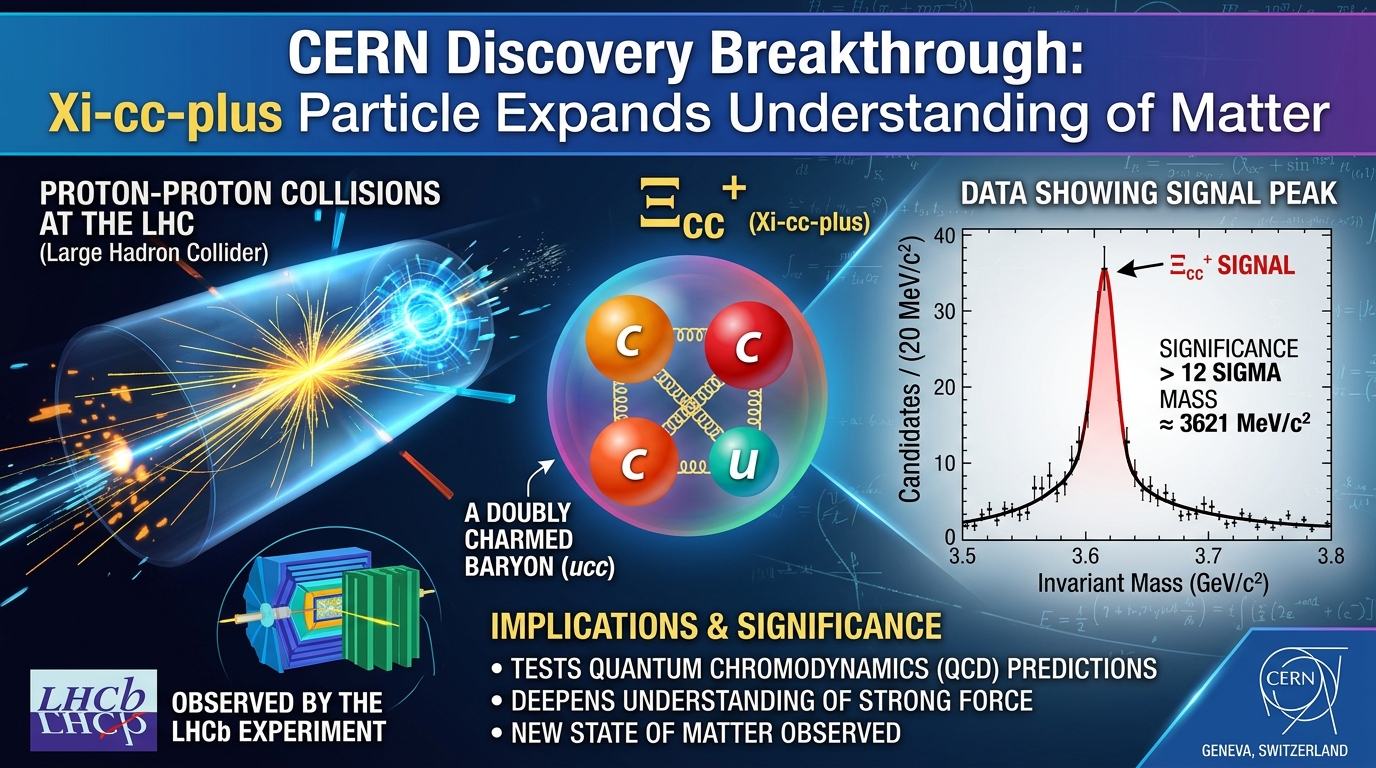
The discovery of the Xi-cc-plus Particle at CERN marks a major breakthrough in particle physics. This finding from the Large Hadron Collider deepens our understanding of quarks, the strong force, and the fundamental structure of matter in the universe.
Why in the News?
- On March 17, 2026, scientists at CERN announced the discovery of a new particle called Xi-cc-plus.
- This discovery was made using the Large Hadron Collider, which is the most powerful particle accelerator in the world.
- This particle is the 80th particle discovered using the Large Hadron Collider.
- This shows how advanced modern physics experiments have become.
- Scientists believe that this discovery will help in understanding the basic structure of matter.
- It may also improve knowledge of quantum mechanics and the strong force.
What are the Key Highlights?
Large Hadron Collider (LHC)
- The Large Hadron Collider is a huge scientific machine.
- It is a circular tunnel of 27 kilometres in length.
- It is located underground, about 100 metres below the border of France and Switzerland.
- The LHC accelerates particles to very high speeds.
- It mainly uses protons, which are tiny particles found inside atoms.
- These protons are accelerated to nearly the speed of light.
- After acceleration, the particles are made to collide.
- These collisions create very high energy conditions.
- Such conditions are similar to those present just after the Big Bang.
- These collisions help scientists observe new particles.
- Many particles exist only for a very short time.
- The LHC helps detect and study these particles.
- The LHC is famous for discovering the Higgs boson.
- The Higgs boson helps explain why particles have mass.
Xi-cc-plus Particle
- Xi-cc-plus is a type of baryon.
- A baryon is a particle made of three quarks.
- This particle has a special composition.
- It contains two charm quarks and one down quark.
- Comparison with a proton helps understanding.
- A proton has two up quarks and one down quark.
- Up quarks are lighter than charm quarks.
- Because of heavy charm quarks, Xi-cc-plus is very heavy.
- It is about four times heavier than a proton.
- This particle is very unstable.
- It exists only for a very short time before decaying.
Importance of Quarks
- Quarks are the smallest building blocks of matter.
- Everything around us is made of atoms, and atoms contain quarks.
- There are six types of quarks.
- These are called flavours: up, down, charm, strange, top, and bottom.
- Quarks combine in different ways.
- Three quarks combine to form baryons like protons and neutrons.
- Two quarks combine to form mesons.
- There are also exotic combinations.
- Tetraquarks contain four quarks.
- Pentaquarks contain five quarks.
- These exotic particles are harder to detect.
- They are unstable and exist for a very short time.
Detection and Observation
- Scientists detected Xi-cc-plus during experiments at the LHC.
- They studied data from proton-proton collisions.
- The detection was made during the third run of the LHC.
- This run had improved technology and better detectors.
- The particle was confirmed with high statistical confidence.
- It reached 7 sigma significance.
- Scientists normally require 5 sigma for confirmation.
- The particle has a very short lifetime.
- It lives about six times shorter than a similar particle discovered earlier.
- Advanced detectors were used for observation.
- The upgraded LHCb detector played an important role.

What is the Significance?
Advances in Quantum Physics
- The discovery helps test theories of quantum physics.
- Quantum physics studies very small particles and their behavior.
- It supports the theory of Quantum Chromodynamics.
- This theory explains how quarks stick together.
- The strong force is one of the four fundamental forces.
- It is responsible for holding atomic nuclei together.
- This discovery provides real data for testing theories.
- It helps scientists check if their models are correct.
Understanding the Structure of Matter
- The discovery improves understanding of matter.
- It shows how heavy quarks behave inside particles.
- It reveals new forms of matter.
- Matter is not limited to simple particles like protons.
- Scientists can study how particles interact.
- This helps in understanding the universe at a deeper level.
- It may lead to new discoveries.
- More unknown particles may be found in future experiments.
Technological Advancement
- The discovery shows the power of modern technology.
- Advanced detectors and computers are required for such research.
- The upgraded LHCb detector played a key role.
- It was improved in 2023 for better performance.
- This encourages further innovation.
- Scientists will develop better tools for future research.
- It also supports future projects.
- The Future Circular Collider is being planned for deeper research.
What are the Challenges?
Detection Difficulty
- Xi-cc-plus exists for a very short time.
- This makes it very difficult to detect.
- Its properties change quickly.
- Scientists need highly sensitive instruments.
- Small errors can affect results.
- Precision is very important in such experiments.
Experimental Complexity
- Particle collisions produce huge data.
- Millions of events happen every second.
- Analyzing this data is very difficult.
- Advanced computers and algorithms are required.
- Scientists must carefully filter useful data.
- Most data is not useful for discovery.
Theoretical Challenges
- Understanding heavy quark systems is complex.
- Current theories are not fully complete.
- Predicting behavior of such particles is difficult.
- Models need continuous improvement.
- New discoveries challenge existing theories.
- Scientists must revise their understanding regularly.
What is the Way Forward?
Improve Detection Tools
- Scientists should upgrade detectors further.
- Better detectors will improve accuracy.
- New methods should be developed.
- These methods will help detect short-lived particles easily.
Expand Research
- More studies should be conducted on baryons.
- Different quark combinations should be explored.
- Exotic particles should be studied in detail.
- Tetraquarks and pentaquarks can reveal new physics.
Build Advanced Colliders
- New particle accelerators should be built.
- They should have higher energy levels.
- The Future Circular Collider is an important step.
- It will allow deeper exploration of the universe.
- These machines will help discover unknown forces.
- They may answer fundamental questions about the universe.
Conclusion
The discovery of Xi-cc-plus shows how science continues to explore the smallest building blocks of nature. It highlights the importance of experiments in improving our understanding of the universe. Such achievements inspire future research and open new paths for scientific progress.
Relevant Articles:
Carbon Credit Programme Confusion: India’s CCUS Policy Focus Raises Questions
Supreme Court Boosts Maternity Leave Rights and Pushes Paternity Leave Reform in India
BRICS STI Cooperation Boost: India Leads BRICS Science Technology Innovation Growth
Read More:
India West Asia Policy Shift: Strategic Autonomy and Rising Global Role
Jungle Cat Conservation Crisis in India
MGNREGA Wage Crisis and Rural Employment Challenges
India Celebrates Breakthrough Prize in Fundamental …
