CSMP IAS : India's Premier Coaching Institute for IAS / PCS
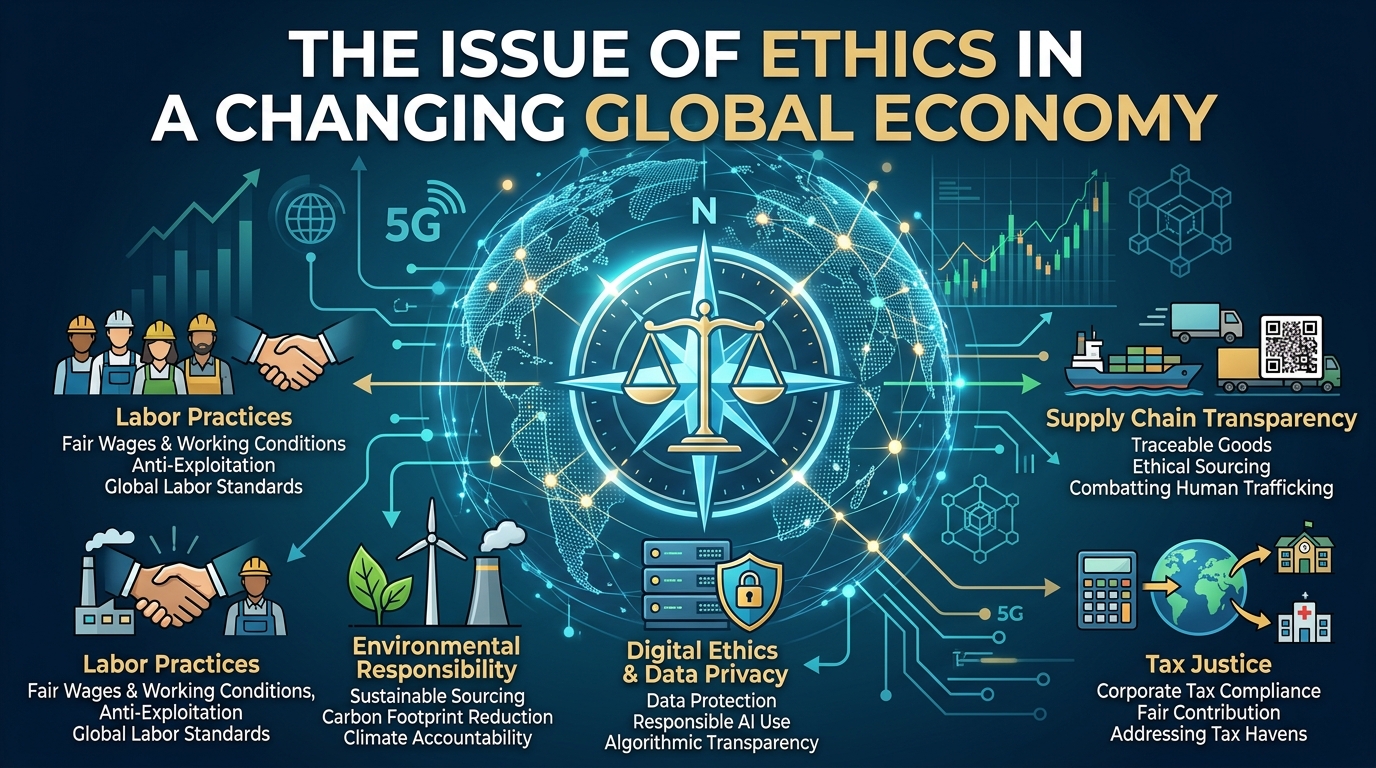
The Issue of Ethics in a Changing Global Economy
Ethics in a Changing Global Economy has become a major concern in today’s rapidly changing world driven by globalization, digitalization, and economic integration. While the global economy creates growth, innovation, and opportunities, it also raises ethical issues like inequality, labor exploitation, corporate greed, and environmental damage.
Approach to the Essay: The Issue of Ethics in a Changing Global Economy
To write on the topic “The issue of ethics in a changing global economy”, we should think in a clear, structured, and multidimensional way:
1. Understand the Core Idea
- The topic combines two key ideas: ethics and global economy.
- It asks how moral values and principles are affected by changes in the global economic system.
2. Define Key Terms
- Ethics means moral principles, right and wrong behavior, fairness, and justice.
- Global economy means the interconnected economic system of all countries, including trade, finance, technology, and labor.
3. Historical Context
- Briefly explain how the global economy evolved from colonial trade to industrialization, and then to globalization.
4. Nature of Change in Global Economy
- Discuss liberalization, privatization, digitalization, and globalization.
5. Ethical Issues Arising
- Inequality, labor exploitation, corporate greed, environmental damage, tax evasion, etc.
6. Multiple Dimensions
- Economic: profit vs fairness
- Political: role of governments and regulation
- Social: inequality and human dignity
- Environmental: sustainability
- Technological: data privacy and AI ethics
7. Case Examples
- Use simple examples like sweatshops, climate change, digital monopolies, etc.
8. Need for Ethical Framework
- Introduce corporate social responsibility (CSR) and sustainable development.
9. Way Forward
- Suggest global cooperation, ethical governance, consumer awareness, and education.
10. Conclusion
- End with a hopeful vision of a just and ethical global economy.

Essay: The Issue of Ethics in a Changing Global Economy
“The world has enough for everyone’s need, but not for everyone’s greed.”
In today’s world, the global economy is changing very fast. Countries are connected through trade, technology, and finance. Goods, services, money, and information move across borders easily. This has created many opportunities for growth and development. However, it has also raised serious questions about ethics. The issue of ethics in a changing global economy is very important because economic progress should not come at the cost of human dignity, justice, and environmental balance.
Ethics refers to moral values that guide human behavior. It includes ideas of right and wrong, fairness, honesty, and responsibility. On the other hand, the global economy refers to the system where countries are economically connected. It includes international trade, investment, multinational companies, and global markets. As the global economy changes, ethical challenges are also increasing.
Historically, the global economy has gone through many stages. During the time of colonialism, powerful countries exploited weaker regions for resources. Later, the industrial revolution increased production but also led to poor working conditions. In recent decades, globalization has connected the world more closely. While globalization has increased wealth, it has also created new ethical problems.
One of the major ethical issues is economic inequality. The benefits of globalization are not equally distributed. Some countries and individuals become very rich, while others remain poor. This creates a gap between the rich and the poor. For example, large multinational companies earn huge profits, but workers in developing countries often receive low wages. This raises questions about fairness and justice.
Another important issue is labor exploitation. In many parts of the world, workers are forced to work in poor conditions for very low pay. These workplaces are often called sweatshops. Workers may not have proper safety, job security, or basic rights. This is a violation of human rights and ethical principles. Economic growth should not be based on the suffering of workers.
Corporate greed is also a serious concern. Many companies focus only on profit maximization and ignore their social responsibilities. They may avoid paying taxes, exploit workers, or damage the environment. For example, some companies shift their profits to tax havens to avoid paying taxes in their home countries. This reduces government revenue and affects public welfare. Such practices are unethical because they harm society.
The issue of environmental degradation is closely linked to the global economy. Industrial activities, mining, and large-scale production often lead to pollution, deforestation, and climate change. Companies may ignore environmental laws to reduce costs and increase profits. This harms not only the present generation but also future generations. Ethical behavior requires that we protect the environment and use resources responsibly.
Technology has also created new ethical challenges. The rise of the digital economy, artificial intelligence, and big data has changed the way businesses operate. While technology brings efficiency, it also raises concerns about data privacy, surveillance, and job loss due to automation. Companies may misuse personal data for profit. This raises questions about individual rights and freedom.
The political dimension of ethics is also important. Governments play a key role in regulating the economy and ensuring ethical practices. However, sometimes governments fail to enforce laws due to corruption or pressure from powerful corporations. Weak regulation allows unethical practices to continue. Therefore, there is a need for strong governance and transparent policies.
From a social perspective, ethical issues in the global economy affect human life in many ways. Inequality leads to social unrest and reduces opportunities for the poor. Exploitation of workers affects their health and dignity. Ethical behavior is necessary to ensure social justice and inclusive development.
To address these issues, the concept of Corporate Social Responsibility (CSR) has become important. CSR means that companies should not focus only on profit but also on their impact on society and the environment. They should follow ethical practices, treat workers fairly, and protect the environment. Many companies are now adopting sustainable practices, such as using renewable energy and reducing waste.
The idea of sustainable development is also very important. It means that economic growth should meet present needs without harming the ability of future generations to meet their needs. It promotes a balance between economic growth, social welfare, and environmental protection. This approach encourages ethical decision-making in the global economy.
International organizations and agreements also play a role in promoting ethics. Global efforts to address issues like climate change, labor rights, and fair trade are steps in the right direction. However, more cooperation is needed among countries to ensure that ethical standards are followed everywhere.
The role of individuals is also important. Consumers can support ethical businesses by choosing products that are environmentally friendly and socially responsible. Awareness and education can help people understand the importance of ethics in economic activities. When people demand ethical behavior, companies are more likely to change.
The way forward requires a combination of strong laws, ethical leadership, and public awareness. Governments should enforce regulations strictly. Companies should adopt ethical values and long-term thinking. Education systems should teach the importance of ethics. Technology should be used responsibly to benefit society.
In conclusion, the issue of ethics in a changing global economy is complex and important. Economic growth has brought many benefits, but it has also created serious ethical challenges. Without ethics, development can lead to inequality, exploitation, and environmental damage. Therefore, it is necessary to ensure that economic progress is guided by moral values. A truly successful global economy is one that promotes justice, fairness, and sustainability for all.
“In a global economy, true progress is not measured by wealth alone, but by the fairness and humanity with which it is achieved.”
UPPCS 2025 Essay:
The Implications of Development and the Environment
Indian Women in the 21st Century: From Dreams to Reality
Global Consciousness of the New India
The Future of Literature in the Age of Artificial Intelligence
Government notifies amendments to Rule 3(1)(d) of the IT …
