
CSMP IAS : India's Premier Coaching Institute for IAS / PCS
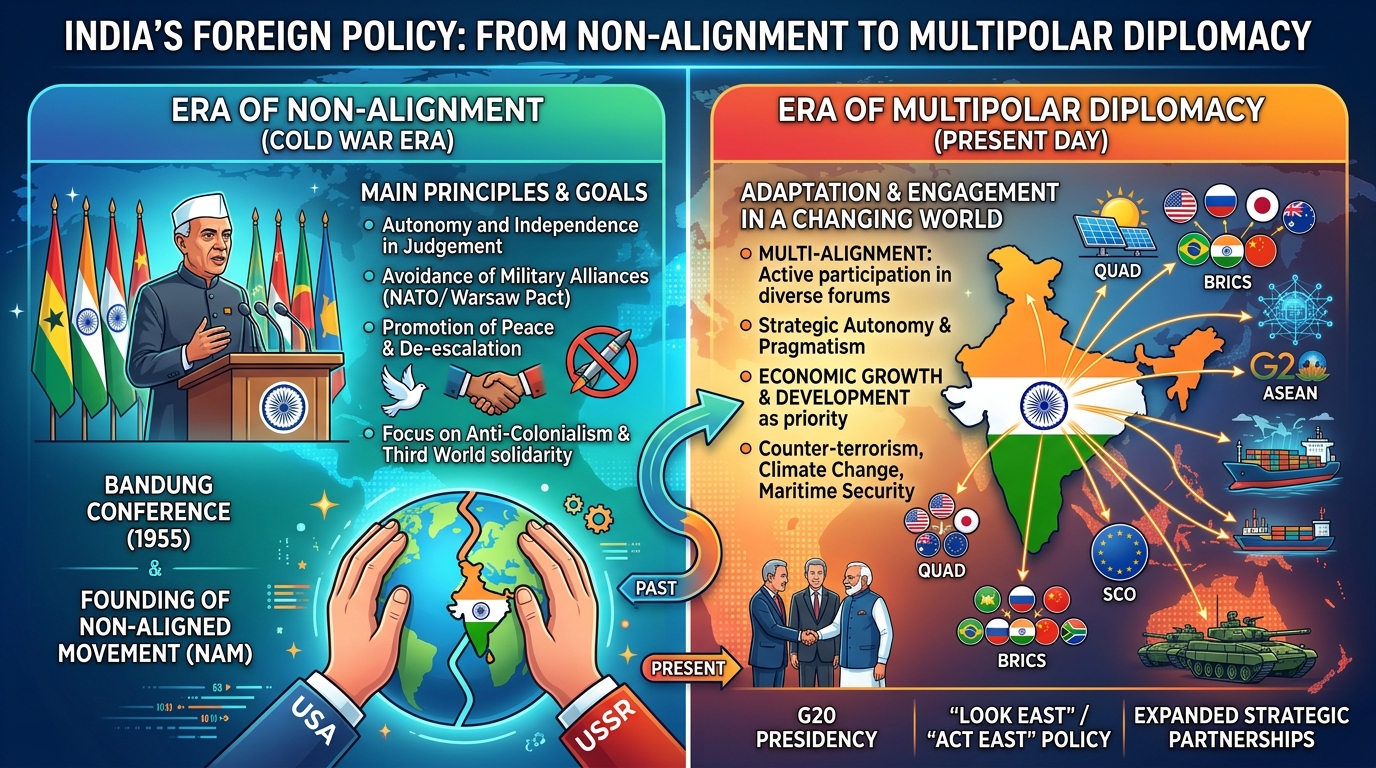
India’s Foreign Policy: From Non-Alignment to Multipolar Diplomacy
India’s Foreign Policy Evolution reflects a dynamic shift from the principles of Non-Alignment during the Cold War to the pragmatic approach of Multipolar Diplomacy in the 21st century. As global power structures change, India has adopted strategic autonomy and multi-alignment to balance its interests.
Approach to the Essay: India’s Foreign Policy: From Non-Alignment to Multipolar Diplomacy
To write on the topic “India’s foreign policy: From non-alignment to multipolar diplomacy”, we should follow a clear, chronological, and analytical structure:
1. Understand the Core Idea
- The topic is about the evolution of India’s foreign policy.
- It traces the journey from Non-Alignment during the Cold War to Multipolar Diplomacy in today’s world.
2. Define Key Terms
- Foreign Policy: A country’s strategy in dealing with other nations.
- Non-Alignment: Not joining any major power bloc during the Cold War.
- Multipolar Diplomacy: Engaging with multiple global powers in a balanced way.
3. Historical Context
- Post-independence period under Jawaharlal Nehru.
- Formation of the Non-Aligned Movement (NAM).
4. Phases of India’s Foreign Policy
- Cold War phase (Non-Alignment)
- Post-Cold War phase (Economic reforms, new partnerships)
- Contemporary phase (Multipolar world)
5. Reasons for Shift
- End of Cold War
- Globalization
- Rise of new powers like China
- India’s economic growth
6. Features of Multipolar Diplomacy
- Strategic autonomy
- Multi-alignment
- Issue-based partnerships
7. Multiple Dimensions
- Political: global power balance
- Economic: trade and investment
- Strategic: defense and security
- Social/Cultural: diaspora and soft power
- Environmental: climate diplomacy
8. Examples
- Relations with USA, Russia, China, Global South
- Participation in global forums
9. Challenges
- Balancing relations
- Regional conflicts
- Strategic pressures
10. Way Forward
- Strengthening autonomy
- Promoting peace and cooperation
11. Conclusion
- India’s foreign policy as dynamic and adaptive

Essay: India’s Foreign Policy: From Non-Alignment to Multipolar Diplomacy
“Foreign policy is not an abstract concept; it is a reflection of a nation’s identity, interests, and aspirations.”
India’s foreign policy has evolved significantly since independence. It reflects the country’s changing national interests, global position, and strategic priorities. In the early years, India followed the policy of Non-Alignment, which aimed to maintain independence from major power blocs. Today, India practices Multipolar Diplomacy, where it engages with multiple global powers in a flexible and pragmatic manner. This journey from Non-Alignment to Multipolar Diplomacy shows how India has adapted to changing global realities.
After independence in 1947, India faced a world divided into two major blocs led by the United States and the Soviet Union. This period is known as the Cold War. Under the leadership of Jawaharlal Nehru, India adopted the policy of Non-Alignment. This meant that India would not join any military alliance and would maintain its strategic independence. The idea was to avoid being influenced by any superpower and to focus on national development.
India was one of the founding members of the Non-Aligned Movement (NAM). This movement included countries that wanted to remain neutral and promote peaceful coexistence. Non-Alignment was not about being passive. It was an active policy that aimed to reduce global tensions and support newly independent countries. It also reflected India’s commitment to sovereignty, peace, and anti-colonialism.
The policy of Non-Alignment had several advantages. It allowed India to receive aid from both the United States and the Soviet Union. It also helped India maintain its independence in decision-making. However, it also faced criticism. Some argued that India was not truly neutral and leaned towards the Soviet Union at times. Others felt that Non-Alignment limited India’s strategic options.
The end of the Cold War in 1991 brought major changes in the global order. The Soviet Union collapsed, and the United States emerged as the dominant power. This marked the beginning of a unipolar world. At the same time, India faced an economic crisis and introduced economic reforms. These changes forced India to rethink its foreign policy.
In the post-Cold War period, India started building closer relations with major powers. It improved ties with the United States, strengthened its partnership with Russia, and engaged with countries in Asia and Europe. India also became more active in global institutions. This period marked the beginning of a shift from Non-Alignment to a more pragmatic and flexible approach.
In the 21st century, the world is moving towards a multipolar system, where multiple countries share power. Countries like China, the European Union, and India itself are emerging as important players. In this context, India has adopted Multipolar Diplomacy. This means that India engages with different countries based on its interests without aligning permanently with any one power.
One of the key features of India’s current foreign policy is strategic autonomy. India makes decisions based on its own interests rather than following any global power. It maintains relations with both the United States and Russia, even though they have tensions between them. This shows India’s ability to balance its relationships.
Another important feature is multi-alignment. India is part of different groups and partnerships. It cooperates with various countries on issues like trade, security, and technology. This approach allows India to benefit from multiple partnerships without being dependent on any one country.
The economic dimension of India’s foreign policy has become more important. India is focusing on increasing trade, attracting investment, and promoting economic cooperation. Strong economic ties help in building stable relationships with other countries. For example, India’s trade relations with major economies support its growth and development.
The strategic dimension is also crucial. India faces security challenges in its neighborhood. Therefore, it strengthens its defense capabilities and builds partnerships for security cooperation. It participates in joint military exercises and shares intelligence with friendly countries. This helps in maintaining regional stability.
The political dimension involves India’s role in global governance. India supports a more democratic and inclusive international system. It advocates for reforms in global institutions to give more representation to developing countries. India also plays an active role in promoting peace and stability.
The social and cultural dimension is reflected in India’s soft power. India’s culture, traditions, and diaspora contribute to its global influence. The Indian diaspora plays an important role in strengthening ties with other countries. Cultural exchanges and people-to-people contacts improve mutual understanding.
The environmental dimension is also becoming important. India actively participates in global efforts to address climate change and promote sustainable development. It supports the use of renewable energy and works with other countries to protect the environment. This shows India’s commitment to global welfare.
However, India’s foreign policy also faces several challenges. Balancing relations with major powers is not easy. There are conflicts and tensions in different parts of the world. Regional issues, such as border disputes and security threats, also affect India’s strategy. Managing these challenges requires careful planning and diplomacy.
The way forward is to continue strengthening strategic autonomy while expanding global partnerships. India should focus on economic growth, technological advancement, and strong defense capabilities. It should also promote peace, cooperation, and sustainable development at the global level.
In conclusion, India’s foreign policy has evolved from Non-Alignment to Multipolar Diplomacy in response to changing global conditions. While Non-Alignment focused on neutrality and independence, Multipolar Diplomacy emphasizes flexibility and engagement. This evolution reflects India’s growing role in the world. By maintaining a balance between its interests and global responsibilities, India can contribute to a more stable and just international order.
“In a multipolar world, the strength of a nation lies in its ability to balance principles with pragmatism.”
UPPCS 2025 Essay:
Organic Farming: Necessity or Compulsion
The Issue of Ethics in a Changing Global Economy
The Implications of Development and the Environment
Indian Women in the 21st Century: From Dreams to Reality
Global Consciousness of the New India
The Future of Literature in the Age of Artificial Intelligence
