
CSMP IAS : India's Premier Coaching Institute for IAS / PCS
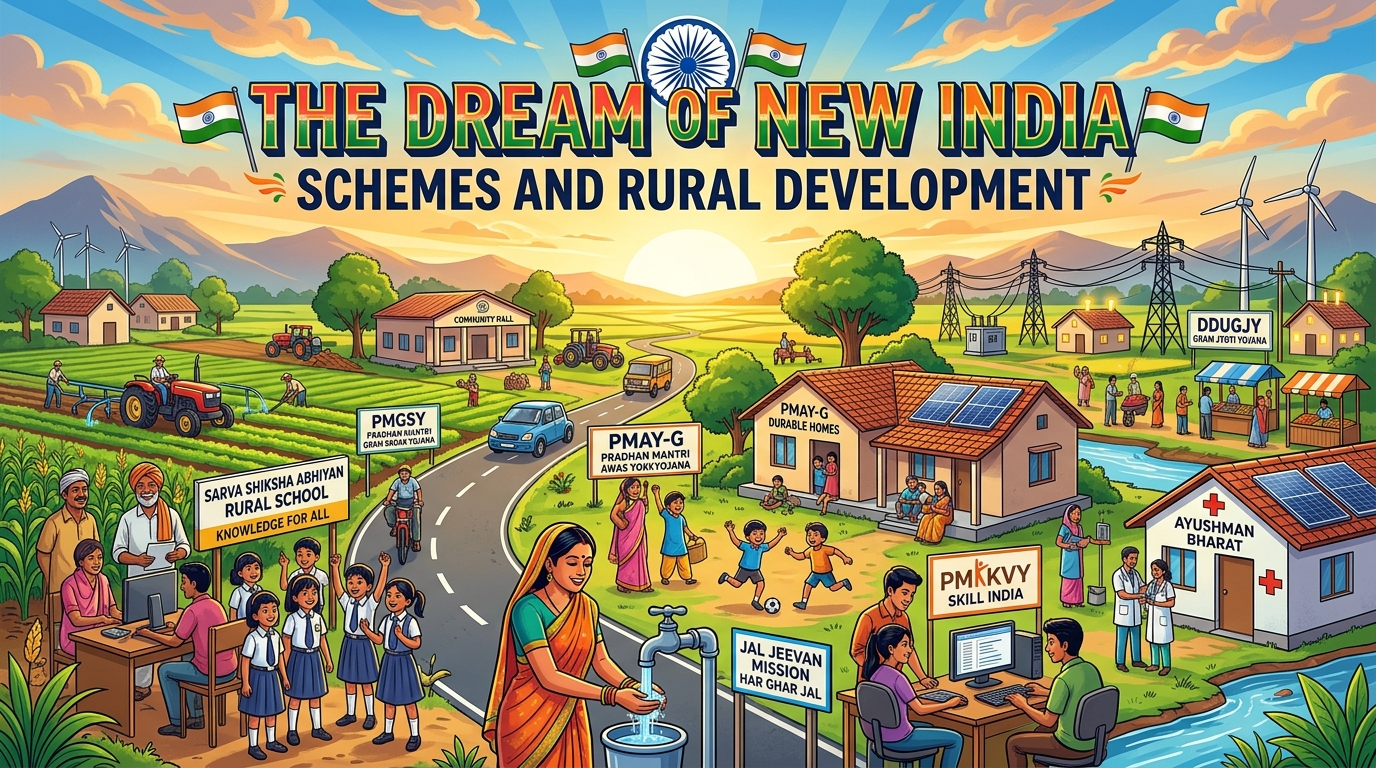
The Dream of New India: Schemes and Rural Development
New India Rural Development is central to achieving the vision of a developed, inclusive, and self-reliant nation. Government schemes focusing on employment, housing, sanitation, healthcare, and digital connectivity are transforming rural India.
Approach to the Essay:The Dream of New India: Schemes and Rural Development
To write on the topic “The dream of New India: Schemes and Rural Development”, we should follow a clear, structured, and multidimensional approach:
1. Understand the Core Idea
- The topic connects New India vision with government schemes and rural development.
- It asks how schemes contribute to building a developed, inclusive, and self-reliant India.
2. Define Key Terms
- New India: A vision of a developed, inclusive, digital, and self-reliant nation.
- Schemes: Government programs for welfare and development.
- Rural Development: Improvement in living standards, infrastructure, and livelihoods in villages.
3. Historical Context
- Rural India has been the backbone since independence.
- Earlier programs focused on poverty reduction and agriculture.
4. Role of Schemes
- Focus on major schemes like employment, health, sanitation, housing, digital inclusion.
5. Multiple Dimensions
- Economic: income, employment
- Social: health, education, equality
- Political: governance and decentralization
- Technological: digital India
- Environmental: sustainable rural practices
6. Achievements
- Poverty reduction, infrastructure growth
7. Challenges
- Implementation gaps, inequality, awareness
8. Way Forward
- Better governance, awareness, innovation
9. Conclusion
- Rural development is key to New India

Essay: The Dream of New India: Schemes and Rural Development
“India lives in its villages, and its future depends on their progress.”
The vision of New India is about building a nation that is developed, inclusive, self-reliant, and sustainable. In this vision, rural development plays a very important role because a large part of India’s population lives in villages. The government has launched many schemes to improve the quality of life in rural areas. These schemes aim to provide employment, housing, healthcare, education, and basic infrastructure. The dream of New India cannot be achieved without the development of rural areas.
India has a long history of focusing on rural development. After independence, the government started programs to reduce poverty and improve agriculture. Over time, the focus shifted towards a more comprehensive approach that includes infrastructure development, social welfare, and economic growth. Today, rural development is not just about agriculture but also about creating opportunities in different sectors.
One of the most important aspects of rural development is employment generation. Schemes like rural employment programs provide work to people and help them earn a livelihood. These programs also create assets such as roads, ponds, and irrigation facilities. This improves both income and infrastructure in villages. Employment generation is essential for reducing poverty and improving living standards.
Another key area is housing. Many rural families do not have proper houses. Government schemes aim to provide affordable housing to the poor. These houses are built with basic facilities such as electricity, water, and sanitation. This improves the dignity and safety of rural families.
Sanitation and cleanliness are also important for rural development. Programs that promote the construction of toilets and awareness about hygiene have improved public health. Clean villages reduce the spread of diseases and create a better environment for living. This shows the link between health and development.
Healthcare is another important dimension. Rural areas often lack proper medical facilities. Government schemes aim to provide affordable healthcare services, including insurance coverage and health centers. This helps in reducing the burden of medical expenses on poor families.
Education plays a crucial role in rural development. Schools, digital learning, and skill development programs are improving the quality of education in villages. Education helps people gain knowledge and skills, which are necessary for employment and personal growth. It also creates awareness about rights and responsibilities.
The economic dimension of rural development includes improving agriculture and promoting non-farm activities. Farmers are supported through schemes that provide subsidies, insurance, and better market access. At the same time, rural industries and small businesses are encouraged. This diversification reduces dependence on agriculture and increases income opportunities.
The technological dimension is becoming increasingly important. Programs that promote digital connectivity are transforming rural areas. Access to the internet allows people to access information, services, and markets. Digital platforms help farmers get better prices for their products and access government services easily. This is an important step towards building a Digital India.
The social dimension focuses on equality and inclusion. Rural development schemes aim to support women, marginalized communities, and weaker sections. Self-help groups and microfinance programs empower women by providing financial independence. Social inclusion ensures that the benefits of development reach all sections of society.
The political dimension is reflected in decentralization and local governance. Institutions like Panchayati Raj play an important role in rural development. They ensure that local needs are addressed and people participate in decision-making. This strengthens democracy at the grassroots level.
The environmental dimension is also important. Rural development schemes promote sustainable practices such as water conservation, organic farming, and renewable energy. Protecting natural resources is essential for long-term development. Sustainable practices ensure that future generations can also benefit from these resources.
The main part of the dream of New India lies in the effective implementation of schemes. Over the years, many schemes have brought positive changes. Rural roads have improved connectivity. Electricity has reached many villages. Access to clean water and sanitation has increased. These achievements show that progress is possible with proper planning and execution.
However, there are still many challenges. One major challenge is the gap between policy and implementation. Sometimes, the benefits of schemes do not reach the intended people due to corruption or lack of awareness. Another challenge is the lack of proper infrastructure and skilled manpower in rural areas. There is also inequality between different regions, with some areas developing faster than others.
To achieve the dream of New India, it is important to address these challenges. There is a need for better governance, transparency, and accountability. Technology can be used to improve the delivery of services. Awareness campaigns can help people understand and access government schemes. Capacity building and training can improve the efficiency of local institutions.
The way forward is to adopt a holistic approach to rural development. All dimensions—economic, social, political, technological, and environmental—must be integrated. Public participation is also important. When people are involved in development, they feel responsible and contribute actively.
In conclusion, the dream of New India is closely linked with rural development. Government schemes have played a significant role in improving the lives of rural people. However, much more needs to be done to achieve inclusive and sustainable development. By strengthening policies, improving implementation, and ensuring participation, India can move closer to its dream of becoming a developed nation.
“The progress of a nation is measured not by the growth of its cities alone, but by the development of its villages.”
UPPCS Essay 2025:
India’s Foreign Policy: From Non-Alignment to Multipolar Diplomacy
Organic Farming: Necessity or Compulsion
The Issue of Ethics in a Changing Global Economy
The Implications of Development and the Environment
Indian Women in the 21st Century: From Dreams to Reality
Global Consciousness of the New India
The Future of Literature in the Age of Artificial Intelligence
