
CSMP IAS : India's Premier Coaching Institute for IAS / PCS
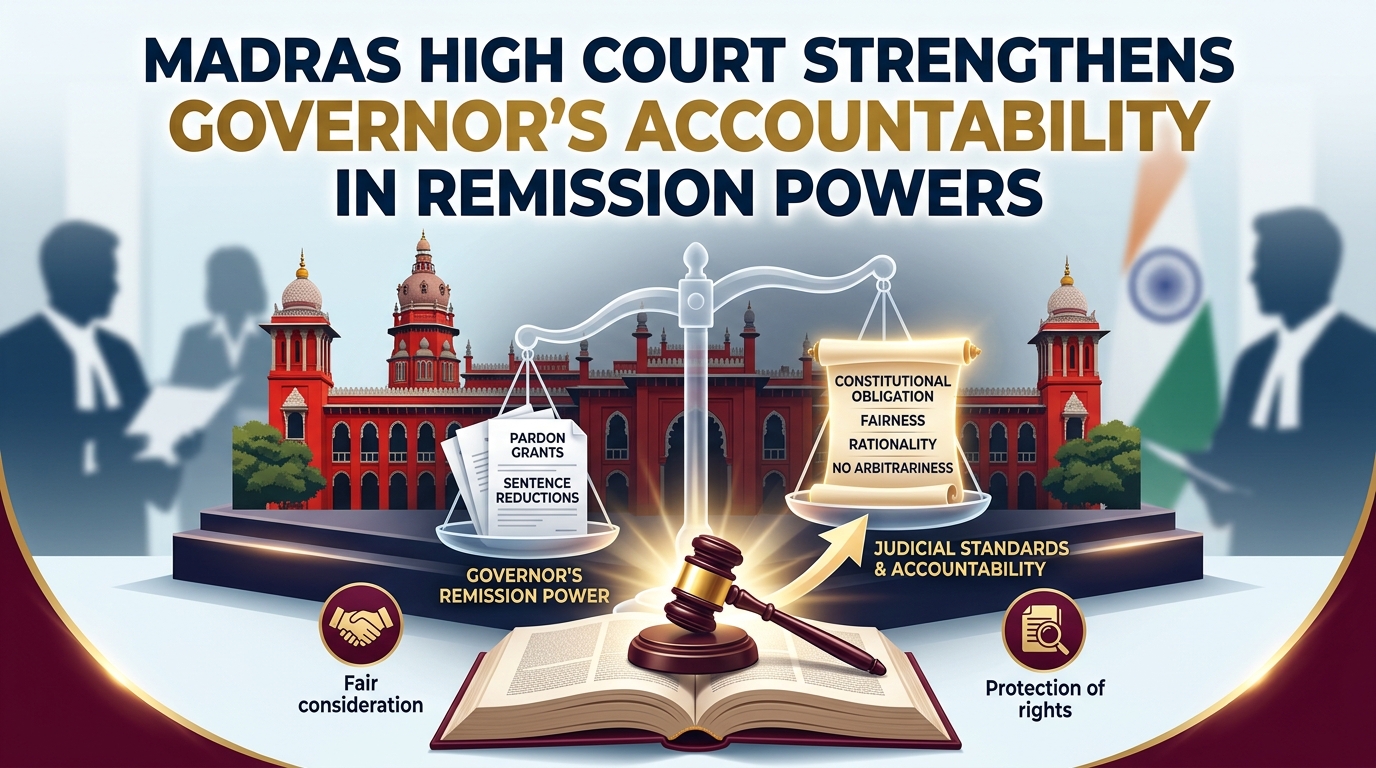
Article 161: Madras High Court Strengthens Governor’s Accountability in Remission Powers
Table of Contents
The recent judgment of the Madras High Court on Article 161 has brought major clarity to the constitutional role of the Governor in granting remission and premature release of convicts. The Court firmly held that the Governor is bound by the advice of the Council of Ministers, reinforcing democratic principles and limiting discretionary power. This decision strengthens constitutional accountability and aligns with Supreme Court precedents, making Article 161 a crucial topic for UPSC and other competitive exams.
Why in the News?
- The Madras High Court recently gave an important judgment on April 2, 2026 regarding the powers of the Governor under Article 161.
- The Court clarified whether the Governor can act independently while granting remission or early release of prisoners.
- A Full Bench of three judges gave this decision to resolve confusion.
- The confusion existed due to conflicting judgments given earlier by different benches of the same High Court.
What are the Key Highlights?
Governor Bound by Council of Ministers
- The Court held that the Governor is bound to follow the advice of the Council of Ministers.
- The Governor cannot act independently or ignore the advice given by the elected government.
No Discretionary Power in Article 161
- The Court clearly stated that the Governor has no personal discretion in granting remission or premature release.
- The Governor must act according to the recommendation of the State government.
Based on Supreme Court Judgments
- The Court relied on important Supreme Court cases to support its decision.
- The 1980 Maru Ram case clearly stated that the Governor must act on ministerial advice.
- The 1974 Shamsher Singh case also confirmed that the Governor is not an independent authority in such matters.
- The 2022 Perarivalan case again followed the same principle and allowed release based on State advice.
Clarification on Conflicting Judgments
- One earlier High Court judgment had allowed some discretion to the Governor.
- Another judgment had denied such discretion.
- The Full Bench clarified that:
- The judgment allowing discretion was incorrect.
- It was declared “per incuriam,” meaning it ignored correct legal principles.
Difference from Other Cases
- The Court clarified that the 2003 M.P. Special Police Establishment case is different.
- That case dealt with sanction to prosecute ministers, not remission of prisoners.
- Therefore, it cannot be used to justify Governor’s discretion under Article 161.
| Concept | Explanation |
|---|---|
| Article 161 | – Article 161 gives the Governor the power to grant pardon. – The Governor can reduce the sentence of a convict. – The Governor can order the early release of prisoners. – This power is related to State laws and offences. |
| Remission and Premature Release | – Remission means reducing the duration of punishment. – Premature release means releasing a prisoner before completing the full sentence. – Example: A life convict may be released early due to good behavior in prison. |
| Council of Ministers | – It is a group of elected leaders headed by the Chief Minister. – They take real executive decisions in the State. – The Governor acts as a constitutional head and follows their advice. |
| Per Incuriam | – It means a judgment given without considering proper law or legal precedent. – Such judgments are not treated as correct in law. |

What is the Significance?
Strengthening Parliamentary Democracy
- This judgment reinforces the idea that real power lies with elected representatives.
- The Governor cannot override the will of the elected government.
Clarity on Constitutional Position
- The decision removes confusion about the Governor’s role.
- It clearly defines that the Governor is not an independent authority in such matters.
Protection Against Arbitrary Decisions
- It prevents misuse of power by ensuring decisions are taken collectively.
- This reduces chances of personal or political bias.
Consistency with Supreme Court Jurisprudence
- The judgment aligns High Court rulings with Supreme Court decisions.
- This ensures uniform interpretation of the Constitution across India.
Impact on Prison Reforms
- It helps in smoother implementation of remission policies.
- Prisoners can benefit from fair and timely decisions based on government policy.
What are the Challenges?
Delay in Decision-Making
- There are often delays in acting on the advice of the Council of Ministers.
- This affects prisoners waiting for remission or release.
Centre-State Tensions
- Differences between the Governor and State government can create conflicts.
- This can slow down administrative processes.
Lack of Clear Timelines
- The Constitution does not specify a time limit for the Governor to act.
- This creates uncertainty and delays.
Political Misuse Concerns
- There is a risk that remission decisions may be influenced by political considerations.
- This may affect fairness and justice.
Way Forward
Fixing Time Limits
- There should be clear timelines for the Governor to act on advice.
- This will reduce delays and ensure timely justice.
Strengthening Constitutional Conventions
- Both the Governor and State government should follow established norms.
- This will maintain harmony and smooth functioning.
Judicial Oversight
- Courts should continue to monitor misuse or delay in such cases.
- This will ensure accountability.
Clear Guidelines on Remission
- Governments should create transparent policies for remission.
- This will ensure fairness and consistency in decisions.
Conclusion
The judgment brings clarity to an important constitutional issue by reinforcing the principle that executive power must remain accountable to elected authority. It highlights the importance of constitutional morality and cooperative governance in maintaining the balance between institutions.
Recent Articles:
The Dream of New India: Schemes and Rural Development
How Much Human-Induced, How Much Natural
India’s Foreign Policy: From Non-Alignment to Multipolar Diplomacy
Read Also:
Organic Farming: Necessity or Compulsion
The Implications of Development and the Environment
Governor Bound By Council Of… – Madras High Court
