CSMP IAS : India's Premier Coaching Institute for IAS / PCS
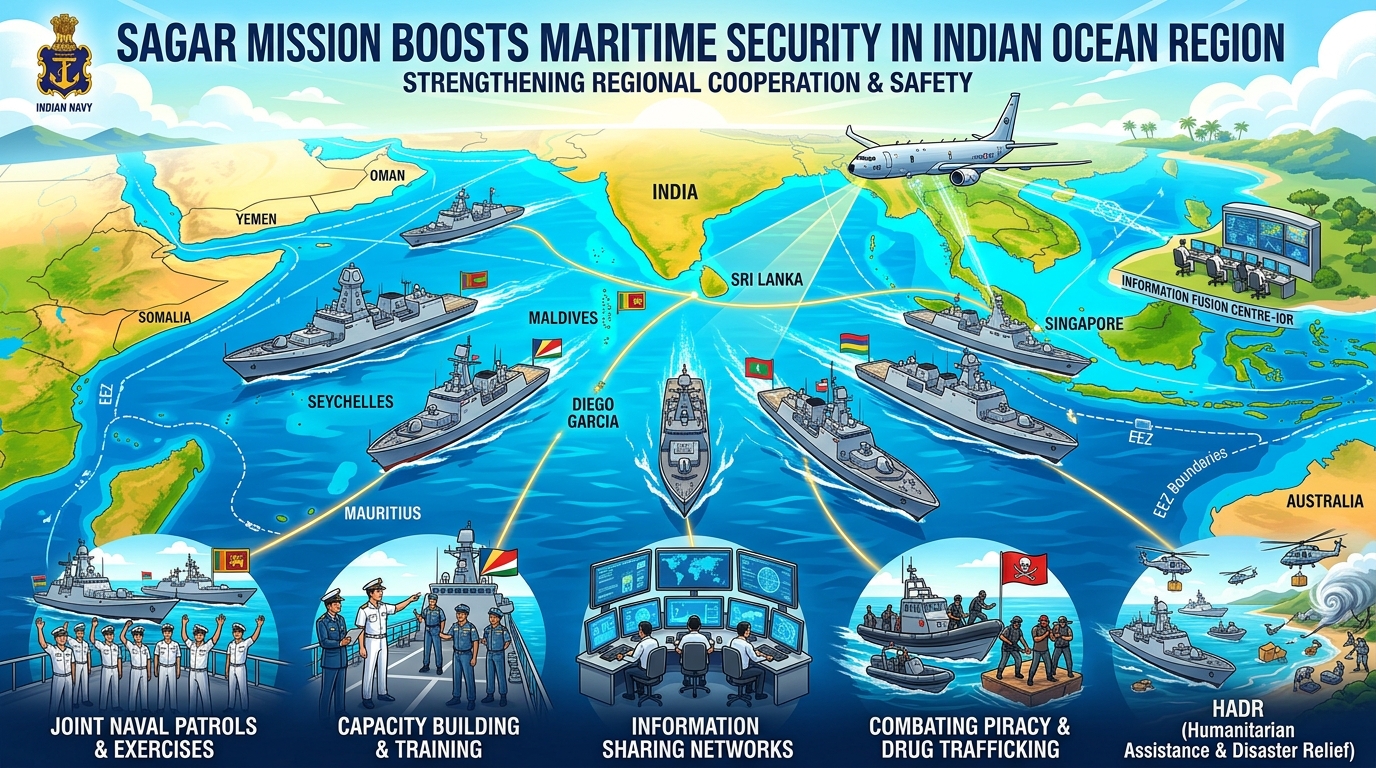
SAGAR Mission Boosts Maritime Security in Indian Ocean Region
The SAGAR Mission Boosts Maritime Security in Indian Ocean Region highlights India’s proactive naval strategy amid rising tensions in West Asia and disruptions in global shipping routes. Through the deployment of INS Sunayna as IOS SAGAR, India is strengthening regional cooperation, enhancing maritime safety, and addressing emerging threats such as piracy, illegal fishing, and narco-trafficking. This initiative reflects India’s commitment to ensuring secure and stable sea lanes in the Indian Ocean Region.
Why in the News?
- The deployment of INS Sunayna as Indian Ocean Ship SAGAR has taken place due to rising tensions in West Asia, especially around the Strait of Hormuz, which is a critical global oil route.
- The ongoing conflict in West Asia has entered its fifth week, which has disrupted shipping and energy supplies.
- This disruption is affecting global trade, oil prices, and economic stability, including India’s energy security.
- The Indian Navy has launched this mission to ensure maritime safety and strengthen cooperation with friendly countries.
- The mission reflects India’s proactive approach to maintaining stability in the Indian Ocean Region.
What are the Key Highlights?
- INS Sunayna has been deployed as IOS SAGAR with participation from 16 friendly countries.
- This shows a collective effort for regional cooperation and shared security responsibility.
- The ship was flagged off in Mumbai by the Minister of State for Defence in the presence of the Chief of Naval Staff.
- This indicates the importance of the mission at the highest levels of defense leadership.
- The mission includes port visits to several countries such as Sri Lanka, Thailand, Indonesia, Singapore, Bangladesh, Myanmar, and Maldives.
- These visits will help in strengthening diplomatic and naval relations.
- The mission focuses on training and capacity building in areas such as seamanship, navigation, communication, firefighting, and boarding operations.
- These activities improve coordination and operational readiness among navies.
- The Indian Ocean Region recorded around 3,700 maritime incidents last year, and narcotics seizures crossed $1 billion in 2025.
- This shows that maritime threats are increasing in scale and complexity.
Key Concepts and Keywords Explained
Maritime Security
- Maritime security refers to the protection of oceans, seas, and coastal areas from threats.
- These threats include piracy, terrorism, smuggling, and illegal fishing.
- For example, piracy near Somalia once threatened global shipping routes and required international naval cooperation.
Strait of Hormuz
- The Strait of Hormuz is a narrow waterway between the Persian Gulf and the Arabian Sea.
- It is one of the most important oil transit chokepoints in the world.
- Around one-fifth of global oil passes through this route.
SAGAR Vision
- SAGAR stands for Security and Growth for All in the Region.
- It is India’s policy for promoting peace, stability, and cooperation in the Indian Ocean Region.
- For example, India provides disaster relief and maritime assistance to neighboring countries under this vision.
IUU Fishing
- Illegal, Unreported, and Unregulated (IUU) fishing refers to fishing activities that violate laws or are not properly recorded.
- It harms marine ecosystems and affects the livelihood of legal fishermen.
- For example, foreign vessels entering another country’s waters without permission is a case of illegal fishing.
VBSS Operations
- VBSS stands for Visit, Board, Search, and Seizure operations.
- These are naval operations used to inspect ships for illegal activities.
- For example, navies use VBSS to stop ships carrying drugs or weapons.
Narco-Trafficking
- Narco-trafficking refers to the illegal trade of drugs across borders.
- Sea routes are often used to transport drugs secretly.
- For example, large drug consignments are sometimes intercepted in the Arabian Sea.
Deep-Sea Resource Competition
- Countries are increasingly competing for resources found under the sea such as rare earth minerals.
- These minerals are important for electronics and green technologies.
- For example, cobalt and lithium are needed for batteries and renewable energy systems.

What are the Significance of SAGAR Mission?
Strengthening Regional Cooperation
- The participation of 16 countries promotes trust and cooperation among nations.
- It helps in building a collective security framework in the Indian Ocean Region.
Enhancing Maritime Security
- The mission addresses threats such as piracy, smuggling, and illegal fishing.
- It ensures safe sea lanes for global trade and energy supplies.
Capacity Building and Training
- Training in navigation, communication, and emergency handling improves the skills of naval personnel.
- It increases interoperability, meaning different navies can work together smoothly.
Protecting India’s Economic Interests
- India depends heavily on sea routes for trade and oil imports.
- Securing these routes is essential for economic stability.
Strategic Presence of India
- The mission increases India’s influence in the Indian Ocean Region.
- It counters the growing presence of other global powers in the region.
What are the Challenges?
Rising Geopolitical Tensions
- Conflicts in West Asia are increasing instability in key maritime regions.
- These tensions can disrupt trade routes and energy supplies.
Increasing Maritime Crimes
- Activities such as piracy, armed robbery, and drug trafficking are rising.
- Advanced technology is making these crimes more sophisticated.
Competition for Marine Resources
- Countries are competing for rare minerals, fishing grounds, and underwater data cables.
- This competition can lead to conflicts over maritime boundaries.
Weak Enforcement Mechanisms
- Many countries lack the capacity to monitor and control their maritime zones.
- This allows illegal activities to continue unchecked.
What is the Way Forward?
Strengthening Multilateral Cooperation
- Countries should work together through joint exercises and information sharing.
- This will improve collective response to maritime threats.
Enhancing Surveillance and Technology
- Use of satellites, drones, and AI-based monitoring systems should be increased.
- This will help in early detection of illegal activities.
Building Capacity of Coastal Nations
- India should continue training and supporting smaller countries.
- This will help them protect their own waters effectively.
Promoting International Maritime Laws
- Countries should follow global rules like UNCLOS for fair use of oceans.
- This will reduce conflicts and ensure peaceful cooperation.
Conclusion
The IOS SAGAR mission reflects India’s growing responsibility in maintaining peace and stability in the Indian Ocean Region. It shows that maritime security is not only about defense but also about cooperation, economic safety, and sustainable use of ocean resources. In a time of rising global tensions, such initiatives are essential for building trust and ensuring a secure and stable maritime future.
Relevant Articles:
Helium Supply Crisis: West Asia Conflict Raises Serious Concerns for India
Artemis II Mission: NASA’s Bold Step in Deep Space Exploration and Moon Race
Read Also:
Article 161: Madras High Court Strengthens Governor’s Accountability in Remission Powers
The Dream of New India: Schemes and Rural Development
