
CSMP IAS : India's Premier Coaching Institute for IAS / PCS
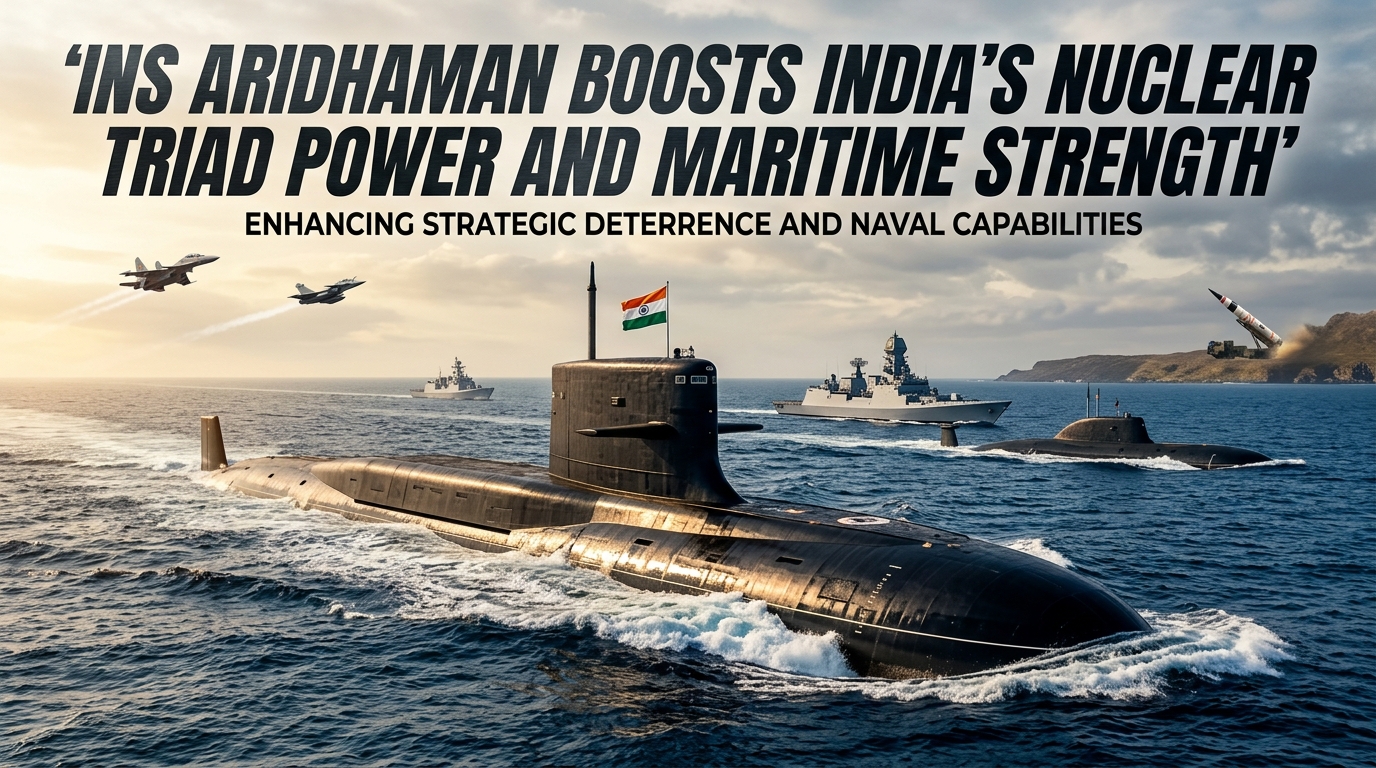
INS Aridhaman Boosts India Nuclear Triad Power and Maritime Strength
Table of Contents
INS Aridhaman has significantly boosted India nuclear triad capability and strengthened the country’s maritime security. The commissioning of this advanced nuclear submarine marks a major step in India’s strategic defence preparedness, enhancing second-strike capability and reinforcing its position among global military powers.
Why in the News?
- India has commissioned its third nuclear-powered ballistic missile submarine INS Aridhaman.
- The ceremony took place at Visakhapatnam.
- The event was kept secret due to its strategic importance.
- The ceremony was presided over by Rajnath Singh.
- He indirectly confirmed the commissioning through a message on social media.
- The submarine is part of India’s strategic weapons programme.
- It strengthens India’s nuclear deterrence and defence capability.
What are the Key Highlights?
Commissioning of INS Aridhaman
- INS Aridhaman is the third submarine in the Arihant-class series.
- It is classified as an SSBN, which means a nuclear-powered submarine carrying ballistic missiles.
- The commissioning was conducted quietly.
- This is common for strategic defence assets to maintain secrecy.
Part of Nuclear Triad
- INS Aridhaman is part of India’s nuclear triad.
- Nuclear triad means the ability to launch nuclear weapons from land, air, and sea.
- India is among a few countries with this capability.
- Other countries include the United States, Russia, China, and France.
Development under ATV Project
- The submarine is developed under the Advanced Technology Vessel (ATV) project.
- This is India’s secret nuclear submarine programme.
- The project is executed at the Ship Building Centre in Visakhapatnam.
Previous Submarines in the Series
- The first submarine, INS Arihant, was launched in 2009 and commissioned in 2016.
- The second submarine, INS Arighaat, was commissioned in 2024.
- INS Aridhaman is the third in this series.
Size and Capacity
- INS Aridhaman is larger than earlier submarines.
- It weighs about 7,000 tonnes compared to 6,000 tonnes of earlier ones.
- It has greater firepower.
- It can carry more missiles than its predecessors.
Missile Capability
- INS Aridhaman can carry multiple types of missiles.
- It can carry up to 24 K-15 Sagarika missiles.
- It can carry around 8 K-4 missiles.
- It can also carry future K-5 missiles.
- The K-4 missile has a range of about 3,500 km.
- It is a nuclear-capable submarine-launched ballistic missile.
Future Developments
- Another submarine named S4* is under sea trials.
- It may be named Arisudan.
- India is also planning to build nuclear-powered attack submarines.
- These are called SSNs and are expected by 2036–39.

What is the Significance?
Strengthening Second-Strike Capability
- INS Aridhaman improves India’s second-strike capability.
- This means India can respond even after a nuclear attack.
- Submarines can remain hidden underwater.
- This ensures survival during conflict.
Enhancing National Security
- The submarine increases India’s defence strength.
- It acts as a strong deterrent against enemies.
- It reduces the chances of nuclear attack by other countries.
Technological Advancement
- The project shows India’s progress in indigenous defence technology.
- Building nuclear submarines requires advanced engineering skills.
- It reflects success in complex military research and development.
Strengthening Maritime Power
- INS Aridhaman improves India’s naval strength.
- It increases dominance in the Indian Ocean region.
- It helps protect sea routes and national interests.
Strategic Deterrence
- The submarine sends a strong message to adversaries.
- It shows India’s capability to defend itself effectively.
- It contributes to maintaining global strategic balance.
Contribution to Defence Self-Reliance
- The submarine is indigenously developed.
- It supports the goal of self-reliance in defence production.
- It reduces dependence on foreign technology.
What are the Challenges?
High Cost of Development
- Nuclear submarines require huge financial investment.
- This puts pressure on defence budgets.
Technical Complexity
- Designing and maintaining nuclear submarines is very complex.
- It requires highly skilled manpower and advanced technology.
Limited Number of Submarines
- India currently has a small number of SSBNs.
- This limits continuous deployment capability.
Secrecy and Security Risks
- Such projects require strict secrecy.
- Any information leak can harm national security.
Maintenance and Operational Challenges
- Nuclear submarines require regular maintenance.
- This needs advanced infrastructure and resources.
Way Forward
Expanding Submarine Fleet
- India should increase the number of SSBNs and SSNs.
- This will ensure better coverage and continuous deterrence.
Strengthening Indigenous Capabilities
- More investment should be made in research and development.
- This will improve domestic defence production.
Advancing Missile Technology
- Development of long-range missiles like K-5 should be accelerated.
- This will enhance strike capability.
Improving Naval Infrastructure
- Shipbuilding and maintenance facilities should be upgraded.
- This will support efficient operations.
Training Skilled Personnel
- Specialized training should be provided to naval officers.
- This ensures safe handling of nuclear submarines.
Enhancing Strategic Planning
- Long-term defence planning should focus on underwater capabilities.
- This will strengthen India’s position globally.
Conclusion
INS Aridhaman marks a significant step in strengthening India’s defence preparedness and reflects the country’s growing capability in advanced military technology and strategic deterrence.
Relevant Articles:
Plastic Waste Management Rules 2026 Raise Concerns Over Weakened Compliance
NaMo Drone Didi Yojana Success: Karnataka Leads Women Drone Pilots
Also Read:
Great Nicobar Project Controversy: Rising Tribal Concerns
Helium Supply Crisis: West Asia Conflict Raises Serious Concerns for India
INS Aridhaman inducted: India boosts nuclear submarine …
