
CSMP IAS : India's Premier Coaching Institute for IAS / PCS
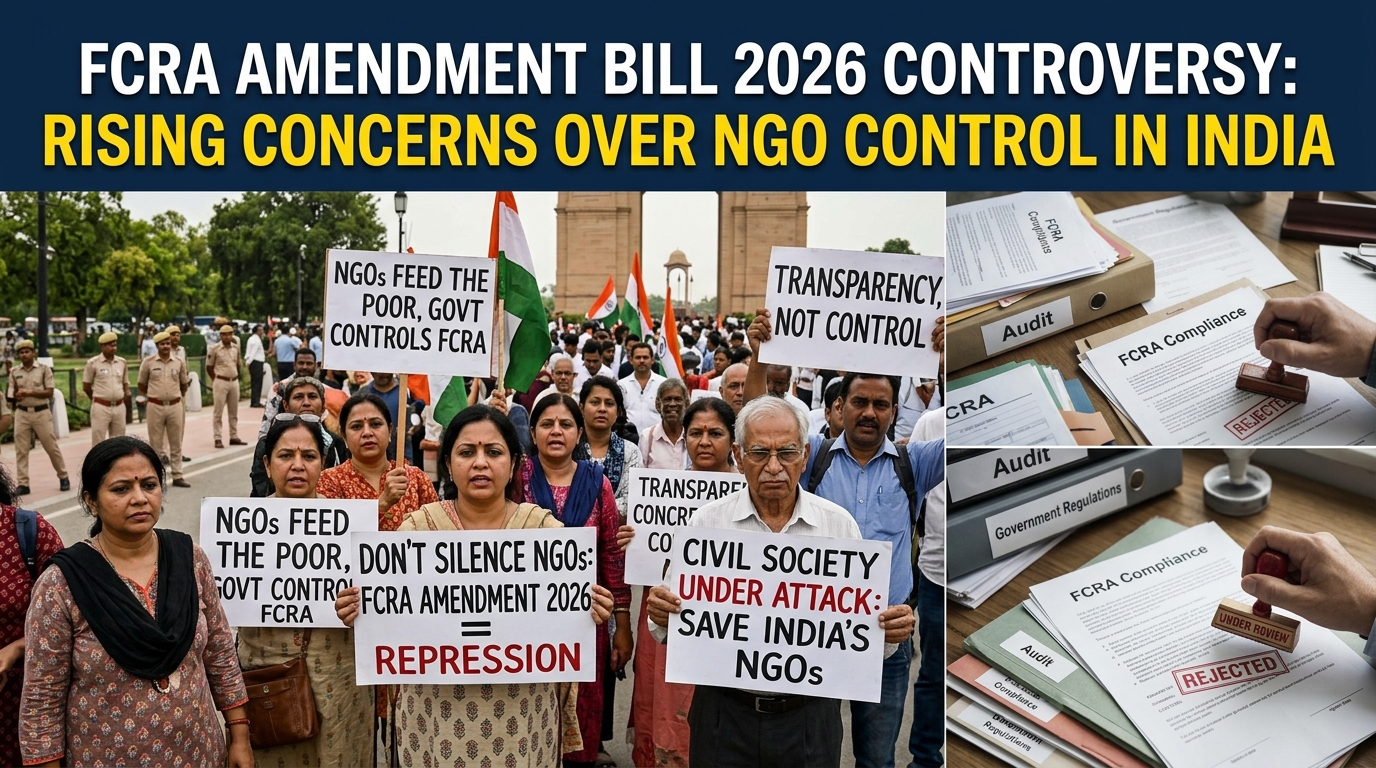
FCRA Amendment Bill 2026 Controversy: Rising Concerns Over NGO Control in India
Table of Contents
The FCRA Amendment Bill 2026 Controversy has sparked a major debate in India after the government proposed changes to the Foreign Contribution (Regulation) Act, 2010. The new bill aims to regulate foreign funding to NGOs more strictly, but critics argue that it may increase government control and reduce the independence of civil society organisations. With strong opposition from political parties and groups like the Catholic Bishops’ Conference of India, the issue has become an important topic for governance, democracy, and transparency in India.
Why in the News?
- The Government of India introduced the Foreign Contribution (Regulation) Amendment Bill, 2026 during the Budget Session of Parliament.
- The Bill was presented in the Lok Sabha on March 25, 2026.
- The Bill could not be discussed or passed because of strong opposition from several political parties.
- Due to protests, the discussion was postponed.
- The Bill aims to change the existing Foreign Contribution (Regulation) Act, 2010.
- This law controls how NGOs receive and use foreign funds in India.
- The issue has become important because NGOs receive a large amount of foreign money every year.
- Around 16,000 organisations are registered under FCRA and receive about ₹22,000 crore annually.
- The government says that stronger rules are needed to protect national interest, public order, and national security.
- However, critics believe that the Bill may reduce the freedom of NGOs and civil society organisations.
What are the Key Highlights?
Background of the FCRA Law
- The FCRA law regulates foreign donations to organisations in India.
- Its purpose is to ensure that foreign money is not used against the country’s interests.
- The law was first introduced in 1976.
- It was later replaced by a new law in 2010.
- The 2010 law came into effect in 2011.
- It has been amended several times in 2016, 2018, and 2020.
- NGOs must register under FCRA to receive foreign funds.
- Registration is valid for five years and must be renewed.
- Since 2015, more than 18,000 NGO registrations have been cancelled.
- As of April 2026, about 14,965 NGOs are actively registered.
Introduction of a Designated Authority
- The Bill proposes the creation of a “designated authority.”
- This authority will manage assets of NGOs if their licence is cancelled or not renewed.
- The authority will have powers similar to a civil court.
- It can order the transfer or sale of assets.
- These assets may include land, buildings, and other property created using foreign funds.
- Earlier, the law did not clearly explain what would happen to such assets.
- This created confusion and chances of misuse.
- The government believes that a clear system is needed to manage these assets.
Expansion of the Definition of Key Functionary
- The Bill expands the meaning of “key functionary.”
- Earlier, it mainly included office bearers and directors.
- Now it will include:
- Trustees of organisations.
- Partners in firms.
- Members of governing bodies.
- The Karta of a Hindu Undivided Family.
- Any person who controls or manages the organisation.
- These individuals will be held responsible for violations of the law.
- They will be considered guilty unless they prove that they had no knowledge or took proper care.
Central Approval for Investigation
- The Bill introduces a new rule for investigations.
- State governments and police must take approval from the Central government before starting any investigation.
- This rule applies to all complaints related to FCRA violations.
- The government says that this will ensure proper coordination and prevent misuse.
- Critics argue that this may delay investigations and reduce the power of States.
Fixed Timelines for Use of Funds
- The Bill introduces clear timelines for using foreign funds.
- This applies especially to funds received under “prior permission.”
- “Prior permission” means that NGOs take approval for one-time funding.
- Earlier, there were no strict timelines for using such funds.
- Now, NGOs must use funds within a specified period.
- This will improve accountability and reduce misuse.
Automatic Cancellation of Registration
- The Bill proposes automatic cancellation of FCRA registration.
- This happens when the registration expires and is not renewed.
- Earlier, there was uncertainty about the status of such registrations.
- This change brings clarity and reduces confusion.
Reduction in Punishment
- The Bill reduces the punishment for FCRA violations.
- The maximum jail term is reduced from five years to one year.
- This change is seen as a move towards making the law less harsh.
- However, some believe that it may reduce the fear of punishment.
What is FCRA?
- The Foreign Contribution (Regulation) Act, 2010 is a law that controls foreign donations.
- It ensures that funds are used properly and legally.

What are the Significance?
Strengthening National Security
- The Bill ensures that foreign funds are not used against the country.
- It helps prevent activities that may harm national security.
Improving Transparency in Fund Usage
- The Bill introduces clear rules for using funds.
- This reduces chances of corruption and misuse.
Clear System for Asset Management
- The designated authority provides a proper system for handling NGO assets.
- This reduces confusion after licence cancellation.
Increased Accountability of Individuals
- More people are made responsible under the law.
- This ensures that organisations follow rules carefully.
Legal Clarity and Certainty
- Automatic cancellation and fixed timelines reduce confusion.
- This makes the law easier to understand and implement.
Better Monitoring of NGOs
- Stronger rules allow better monitoring of NGO activities.
- This ensures proper use of foreign funds.
Protection Against Misuse of Funds
- The Bill aims to stop misuse of foreign donations.
- It ensures that funds are used for genuine purposes.
What are the Challenges?
Fear of Excessive Government Control
- Many critics believe that the Bill gives too much power to the government.
- This may reduce the independence of NGOs.
Impact on Civil Society Organisations
- NGOs play an important role in development.
- Strict rules may affect their functioning and funding.
Concerns of Minority Institutions
- Organisations like the Catholic Bishops’ Conference of India have raised concerns.
- They fear interference in religious institutions.
Risk of Misuse of Authority
- The designated authority has strong powers.
- These powers may be misused in some cases.
Centralisation of Power
- The requirement of central approval reduces the role of States.
- This may affect the federal structure of India.
Delays in Investigation
- Approval from the Centre may delay action.
- This can slow down the justice process.
Political Opposition
- Several states like Kerala and Tamil Nadu have opposed the Bill.
- Political disagreements may delay its passage.
What is the Way Forward?
Maintain Balance Between Control and Freedom
- The government should ensure that rules do not harm genuine NGOs.
- A balance between regulation and freedom is necessary.
Clear and Transparent Guidelines
- The government should issue clear rules for implementation.
- This will reduce confusion and misuse.
Strengthen Centre-State Cooperation
- Both the Centre and States should work together.
- This will improve enforcement and trust.
Protect Rights of Minority Institutions
- Safeguards should be introduced for minority organisations.
- This will address concerns of discrimination.
Improve Capacity of NGOs
- NGOs should be trained to follow FCRA rules.
- This will reduce violations.
Ensure Judicial Oversight
- Courts should monitor the use of powers.
- This will prevent misuse and protect rights.
Encourage Transparency and Accountability
- NGOs should maintain proper records and disclosures.
- This will build trust among stakeholders.
Conclusion
The proposed amendments reflect a major step towards tightening regulation of foreign funding in India. While the intention is to improve transparency and protect national interests, concerns about excessive control and reduced autonomy of civil society cannot be ignored. A balanced and inclusive approach, supported by proper safeguards and cooperation between institutions, will be essential to ensure that both national security and democratic values are protected in the long run.
Relevant Articles:
Nuclear Fusion Cost Crisis: Overestimated Experience Rate Raises Investment Risks
RBI Guidelines on Insurance Mis-selling: Fixing Commission-Driven Fraud in India
Read Also:
ISRO Mission MITRA Boosts Gaganyaan Programme with High-Altitude Human Space Research
INS Aridhaman Boosts India Nuclear Triad Power and Maritime Strength
parliament question: nuclear energy projects
