
CSMP IAS : India's Premier Coaching Institute for IAS / PCS
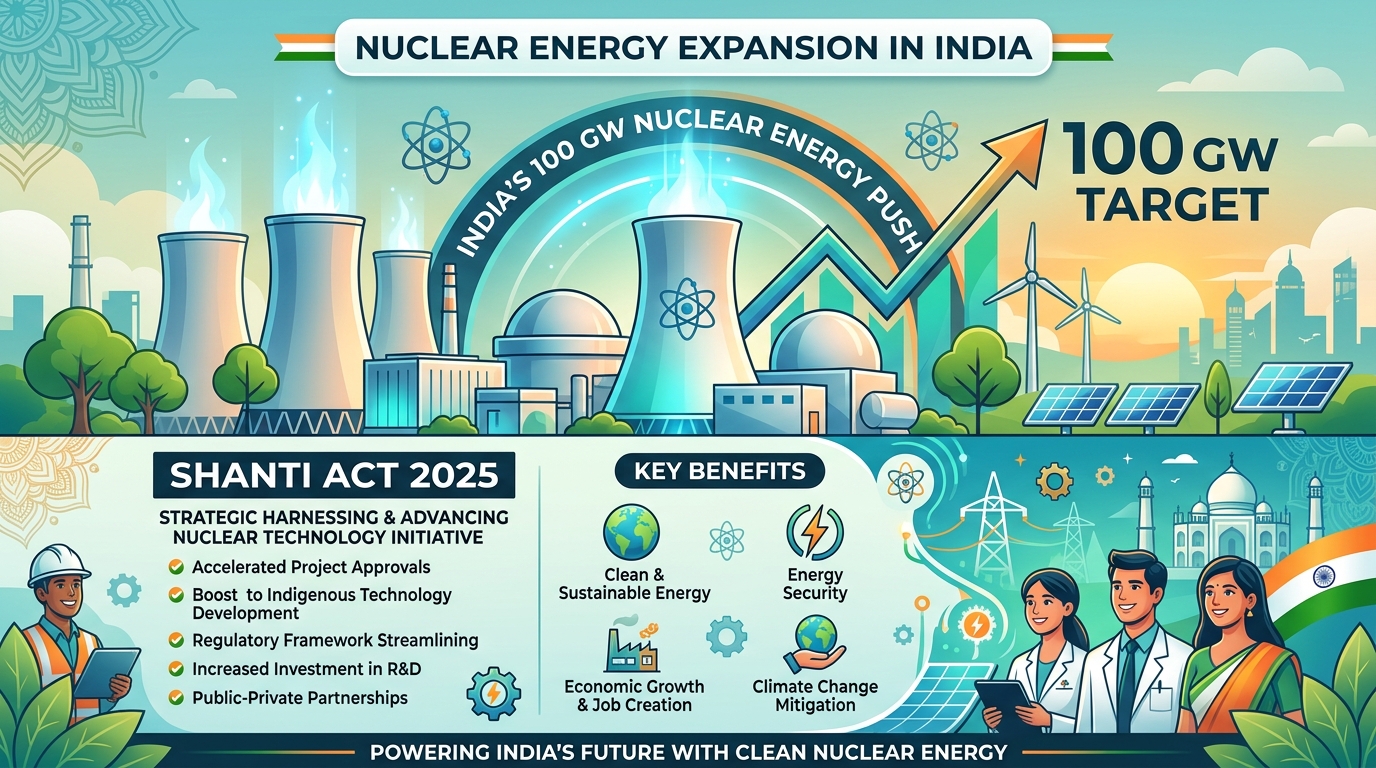
Nuclear Energy Expansion in India: SHANTI Act 2025 and India’s 100 GW Nuclear Energy Push
Table of Contents
India’s nuclear energy sector is undergoing a major transformation with the introduction of the SHANTI Act 2025, which aims to expand nuclear power capacity from 8.8 GW to 100 GW by 2047. The reform allows private participation, strengthens regulation through AERB, and supports India’s twin goals of Viksit Bharat 2047 and Net Zero Emissions 2070, making nuclear energy a key pillar of India’s future clean and reliable power strategy.
Why in the News?
- The Union Budget 2025–26 announced a major expansion of nuclear power capacity from 8,180 MW to 100 GW by 2047.
- The government passed the Sustainable Harnessing and Advancement of Nuclear Energy for Transforming India (SHANTI) Act, 2025.
- The Act replaces two earlier laws: the Atomic Energy Act, 1962 and the Civil Liability for Nuclear Damage Act, 2010 (CLNDA).
- The reform aims to transform India’s nuclear sector by enabling private participation, foreign investment, and stronger regulation.
- It supports two national goals: Viksit Bharat by 2047 and Net Zero emissions by 2070.
What are the Key Highlights?
Shift from Government Monopoly to Private Participation
- Earlier, nuclear energy was fully controlled by the government through the Department of Atomic Energy (DAE).
- Only government companies like NPCIL operated nuclear power plants.
- The SHANTI Act now allows private companies to:
- Build nuclear power plants
- Own nuclear power plants
- Operate nuclear power plants
- Foreign companies are also allowed to invest in the sector.
- This is a major reform similar to opening of sectors like telecom and aviation in earlier decades.
Strengthening of Regulatory Framework
- The Atomic Energy Regulatory Board (AERB) is given statutory status.
- This means it now has legal authority and independence.
- Its functions include:
- Ensuring nuclear safety
- Monitoring compliance
- Enforcing safety standards
- This improves transparency, accountability, and public trust.
Reform of Nuclear Liability Framework
- Earlier law (CLNDA 2010) imposed strong liability on suppliers in case of accidents.
- This discouraged foreign companies from entering India.
- The SHANTI Act introduces a balanced liability system.
- It reduces financial risk for investors while maintaining safety responsibility.
- This is important to attract global nuclear technology providers.
Target of 100 GW Nuclear Capacity
- Current nuclear capacity is about 8.8 GW.
- The target is to reach 100 GW by 2047.
- This requires more than 10 times expansion.
- Estimated investment needed is around $200 billion (₹18 lakh crore).
- Such expansion is possible only with private and foreign investment.
Focus on New Nuclear Technologies
- The government is promoting Small Modular Reactors (SMRs).
- SMRs are:
- Small nuclear reactors (5 MW to 200 MW)
- Faster to build and safer to manage
- Suitable for industries and remote areas
- India is also focusing on thorium-based nuclear energy.
- India has one of the world’s largest thorium reserves, especially along coastal regions.
India’s Current Energy Situation
- Total installed power capacity: 476 GW (2025)
- Around 50% is non-fossil fuel based
- Major renewable sources:
- Solar: 111 GW
- Wind: 51 GW
- Hydro: 48 GW
- Nuclear capacity: 8.8 GW (about 1.8%)
- Electricity generation share:
- Thermal: 75%
- Renewable: 22%
- Nuclear: 3%
- This shows heavy dependence on coal-based energy.
Key Concepts Explained Simply
Nuclear Energy
- Nuclear energy is produced by splitting atoms in a process called nuclear fission.
- This releases large amounts of heat.
- Heat is used to produce steam that generates electricity.
Baseload Power
- Baseload power means the minimum continuous electricity required at all times.
- Nuclear and thermal power plants provide baseload electricity.
- Solar and wind cannot provide constant supply due to weather dependence.
Net Zero Emissions
- Net zero means balancing greenhouse gas emissions with removal of emissions.
- It requires shifting from fossil fuels to clean energy sources like nuclear and renewables.
Small Modular Reactors (SMRs)
- SMRs are compact nuclear reactors.
- They can be built in factories and installed at sites.
- They are cheaper, safer, and faster than traditional large reactors.
Thorium Energy
- Thorium is a nuclear fuel alternative to uranium.
- India has large reserves of thorium.
- It can provide long-term sustainable nuclear energy with less waste.

What are the Significance?
Support for Net Zero Emissions
- Nuclear energy is a low-carbon energy source.
- It does not emit greenhouse gases during electricity production.
- It helps reduce dependence on coal power plants.
- It supports India’s climate commitments under net zero targets.
Reliable and Continuous Power Supply
- Nuclear plants provide 24×7 uninterrupted electricity.
- Unlike renewable sources, they do not depend on sunlight or wind.
- This ensures grid stability and energy security.
Supporting Economic Development
- India’s per capita electricity consumption is low compared to developed countries.
- Economic growth will increase electricity demand significantly.
- Nuclear energy can support:
- Industrial growth
- Urban expansion
- Digital infrastructure
Efficient Land Use
- Nuclear plants require very small land area compared to solar or wind farms.
- This is important for a densely populated country like India.
Industrial Decarbonisation
- Heavy industries need continuous high power supply.
- Nuclear energy can replace coal-based captive plants in:
- Steel
- Cement
- Petrochemicals
- Data centres
- This reduces industrial carbon emissions.
Attracting Investment and Technology
- Private entry will bring large-scale investment.
- Foreign companies will bring advanced technology and expertise.
- This will improve efficiency and innovation in the sector.
Strategic Energy Security
- Nuclear power reduces dependence on imported fossil fuels.
- It improves India’s long-term energy independence.
- It strengthens India’s global position in clean energy leadership.
What are the Challenges?
High Capital Cost
- Nuclear power plants require very high initial investment.
- Returns come only after long operational periods.
Technology Dependence
- Advanced reactor designs are controlled by a few countries.
- India needs to develop and indigenise technology.
Safety Concerns
- Nuclear accidents can have severe environmental and human impacts.
- Public fear remains a major challenge.
Waste Management Issues
- Nuclear energy produces radioactive waste.
- Safe storage and disposal require long-term solutions.
Regulatory Uncertainty
- Clear rules on tariffs, liability, fuel ownership, and insurance are still needed.
- Lack of clarity may slow investment.
Project Delays
- Many nuclear projects have been delayed for years.
- Delays increase costs and reduce investor confidence.
Limited Skilled Human Resources
- The nuclear sector requires highly specialised engineers and scientists.
- India needs to expand training and education capacity.
What should be the Way Forward?
Promote Indigenous Technology Development
- India should strengthen indigenous reactor designs like PHWRs.
- Focus should be on reducing dependence on foreign technology.
Develop Strong Financing Models
- Use Public-Private Partnerships (PPP).
- Provide government support for long-term investment stability.
Expand Small Modular Reactor Deployment
- SMRs should be used for industrial clusters and remote regions.
- They offer flexibility and lower cost risks.
Strengthen Regulatory Institutions
- AERB must remain independent and powerful.
- Strong safety monitoring systems should be ensured.
Invest in Research and Development
- Focus areas should include:
- Thorium fuel cycle
- Advanced reactors
- Waste management technologies
Improve Project Execution Efficiency
- Use fleet mode construction for faster completion.
- Improve coordination between agencies and contractors.
Build Public Awareness
- Educate citizens about nuclear safety and benefits.
- Address misinformation and safety fears.
Conclusion
India’s nuclear energy expansion through the SHANTI Act, 2025 marks a major shift in the country’s energy strategy. It aims to combine economic growth, clean energy transition, and energy security. However, achieving the ambitious target of 100 GW will depend on strong regulation, technological progress, investment confidence, and public trust.
Relevant Articles:
FCRA Amendment Bill 2026 Controversy: Rising Concerns Over NGO Control in India
Nuclear Fusion Cost Crisis: Overestimated Experience Rate Raises Investment Risks
Read More:
RBI Guidelines on Insurance Mis-selling: Fixing Commission-Driven Fraud in India
ISRO Mission MITRA Boosts Gaganyaan Programme with High-Altitude Human Space Research
