CSMP IAS : India's Premier Coaching Institute for IAS / PCS
Women’s Reservation Act and Delimitation Debate: Balancing Representation and Federal Fairness
Table of Contents
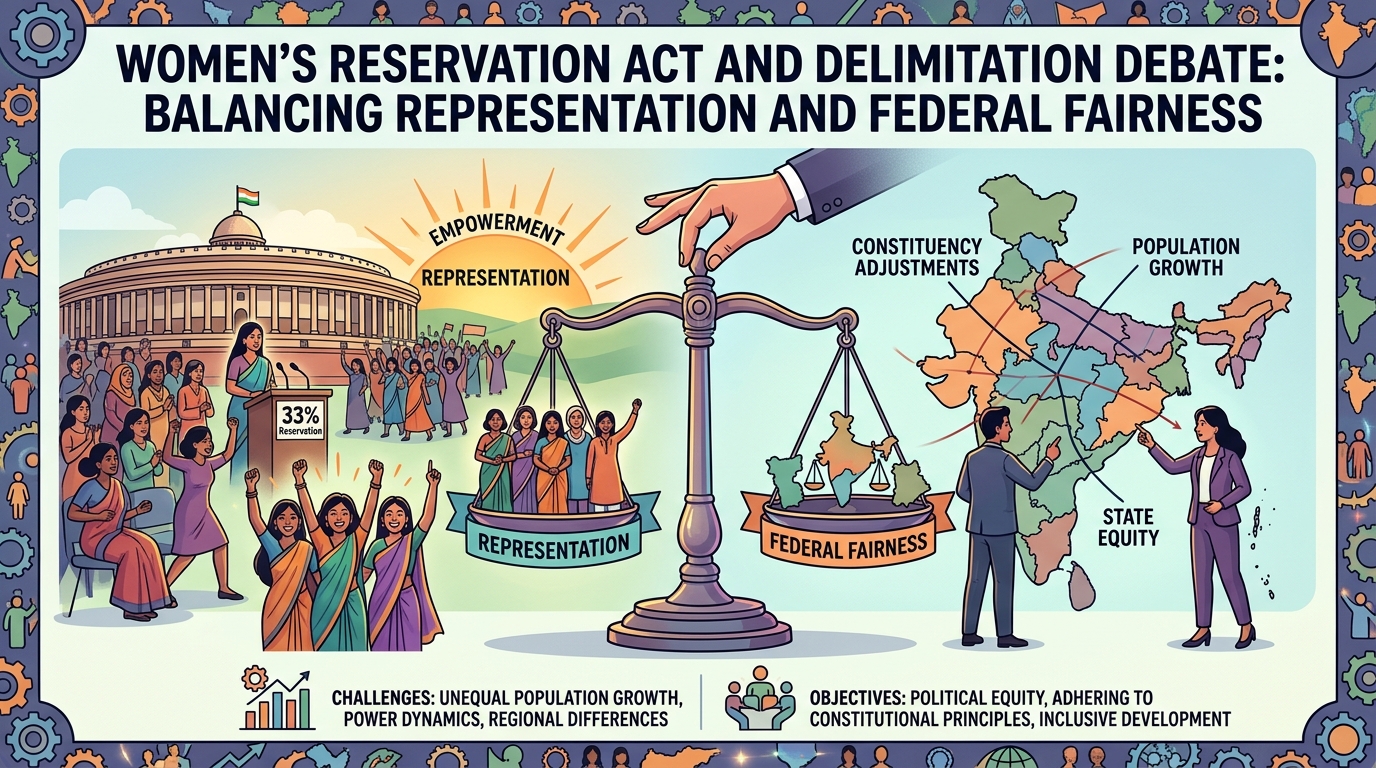
The Women’s Reservation Act and Delimitation Debate has become a major constitutional and political issue in India after the passage of the Constitution (One Hundred and Sixth Amendment) Act, 2023. While the law promises 33% reservation for women in the Lok Sabha and State Assemblies, concerns over delayed implementation, delimitation based on outdated Census data, and regional imbalance have raised important questions about representation, federalism, and electoral fairness.
Why in the News?
- The Constitution (One Hundred and Sixth Amendment) Act, 2023 has brought attention to the issue of reservation for women in legislatures and the delay in its implementation.
- The law promises 33% reservation for women, but its implementation is linked to the next Census and delimitation.
- Recent developments suggest that the government may implement the law earlier by using 2011 Census data.
- At the same time, there are proposals to increase the number of seats in the Lok Sabha and State Assemblies by nearly 50%.
- These developments have created debate about political fairness, federal balance, and representation.
What are the Key Highlights?
Women’s Reservation Act (Nari Shakti Vandan Adhiniyam)
- The law provides that one-third of seats will be reserved for women in:
- The Lok Sabha.
- The State Legislative Assemblies.
- The law also ensures that this reservation will apply to seats already reserved for Scheduled Castes and Scheduled Tribes.
Delay in Implementation
- The law clearly states that its implementation will happen only after:
- A new Census is conducted.
- A delimitation exercise is completed.
- This means that the benefit of reservation will not be available immediately.
Proposed Change in Approach
- The government is now considering using 2011 Census data instead of waiting for a new Census.
- This indicates a shift in earlier policy.
- At the same time, the government is considering increasing the number of seats in the Lok Sabha from 543 to around 816.
What is Delimitation? (Key Concept)
- Delimitation refers to the process of redrawing the boundaries of electoral constituencies.
- This process is based on population data.
- The purpose of delimitation is to ensure that each representative represents roughly equal population.
Concerns About Delimitation
- If delimitation is based only on population, then:
- Northern States like Uttar Pradesh and Bihar will gain more seats.
- Southern States may lose their relative political influence.
- This situation can create a North–South divide in political power.
Census Data Issue
- Using the 2011 Census data may not reflect current realities.
- India has seen significant changes due to urbanisation, migration, and the COVID-19 pandemic.
- The upcoming Census is also expected to include caste data, which may lead to new demands for representation.
Seat Expansion
- The proposal to increase seats by 50% aims to balance representation.
- However, larger States will still gain more seats in absolute terms.
- This means that the balance of power may still shift towards more populous States.
Rotation of Reserved Seats (Key Concept)
- Rotation means that reserved constituencies will change over time.
- This ensures that different areas get representation.
- However, the current law does not clearly explain how this rotation will work.
- This creates uncertainty for both politicians and voters.

What are the Significance?
1. Gender Justice and Political Inclusion
- Women’s reservation will increase the participation of women in politics.
- This will help in better representation of women’s issues and concerns.
2. Structural Change in Democracy
- These reforms will bring a major change in who represents the people.
- It will reshape the electoral system and political structure of India.
3. Impact on Federalism
- Delimitation will affect the balance of power between different States.
- It may increase the political strength of northern States.
4. Electoral and Political Strategy
- The timing of implementation may influence upcoming elections.
- It may help political parties attract women voters.
5. Representation of Social Groups
- The next Census may lead to demands for:
- OBC reservation within women’s quota.
- Better representation of minority groups.
- This will make the system more complex but also more inclusive.
What are the Challenges?
1. Use of Outdated Census Data
- Using 2011 Census data may not reflect the current population.
- This can lead to incorrect representation.
2. North–South Divide
- Population-based delimitation may favor high population States.
- This can create regional imbalance and tension.
3. Lack of Clarity on Rotation
- The law does not clearly define how reserved seats will rotate.
- This creates confusion and uncertainty.
4. Demand for Sub-Quotas
- There are increasing demands for OBC and minority sub-quotas within women’s reservation.
- Ignoring these demands may lead to political conflict.
5. Political Motivations
- The timing of reforms may be influenced by electoral considerations.
- This may reduce trust in the policy.
What is the Way Forward?
1. Use Updated Census Data
- The government should use latest Census data for delimitation.
- This will ensure accurate and fair representation.
2. Transparent Delimitation Process
- The delimitation process should be transparent and fair.
- It should consider factors like development and geography, not just population.
3. Clear Rules on Rotation
- The government should clearly define the rotation mechanism.
- This will ensure stability in governance and accountability.
4. Address Sub-Quota Demands
- There should be a proper discussion on OBC and minority representation.
- This will make the system more inclusive and just.
5. Build Political Consensus
- All political parties should work together to build consensus.
- This will strengthen democratic values and trust.
Conclusion
India is moving towards a major transformation in its democratic system, and this change requires careful planning and inclusive decision-making. A balanced approach will ensure that the reform strengthens democracy while maintaining fairness and unity across the country.
Relevant Articles:
Sabarimala Case and Religious Freedom Debate: Supreme Court Examines Women’s Entry and Rights
Urban Tuberculosis Crisis in India: Why Health for All Is Still a Distant Goal
Read More:
Brain Science, Ego Dissolution and Self Awareness
International Women’s Day 2026
