
CSMP IAS : India's Premier Coaching Institute for IAS / PCS
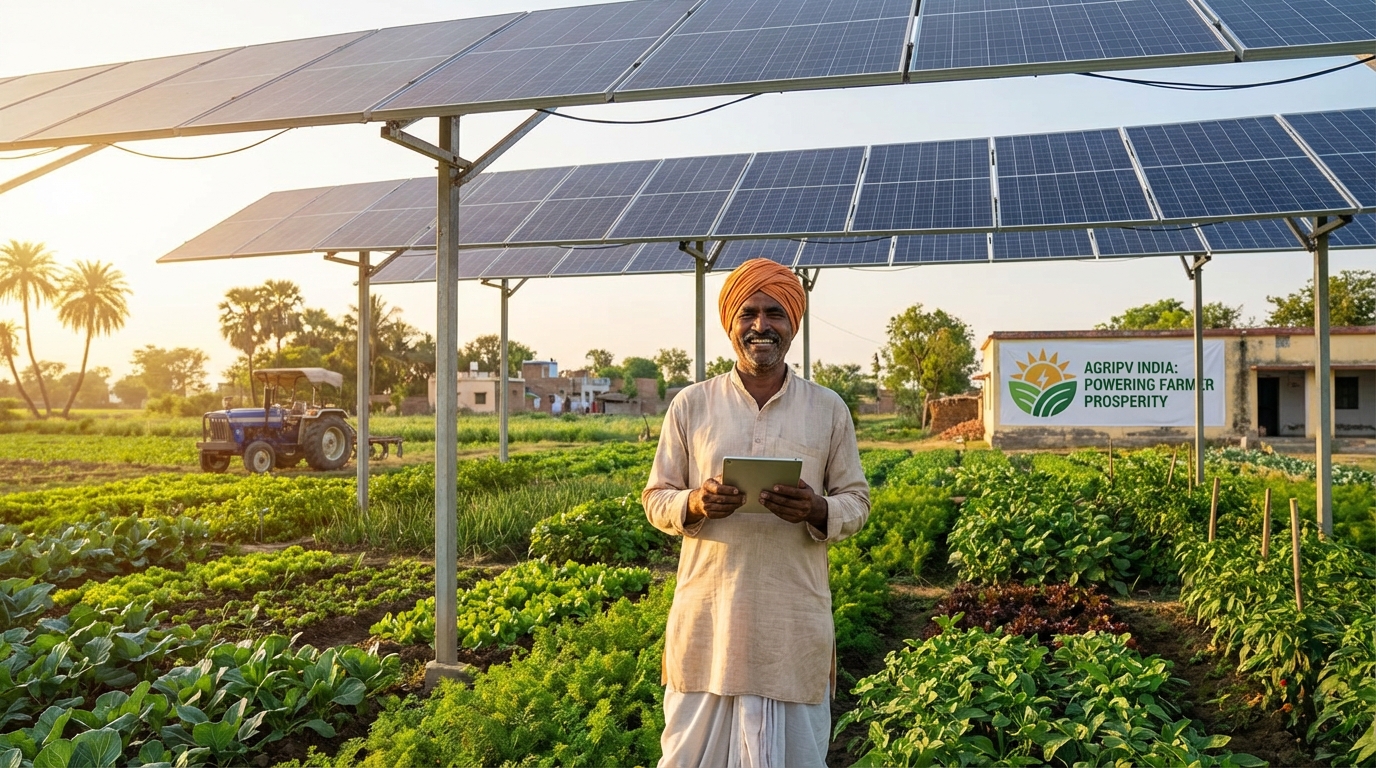
AgriPV in India: Powerful Solar Farming Revolution Unlocks Farmer Growth
AgriPV in India is driving a powerful transformation in the agriculture and energy sectors as the Union Budget 2026–27 boosts the PM-KUSUM scheme. This innovative approach allows farmers to grow crops and generate solar power on the same land, solving the challenge of land scarcity. AgriPV in India not only increases farmer income but also supports clean energy goals and climate resilience. As India moves towards sustainable development, this solar farming revolution offers massive opportunities, though challenges like cost and policy clarity remain.
Table of Contents
Why in the News?
- The Union Budget 2026–27 has significantly increased the allocation for the PM-KUSUM scheme to ₹5,000 crore.
- This reflects a strong push by the government towards solarisation of agriculture.
- The scheme focuses on improving farmers’ income, energy access, and sustainability.
- At the same time, India is rapidly expanding its renewable energy capacity.
- The country aims to add large solar capacity as part of its clean energy transition.
- PM-KUSUM alone targets adding about 34,800 MW of solar capacity by 2026.
- However, this expansion raises a critical concern.
- Solar power requires large land areas.
- Agriculture already occupies more than half of India’s land.
- This has created a key policy challenge.
- How to balance food security and energy security.
- Agri-photovoltaics (AgriPV) is emerging as a promising solution.
- It allows farmers to produce crops and electricity on the same land.
- It reduces the conflict between agriculture and solar energy expansion.
What are the Key Highlights?
- Increase in PM-KUSUM Budget Allocation
- The scheme’s funding has nearly doubled to ₹5,000 crore.
- This shows a strong government commitment to solar-based agriculture.
- Objectives of PM-KUSUM Scheme
- To provide reliable daytime electricity for irrigation.
- To reduce dependence on diesel pumps.
- To increase farmers’ income.
- To promote clean energy and reduce emissions.
- Structure of the Scheme
- Component A:
- Decentralised solar plants of 500 kW to 2 MW.
- Farmers can sell electricity to DISCOMs.
- Component B:
- Installation of standalone solar pumps.
- Component C:
- Solarisation of existing grid-connected pumps.
- Component A:
- Emergence of Agri-Photovoltaics (AgriPV)
- AgriPV combines solar panels with crop cultivation.
- Panels are installed at a height to allow farming below.
- This ensures dual use of land.
- Types of AgriPV Systems
- Elevated systems:
- Panels are installed above ground.
- Farming continues below.
- Row-based systems:
- Panels are placed between crop rows.
- Vertical systems:
- Panels are installed upright.
- Greenhouse systems:
- Panels are integrated with greenhouse structures.
- Elevated systems:
- Importance of Crop Selection
- Crop choice depends on sunlight availability.
- Shade-tolerant crops grow well under panels.
- Sun-loving crops grow in open spaces between panels.
- Examples of Suitable Crops
- Madhya Pradesh:
- Tomato, onion, garlic, turmeric, leafy vegetables.
- Karnataka and Maharashtra:
- Ragi, jowar, grapes, potato, chilli, banana.
- Madhya Pradesh:
- Business Models for AgriPV
- Farmers can own and operate solar systems.
- Farmers can sell surplus electricity.
- Farmer Producer Organisations can develop projects collectively.
- Private developers can lease land and share revenue.
- Government agencies can develop community projects.
- Current Status
- Around 50 pilot projects are operating in India.
- Large-scale adoption is still limited.
- More research and testing are required.
- Future Policy Direction
- PM-KUSUM 2.0 may include a 10 GW AgriPV component. (solarsure.in)
- Financial support such as viability gap funding may be introduced.
What are the Significance?
Efficient Use of Scarce Land
- AgriPV allows dual use of agricultural land.
- The same land produces crops and electricity.
- This reduces competition between food production and energy generation.
- Land is a limited resource in India.
- It helps avoid land acquisition conflicts.
Increase in Farmers’ Income
- Farmers can earn additional income from electricity generation.
- They can sell surplus electricity to the grid.
- AgriPV systems can significantly increase income per acre.
- Income from solar can be higher than traditional land leasing.
- This reduces dependence on crop income alone.
Support to Clean Energy Transition
- AgriPV contributes to solar energy capacity expansion.
- It supports India’s target of 300 GW solar capacity.
- It helps reduce dependence on fossil fuels.
- It supports India’s commitment to net-zero emissions by 2070.
Reduction in Water Stress
- Solar panels provide partial shade.
- This reduces evaporation of water.
- Soil moisture retention improves.
- This increases water-use efficiency.
- It is especially useful in drought-prone regions.
Protection Against Climate Risks
- Solar panels act as a protective cover.
- They shield crops from extreme heat, heavy rain, and hail.
- This reduces crop damage.
- It helps farmers adapt to climate change.
Reduction in Diesel Use
- Solar pumps replace diesel-based irrigation.
- This reduces fuel costs.
- It reduces air pollution and carbon emissions.
Strengthening Rural Economy
- AgriPV can support rural industries.
- It can power cold storage and processing units.
- It can create jobs in installation and maintenance.
- Each MW of solar can generate employment. (iForest)
Diversification of Rural Livelihoods
- Farmers get income from both farming and energy.
- This reduces financial risk.
- It improves economic stability in rural areas.
Energy Security and Decentralisation
- Decentralised solar systems reduce dependence on central grids.
- They provide reliable electricity in rural areas.
- They reduce transmission losses.
Alignment with Sustainable Development Goals
- AgriPV supports multiple goals.
- Clean energy.
- Sustainable agriculture.
- Climate action.
- It promotes balanced development.
Challenges
High Capital Cost
- AgriPV systems are more expensive than normal solar systems.
- Elevated structures and special mounting increase cost.
- Farmers may not afford these systems.
Lack of Clear Policy Framework
- There are no uniform national guidelines for AgriPV.
- Land use rules are unclear.
- Regulatory uncertainty discourages investment.
Risk to Agricultural Productivity
- Improper design can reduce sunlight for crops.
- This may reduce crop yield.
- Crop response to shading varies.
Limited Research and Data
- Only a small number of pilot projects exist.
- There is limited data across regions.
- Different agro-climatic zones need different models.
Financing Constraints
- Farmers face difficulty in accessing loans.
- Banks demand collateral.
- Financial risk remains high.
Land Ownership and Legal Issues
- Ownership of solar systems may create disputes.
- Revenue-sharing agreements may not be clear.
- Long-term land rights may be affected.
Grid Connectivity Problems
- Rural areas may lack strong grid infrastructure.
- Power evacuation is difficult.
- Delays in payment from DISCOMs can occur.
Technical Complexity
- Designing AgriPV systems requires expertise.
- Farmers may lack technical knowledge.
- Maintenance and repair can be challenging.
Institutional Barriers
- Coordination between multiple agencies is required.
- This slows implementation.
- Lack of standard designs creates uncertainty.
Way Forward
Develop Clear National Policy
- The government should create a dedicated AgriPV policy.
- Clear rules for land use and ownership should be defined.
- Standard guidelines should be developed.
Provide Financial Support
- Subsidies and viability gap funding should be increased.
- This will reduce initial cost.
- Easy and low-interest loans should be provided.
Promote Research and Innovation
- Large-scale pilot projects should be expanded.
- Data should be collected across regions.
- Research should focus on crop-solar compatibility.
Build Capacity and Awareness
- Farmers should be trained in AgriPV systems.
- Technical knowledge should be provided.
- Awareness programs should be conducted.
Strengthen Infrastructure
- Grid connectivity in rural areas should be improved.
- Storage systems should be developed.
- Efficient transmission systems should be built.
Encourage Private Sector Participation
- Private companies should be encouraged to invest.
- Public-private partnerships should be promoted.
- This will bring technology and finance.
Promote Farmer Cooperatives
- Farmers should form groups or FPOs.
- Collective projects reduce cost.
- It improves bargaining power.
Integrate with National Energy Goals
- AgriPV should be part of India’s solar mission.
- It should be integrated with PM-KUSUM 2.0.
- This will ensure large-scale adoption.
Region-Specific Planning
- Different regions need customised solutions.
- Crop selection should match local conditions.
- Climate and irrigation patterns should be considered.
Improve Governance and Transparency
- Clear contracts and revenue-sharing models should be created.
- This will reduce disputes.
- Monitoring systems should be established.
Conclusion
Agri-photovoltaics represents a new way of thinking where agriculture and energy are not seen as competing sectors but as partners in development. Its success will depend on how effectively India can align technology, policy, and farmer participation to create a system that is both productive and sustainable.
Relevant Articles:
India LNG Crisis: West Asia Conflict Threatens Fertilizer Supply
Ayurveda Global Expansion: Budget 2026 & India–EU FTA Unlock Massive Opportunities
Mahad Satyagraha and the Fight for Equality
Read Also:
Strait of Hormuz Crisis and Global Energy Shock
Alarming Tuberculosis (TB): Women at Risk
Agriculture Voltage Technology