
CSMP IAS : India's Premier Coaching Institute for IAS / PCS
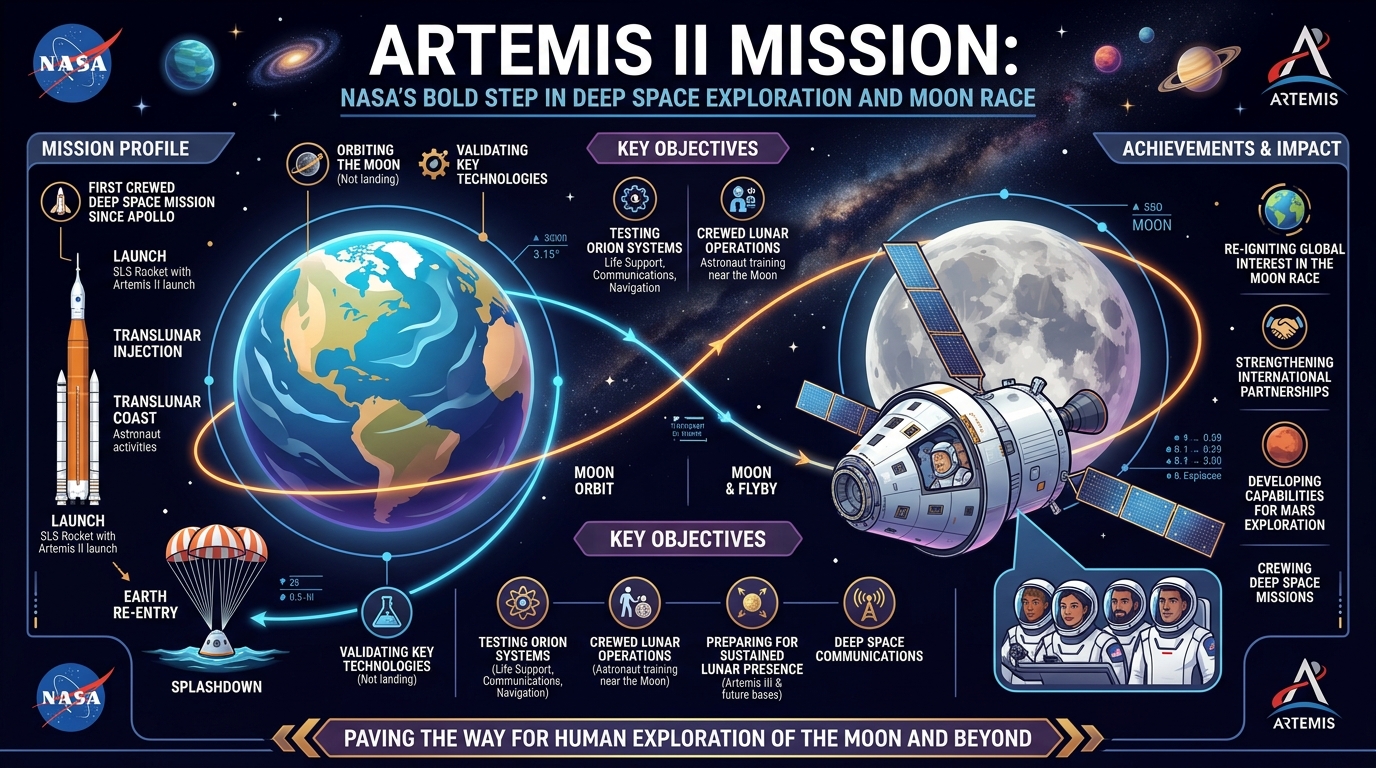
Artemis II Mission: NASA’s Bold Step in Deep Space Exploration and Moon Race
Table of Contents
The Artemis II Mission by NASA marks a historic return of humans to deep space after more than 50 years. This mission will test advanced technologies and carry astronauts around the Moon, paving the way for future lunar landings. As global competition in space intensifies, especially with China, the Artemis II Mission becomes crucial for understanding modern space geopolitics and technological advancements, making it highly important for UPSC and other competitive exams.
Why in the News?
- The Artemis II mission of NASA is scheduled to launch no earlier than April 1, 2026.
- This mission will send humans near the Moon for the first time since the Apollo 17 mission.
- This development is important because:
- It marks the return of human spaceflight beyond low-Earth orbit after more than 50 years.
- It represents a major milestone in modern space exploration.
- It reflects growing global competition in space, especially between the United States and China.
What are the Key Highlights?
Mission Objective and Nature
- Artemis II is a crewed mission but it will not land on the Moon.
- Its main purpose is to test the entire system before actual landing missions.
- It will validate the readiness of the rocket, spacecraft, astronauts, and ground systems.
- The mission focuses on safety and reliability.
- It ensures that future missions carrying astronauts to the Moon can be conducted without major risks.
Rocket and Spacecraft Technology
- The mission uses the Space Launch System (SLS).
- It is one of the most powerful rockets ever built by humans.
- It is designed to carry heavy payloads into deep space.
- The astronauts will travel in the Orion spacecraft.
- Orion is specially designed for long-duration deep space missions.
- It includes life-support systems, navigation tools, and safety mechanisms.
Trajectory and Mission Path
- The spacecraft will follow a free-return trajectory.
- This means it will orbit the Moon and return automatically due to Earth’s gravity.
- The mission will reach about 7,500 km above the Moon’s surface.
- This is much farther than low-Earth orbit.
- The mission duration will be slightly more than one week.
- The spacecraft will splash down in the Pacific Ocean after completing its journey.
Crew and Representation
- The mission includes four astronauts:
- Reid Wiseman as commander.
- Victor Glover as pilot.
- Christina Koch as mission specialist.
- Jeremy Hansen as mission specialist.
- The mission is historically significant because:
- It includes the first woman to travel on a lunar trajectory.
- It includes the first person of colour in such a mission.
- It includes the first non-U.S. astronaut in a lunar mission.
Testing and Scientific Experiments
- The crew will test multiple systems during the mission.
- Life-support systems will be tested to ensure survival in deep space.
- Communication systems will be tested for long-distance connectivity.
- Navigation systems will be tested for accuracy in deep space.
- The astronauts will also perform manual piloting exercises.
- This ensures that human control is possible if automated systems fail.
- Scientists will study the physiological and biological effects of deep space travel.
- This includes understanding radiation exposure and stress on the human body.
Re-entry and Heat Shield Challenge
- The spacecraft will re-enter Earth’s atmosphere at a speed of about 40,000 km per hour.
- This is extremely fast and generates intense heat.
- The heat shield will face temperatures of around 5,000°C.
- This is hotter than molten lava.
- During the Artemis I mission, some damage was observed in the heat shield.
- Engineers have modified the re-entry path to reduce stress on the shield.
Changes in Artemis Program Plan
- The Artemis program has been restructured recently.
- Earlier plan:
- Artemis III was supposed to land humans on the Moon.
- New plan:
- Artemis III will test docking with lunar landers in Earth orbit.
- Artemis IV will attempt the actual Moon landing in 2028.
- NASA has also increased mission frequency.
- There will be more regular missions after 2027.
Cancellation of Lunar Gateway
- NASA has cancelled the Lunar Gateway space station project.
- Instead, resources will be used for building infrastructure directly on the Moon.
- Focus has shifted to the Moon’s south pole region.
- This area is believed to contain water ice.
Role of Private Companies
- Private companies play a key role in the Artemis program.
- SpaceX is developing lunar landers.
- Blue Origin is also working on landing systems.
- These companies are essential for innovation and cost efficiency.

What are the Significance?
Revival of Deep Space Exploration
- The mission marks the return of human exploration beyond Earth orbit.
- It revives interest in space science and exploration.
Foundation for Future Moon Missions
- Artemis II acts as a testing ground for future missions.
- It ensures safety before landing humans on the Moon.
Technological Advancement
- The mission pushes the limits of technology.
- It improves spacecraft design, navigation, and safety systems.
Strategic and Geopolitical Importance
- Space exploration has become a symbol of global power.
- Success in such missions enhances national prestige.
Competition with China
- China is rapidly advancing in space exploration.
- It plans to land humans on the Moon by 2030.
- This creates a new space race similar to the Cold War era.
Resource Utilisation on the Moon
- The Moon’s south pole contains water ice.
- Water can be converted into oxygen and hydrogen fuel.
- Control over these resources can shape future space exploration.
International Collaboration
- The mission includes global participation.
- It strengthens diplomatic and scientific ties.
What are the Challenges?
Frequent Delays
- Artemis missions have faced multiple delays.
- Delays affect timelines and credibility.
High Financial Cost
- The program has already cost around $93 billion.
- Each launch costs at least $2 billion.
Technical Uncertainty
- There are risks related to:
- Rocket performance.
- Heat shield durability.
- Human survival in deep space.
Dependence on Private Sector
- NASA depends heavily on private companies.
- Delays in their projects can affect the entire mission.
Workforce and Expertise Loss
- Long gaps between missions can lead to loss of skilled workforce.
- This affects continuity and efficiency.
Rising Competition from China
- China is progressing steadily with clear timelines.
- Its missions are state-driven and consistent.
Way Forward
Ensuring Timely Execution
- NASA should reduce delays and improve planning.
- Timely missions will maintain global leadership.
Strengthening Technology and Safety
- Continuous testing and innovation are necessary.
- This will reduce risks and improve success rates.
Cost Management
- Reducing costs through innovation is essential.
- Public-private partnerships can help achieve this.
Enhancing International Cooperation
- Collaboration with other countries should be increased.
- It will share costs and knowledge.
Strategic Planning Against Competition
- The U.S. must respond to China’s progress effectively.
- Faster execution and clear goals are necessary.
Focus on Lunar Infrastructure
- Building infrastructure on the Moon should be prioritized.
- This will support long-term human presence.
Conclusion
The Artemis II mission stands at the intersection of science, technology, and global strategy, representing a renewed human ambition to explore beyond Earth. Its outcome will not only influence future lunar missions but also determine the pace and direction of humanity’s expansion into deep space.
Relevant Articles:
Article 161: Madras High Court Strengthens Governor’s Accountability in Remission Powers
The Dream of New India: Schemes and Rural Development
How Much Human-Induced, How Much Natural
Read More:
India’s Foreign Policy: From Non-Alignment to Multipolar Diplomacy
parliament question: artemis programme