
CSMP IAS : India's Premier Coaching Institute for IAS / PCS
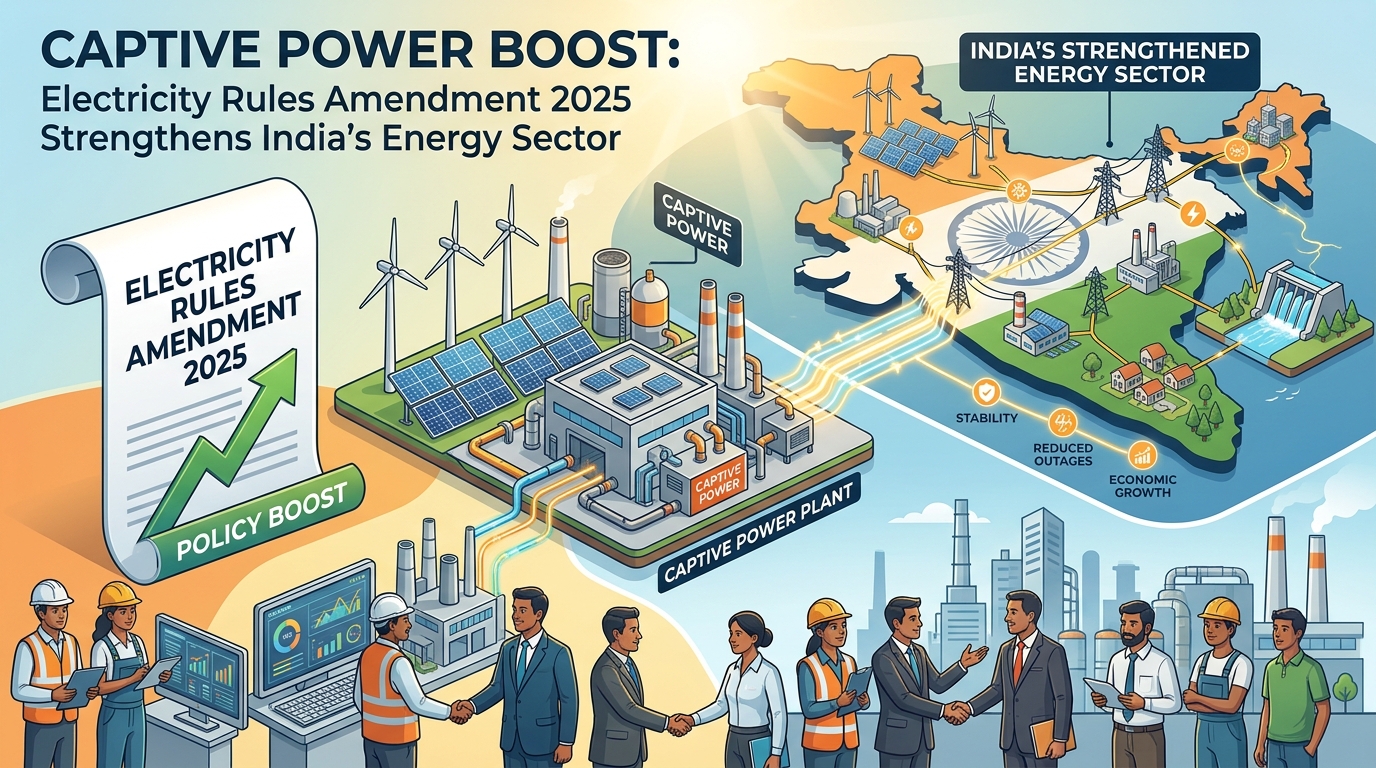
Captive Power Boost: Electricity Rules Amendment 2025 Strengthens India’s Energy Sector
Table of Contents
he Captive Power Boost through the recent amendment in the Electricity Rules 2005 by the Ministry of Power aims to remove regulatory confusion and promote clean energy investments. This reform supports industries by improving ease of doing business, enabling flexible corporate participation, and encouraging captive power generation, which is essential for reliable and cost-effective electricity in India.
Why in the News?
- The Ministry of Power has amended the Electricity Rules 2005 to remove confusion related to captive power generation.
- The amendment aims to bring clarity in rules that were earlier creating disputes between industries and regulators.
- The government wants to support industries that are investing in clean and non-fossil fuel energy sources.
- The reform is also important because:
- It aligns electricity regulations with modern corporate structures.
- It promotes ease of doing business in India.
- It supports India’s long-term energy transition goals.
What are the Key Highlights?
Amendment in the Electricity Rules
- The Union government has introduced changes in the Electricity Rules 2005.
- The main objective is to remove regulatory ambiguity in captive power generation.
- These changes aim to reduce disputes related to eligibility and benefits.
- Concept Understanding: Regulatory Ambiguity
- Regulatory ambiguity means lack of clarity in rules.
- It leads to different interpretations by industries and authorities.
- This often results in legal disputes and delays.
Meaning of Captive Power Generation
- Captive power generation refers to:
- Industries generating electricity for their own consumption.
- Industries not depending fully on the public electricity grid.
- Example:
- A steel plant sets up its own power plant to ensure uninterrupted electricity supply.
- Concept Understanding:
- Captive power plants are used when grid power is unreliable or expensive.
- They improve energy security for industries.
Annual Verification of Captive Status
- Captive status will now be verified for the entire financial year.
- This ensures uniformity in implementation.
- It reduces confusion about eligibility.
- Earlier Issue:
- Verification methods were not consistent.
- This created disputes regarding benefits.
Nodal Agencies for Verification
- States and Union Territories must appoint nodal agencies.
- These agencies will verify captive power status.
- This rule will be effective from April 1.
- Role of Nodal Agencies:
- They will check ownership and consumption criteria.
- They will ensure compliance with rules.
Role of National Load Despatch Centre
- Inter-state captive power verification will be done by the National Load Despatch Centre.
- Concept Understanding:
- The National Load Despatch Centre manages electricity flow across states.
- It ensures grid stability and coordination.
Relief from Surcharges During Verification
- Users who submit a declaration will not have to pay:
- Cross-subsidy surcharge.
- Additional surcharge.
- This relief will continue until verification is completed.
- Concept Understanding:
- Cross-subsidy surcharge is charged to compensate distribution companies.
- Additional surcharge covers fixed costs of unused power capacity.
Flexibility in Group Captive Projects
- Multiple companies can jointly operate group captive power plants.
- Flexibility provided:
- Captive users can draw electricity based on their needs.
- If one user consumes more than their share, the project will not be disqualified.
- This is allowed as long as overall rules are followed.
- Example:
- A group of small industries jointly invests in a solar plant and shares power.
Clarification of Ownership Definition
- Ownership definition now includes:
- Subsidiaries.
- Holding companies.
- Other subsidiaries of the holding company.
- Concept Understanding:
- Modern companies often operate through group structures.
- Power projects are set up through special purpose vehicles (SPVs).
- This amendment recognizes such structures.
Promotion of Investment
- The amendments aim to:
- Reduce disputes and regulatory confusion.
- Improve ease of doing business.
- Encourage investment in clean energy.
- Impact:
- More industries will invest in captive and renewable power.
- This will strengthen India’s energy sector.

What are the Significance?
Support for Energy Transition
- The amendment promotes investment in non-fossil fuel energy.
- Importance:
- It supports India’s commitment to reduce carbon emissions.
- It encourages industries to adopt renewable energy like solar and wind.
- Example:
- Many industries are installing rooftop solar systems for captive use.
Reliable Power Supply for Industries
- Captive power ensures uninterrupted electricity supply.
- Importance:
- Industries can avoid production losses due to power cuts.
- It improves operational efficiency.
- Example:
- Manufacturing plants require continuous power for machinery.
Reduction in Electricity Costs
- Captive power reduces electricity expenses.
- Benefits:
- Industries can produce electricity at lower cost.
- It ensures predictable pricing.
- Impact:
- Improves competitiveness of Indian industries in global markets.
Promotion of Ease of Doing Business
- Clear rules reduce confusion and disputes.
- Importance:
- Industries can plan investments with certainty.
- It reduces legal and administrative burden.
Encouragement for Corporate Participation
- Recognition of holding companies and subsidiaries helps large corporate groups.
- Benefits:
- Companies can structure investments efficiently.
- It encourages private sector participation.
Development of Group Captive Projects
- Group captive projects allow multiple users to share power plants.
- Importance:
- Makes power generation affordable for small industries.
- Promotes collaboration among industries.
Strengthening Energy Security
- Captive power reduces dependence on grid electricity.
- Importance:
- Enhances energy security for industries.
- Reduces pressure on public power systems.
Boost to Renewable Energy Sector
- Encourages investment in solar and wind projects.
- Impact:
- Supports India’s renewable energy targets.
- Promotes sustainable development.
Challenges
Regulatory Complexity
- Electricity regulation involves multiple authorities.
- Problem:
- Coordination between central and state agencies is difficult.
- Different interpretations may still exist.
Monitoring and Verification Issues
- Verification requires accurate data.
- Problem:
- Weak monitoring systems can lead to misuse.
- Industries may incorrectly claim captive status.
Financial Constraints for Industries
- Setting up captive plants requires high investment.
- Problem:
- Small and medium industries may not afford it.
- Access to finance is limited.
Infrastructure Limitations
- Transmission infrastructure is uneven across regions.
- Problem:
- Poor infrastructure affects power distribution.
- Limits effective use of captive plants.
Integration of Renewable Energy
- Renewable energy sources are intermittent.
- Problem:
- Solar and wind depend on weather conditions.
- Industries may face supply instability.
Legal Disputes and Interpretation Issues
- Despite clarity, disputes may still arise.
- Problem:
- Different stakeholders may interpret rules differently.
- Litigation may continue.
Way Forward
Strengthening Monitoring Mechanisms
- Governments should develop digital verification systems.
- Benefits:
- Improves transparency.
- Ensures accountability.
Encouraging Renewable Captive Power
- Policy support should promote clean energy.
- Measures:
- Incentives for solar and wind projects.
- Simplified approval processes.
Financial Support for Industries
- Financial assistance should be provided.
- Measures:
- Low-interest loans.
- Subsidies for renewable projects.
Improving Power Infrastructure
- Investment in transmission and grid systems is required.
- Benefits:
- Efficient power distribution.
- Better integration of captive plants.
Capacity Building for Regulatory Agencies
- Training should be provided to nodal agencies.
- Benefits:
- Better implementation of rules.
- Reduced errors and delays.
Promoting Technological Innovation
- Adoption of advanced technologies is needed.
- Examples:
- Smart grids.
- Energy storage systems.
Enhancing Awareness Among Industries
- Industries should be educated about new rules.
- Benefits:
- Better compliance.
- Increased adoption of captive power.
Conclusion
The amendment to captive power rules reflects a forward-looking approach that connects industrial growth with energy independence and sustainability. By enabling flexible corporate participation and encouraging cleaner energy choices, the reform can create a more adaptive and future-ready electricity ecosystem that supports India’s economic and environmental aspirations.
Relevant Articles:
NavIC Crisis: IRNSS-1F Atomic Clock Failure Weakens India’s Navigation System
Discovery of Euthalia Zubeengargi: New Butterfly Species Highlights India’s Rich Biodiversity
Controversial Transgender Rights Amendment Bill 2026 Raises Concerns Over Inclusion and Democracy
Read Also:
Illegal Sand Mining Crisis in Chambal Sanctuary Raises Environmental Concerns
U.S. Forced Labour Probe Raises Concerns for Global Trade and India
India–Canada Relations Strengthen with Strategic Economic and Energy Partnership
Government amends Electricity Rules to strengthen captive …