
CSMP IAS : India's Premier Coaching Institute for IAS / PCS
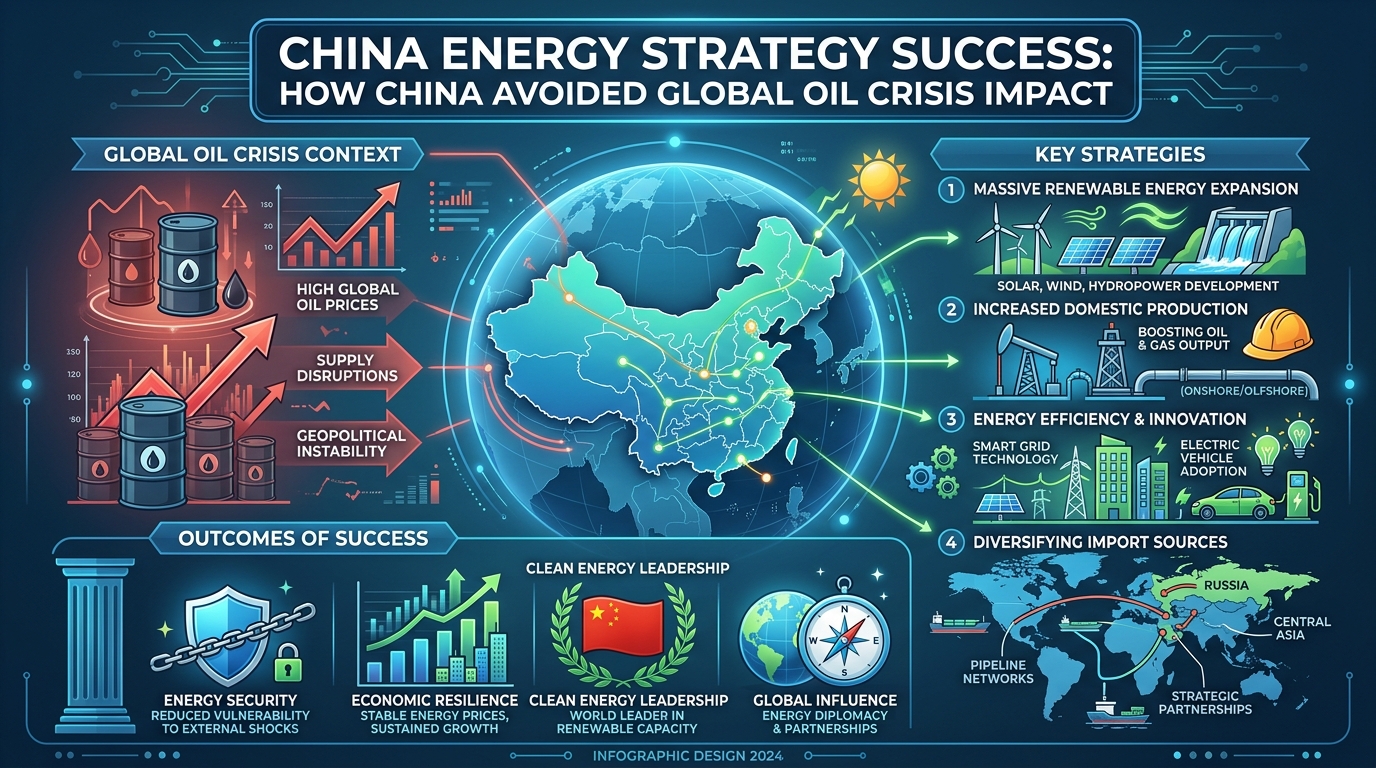
China Energy Strategy Success: How China Avoided Global Oil Crisis Impact
Table of Contents
The China Energy Strategy Success story highlights how China managed to avoid the worst effects of the global oil crisis triggered by tensions in West Asia. Through long-term planning such as Strategic Petroleum Reserves (SPR), diversification of energy sources, promotion of electric vehicles (EVs), and strong geopolitical strategies, China has built a resilient energy system.
Why in the News?
- The ongoing conflict involving Israel, United States, and Iran has disrupted global energy supply chains and created uncertainty in oil markets.
- This region is extremely important because a large portion of the world’s oil passes through it, especially via the Strait of Hormuz.
- India has experienced shortages of LPG (Liquified Petroleum Gas) and public panic regarding the availability of petrol and diesel, which reflects the vulnerability of energy-importing countries.
- In contrast, China has not experienced similar immediate disruptions despite having a larger economy, higher energy demand, and a bigger consumer base.
- This situation highlights the importance of energy security, strategic planning, and diversification policies.
What are the Key Highlights?
Strategic Petroleum Reserves (SPR): China’s Energy Safety Net
- China has built large Strategic Petroleum Reserves (SPR) over the past two decades as part of its long-term energy security strategy.
- SPR refers to emergency stockpiles of crude oil that a country stores to use during supply disruptions or geopolitical crises.
- China currently has reserves sufficient for around 120 days of consumption, which provides a strong buffer against short-term shocks.
- This means that even if imports stop suddenly, China can continue functioning for several months.
- Key features of China’s SPR strategy include:
- Government-controlled storage facilities across different regions.
- Gradual filling of reserves during periods of low global oil prices.
- Integration with national oil companies for efficient management.
- Example:
- During global oil price drops, China increased imports and stored excess oil, turning a crisis into an opportunity.
Tackling the Malacca Dilemma
- The Malacca Dilemma refers to China’s heavy dependence on the Strait of Malacca for oil and trade.
- Nearly 80% of China’s oil imports once passed through this narrow sea route, making it vulnerable to blockades or military control.
- China adopted a multi-pronged strategy to reduce this risk:
- Development of alternative routes:
- China built pipelines from Central Asia and Russia to import oil and gas directly through land routes.
- Around 20% of China’s crude oil imports now come through pipelines, reducing reliance on sea routes.
- Strengthening diplomatic ties:
- China developed strong relations with Central Asian countries like Kazakhstan and Turkmenistan.
- Stable political relations ensured uninterrupted energy supply.
- Infrastructure expansion under Belt and Road Initiative (BRI):
- China invested in ports, pipelines, and transport corridors across Asia and Africa.
- This helped in creating multiple supply channels, reducing vulnerability.
- Development of alternative routes:
Diversification of China Energy Strategy
- China has diversified its energy imports across different regions to avoid dependence on a single supplier.
- It imports oil from:
- Russia
- Central Asia
- Africa (Sudan, Angola)
- Middle East
- It imports oil from:
- Role of national oil companies:
- Sinopec focuses on refining and petrochemicals.
- CNPC (China National Petroleum Corporation) handles exploration and production.
- CNOOC (China National Offshore Oil Corporation) focuses on offshore oil resources.
- These companies:
- Invest in foreign oil fields.
- Sign long-term supply contracts.
- Operate in politically unstable regions to secure resources.
- Example:
- China invested in oil projects in Africa where Western companies were hesitant due to instability.
Comparison with India’s Pipeline Challenges
- India attempted to build regional pipelines such as:
- IPI (Iran-Pakistan-India) pipeline
- TAPI (Turkmenistan-Afghanistan-Pakistan-India) pipeline
- However, these projects failed due to:
- Security concerns in regions like Afghanistan.
- Political tensions between India and Pakistan.
- Diplomatic and financial challenges.
- In contrast, China successfully built pipelines due to:
- Strong state control and funding.
- Better diplomatic coordination.
- Willingness to operate in risky regions.
Climate and Energy Transition Strategy
- China initially joined developing countries like India, Brazil, and South Africa in the BASIC bloc to protect their development rights.
- Carbon space means the allowable emissions a country can use for economic growth.
- However, China later shifted strategy and became a leader in clean energy:
- It entered into the US-China Energy Cooperation Framework (2008).
- It actively contributed to the Paris Climate Agreement.
- As a result, China developed strong industries in:
- Solar panel manufacturing (China is the world leader).
- Wind energy production.
- Electric mobility (cars, buses, batteries).
- Carbon capture and storage technologies.
- This strategy helped China:
- Reduce dependence on fossil fuels.
- Become a global exporter of clean technologies.
Role of Electric Vehicles (EVs) in Reducing Oil Demand
- China is the largest market for electric vehicles (EVs) in the world.
- In 2025, nearly 50% of new cars sold were electric vehicles.
- Government policies promoting EVs include:
- Tax exemptions and subsidies.
- Restrictions on petrol/diesel vehicles in major cities.
- Easier registration for EVs compared to traditional vehicles.
- Impact on energy demand:
- EVs reduce the need for petrol and diesel.
- This directly lowers oil imports.
- Example:
- Large-scale use of electric buses in cities like Beijing reduces fuel consumption significantly.
Addressing Air Pollution and Coal Dependency
- China has faced severe air pollution problems, especially in cities like Beijing.
- It is also the largest consumer of coal, which contributes to pollution.
- Government measures include:
- Setting time-bound pollution reduction targets.
- Closing inefficient coal plants.
- Promoting cleaner alternatives like natural gas and renewables.
- These measures have dual benefits:
- Improve public health.
- Reduce fossil fuel dependency.
Impact of Economic Slowdown
- China’s economic growth has slowed to around 4.5% for 2026, which is lower than earlier decades.
- Key sectors affected:
- Construction
- Steel
- Cement
- This slowdown has reduced energy demand because:
- Less construction means less fuel use.
- Reduced industrial activity lowers energy consumption.
- This indirectly helps China during energy crises by:
- Lowering import needs
- Reducing pressure on supply chains

What are the Significance?
Strategic Energy Planning
- China’s long-term planning shows that energy security is not achieved overnight but through continuous efforts.
- Countries that invest in reserves and infrastructure can better handle crises.
Diversification of Strategy
- Diversification reduces dependence on a single route or supplier.
- It ensures that disruption in one region does not affect the entire economy.
Infrastructure Development
- Pipelines, storage facilities, and transport networks provide control over supply chains.
- They reduce vulnerability to external shocks.
Energy Transition
- Investment in renewables reduces dependence on imported fossil fuels.
- It also supports climate goals and sustainable development.
Industrial Policy
- China used energy policies to build global leadership in industries like EVs and solar panels.
- This shows how economic growth and energy security can be aligned.
Geopolitical Strategy
- Strong diplomatic relations ensure stable energy supplies.
- Energy security is closely linked to foreign policy.
Significance for India
- India can learn from China’s experience by:
- Expanding Strategic Petroleum Reserves.
- Promoting EV adoption.
- Diversifying import sources.
What are the Challenges?
Overdependence on Coal
- China still relies heavily on coal for energy.
- This creates environmental and sustainability challenges.
Environmental Degradation
- China remains the largest global polluter, contributing to climate change.
Geopolitical Risks
- Dependence on countries like Russia may create strategic vulnerabilities.
Economic Slowdown
- Slower growth may reduce investment capacity for future energy projects.
High Infrastructure Costs
- Building pipelines, reserves, and EV infrastructure requires massive investment.
Technological Challenges
- Transition to clean energy requires advanced technology and innovation.
Way Forward
Accelerating Renewable Energy Transition
- China should continue expanding solar, wind, and other clean energy sources.
Reducing Coal Usage
- Gradual reduction of coal dependence is necessary for sustainability.
Strengthening Energy Diplomacy
- Expanding partnerships with multiple countries can reduce risks.
Promoting Innovation
- Investment in hydrogen energy, battery storage, and smart grids is essential.
Enhancing Domestic Efficiency
- Improving energy efficiency can reduce overall consumption.
Lessons for India
- India should:
- Build stronger energy reserves.
- Invest in EV infrastructure.
- Improve regional cooperation for pipelines.
Conclusion
China’s response to the current energy crisis demonstrates the importance of foresight, strategic investment, and policy coordination. A country that plans for long-term resilience, diversifies its resources, and adopts new technologies is better positioned to manage global uncertainties and ensure stable growth in an increasingly unpredictable world.
Relevant Articles:
WTO Crisis: Trade Multilateralism Faces Serious Breakdown
Plastic Waste Management Rules 2026: Weakening EPR Enforcement Raises Environmental Concerns
Read Also:
Nuclear Energy Expansion in India: SHANTI Act 2025 and India’s 100 GW Nuclear Energy Push
FCRA Amendment Bill 2026 Controversy: Rising Concerns Over NGO Control in India
Memorandum of Understanding between Ministry of Power …
