
Continental Drift Theory: A Complete Guide for UPSC Aspirants
Introduction
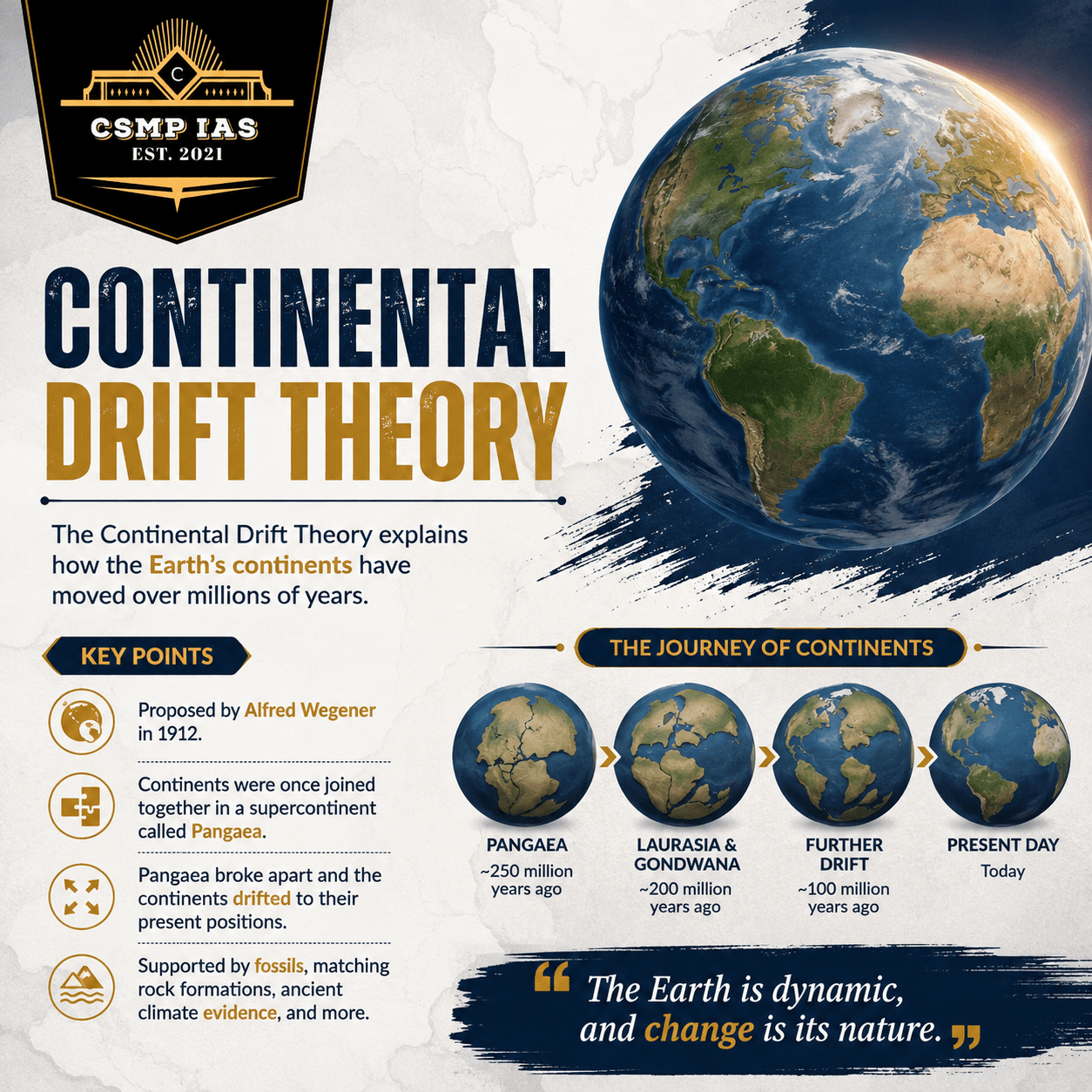
Few ideas in the history of science have travelled as rocky a road as the Continental Drift Theory. Proposed in 1912 by German meteorologist and geophysicist Alfred Wegener, it suggested that continents were not fixed in place but had drifted apart over millions of years from a single landmass. Ridiculed for decades, the theory was eventually vindicated and became the foundation of modern Plate Tectonics.
For UPSC Civil Services aspirants, Continental Drift Theory is a recurring topic in GS Paper I (Geography) and often appears in the Prelims as a factual/conceptual question and in Mains as part of "geomorphic processes" or "distribution of landforms and their relation to geological structures." This post breaks the theory down in an exam-oriented, easy-to-revise format.
1. Background: Why Was a New Theory Needed?
Before Wegener, most geologists believed in permanence theory — the idea that continents and ocean basins were fixed and permanent features of the Earth's crust. However, certain observations didn't fit this model:
Similar fossil species found on continents separated by vast oceans
Matching rock formations across distant coastlines
The jigsaw-like fit between the coastlines of South America and Africa
These anomalies demanded an explanation, which Wegener attempted to provide.
2. Wegener's Continental Drift Theory: Core Idea
Wegener proposed that:
All continents were once joined together in a single supercontinent called Pangaea ("all lands"), surrounded by a single vast ocean called Panthalassa.
Around 200 million years ago, Pangaea began to break apart.
The fragments — the present-day continents — drifted slowly across the Earth's surface to their current positions, a process still continuing today.
Stages of Break-up (Important for Mains diagrams)
Stage Event Pangaea Single supercontinent, surrounded by Panthalassa Laurasia & Gondwanaland Pangaea split into a northern block (Laurasia) and a southern block (Gondwanaland), separated by the Tethys Sea Further fragmentation Laurasia broke into North America, Europe, and Asia; Gondwanaland broke into South America, Africa, India, Australia, and Antarctica
3. Evidence Presented by Wegener
This is a high-yield section for Prelims — evidence-based questions are common.
a) Jigsaw Fit of Continents
The coastlines of South America and Africa fit together almost like puzzle pieces, especially along the continental shelf margins rather than the present-day coastline.
b) Fossil Evidence
Mesosaurus (a freshwater reptile) fossils found in both Brazil and South Africa — it could not have swum across the Atlantic.
Glossopteris (a fern) fossils found across South America, Africa, India, Australia, and Antarctica — regions now widely separated but climatically similar only if once joined.
c) Rock and Mountain Correlation
Rock strata of the same age and type found on matching coastlines of Africa and South America.
The Appalachian Mountains (North America) align geologically with the Caledonian Mountains (Scotland/Scandinavia).
d) Evidence from Paleoclimate
Evidence of glaciation (tillite deposits) in present-day tropical regions like India, Africa, and South America suggests these landmasses were once located near the polar regions.
Coal deposits (formed in tropical/humid conditions) found in present-day cold regions like Antarctica indicate those regions once lay closer to the equator.
4. Forces Behind the Drift: Wegener's (Flawed) Mechanism
Wegener proposed two forces to explain the movement of continents:
Pole-fleeing force (Polflucht force): Due to the Earth's rotation, continents were said to move away from the poles toward the equator.
Tidal force: Gravitational pull of the sun and moon was said to cause a westward drift of continents.
This is the theory's biggest weakness — these forces were mathematically shown (by physicist Harold Jeffreys) to be far too weak to move massive continental landmasses through solid oceanic crust. This became the primary reason for the theory's rejection at the time.
5. Why the Theory Was Initially Rejected
Inadequate and physically impossible driving forces
No plausible mechanism for continents to "plough through" the rigid ocean floor
Lack of technology (like sonar, paleomagnetism) to verify claims at the time
Wegener was not a geologist by training, which made the geological community skeptical
Wegener died in 1930 during a Greenland expedition, without seeing his theory vindicated.
6. Revival: From Continental Drift to Plate Tectonics
The theory was revived in the mid-20th century due to advances in ocean floor mapping and geophysics:
Paleomagnetism studies (1950s) showed that magnetic minerals in rocks pointed to different pole positions over time, proving continents had indeed moved.
Harry Hess's Seafloor Spreading theory (1960s) provided the missing mechanism — new oceanic crust forms at mid-ocean ridges and spreads outward, pushing continents along with it.
This evolved into the modern Theory of Plate Tectonics, which explains that the Earth's lithosphere is broken into rigid plates that move due to mantle convection currents, not the weak forces Wegener proposed.
Exam tip: Continental Drift Theory is often asked in comparison with Plate Tectonic Theory — remember that Plate Tectonics subsumes and corrects Wegener's original idea by providing a scientifically valid driving mechanism.
7. Significance for UPSC Preparation
Prelims: Expect factual questions on Pangaea, Gondwanaland, Laurasia, evidence (Mesosaurus, Glossopteris), and the scientists associated with the theory.
Mains (GS I): Can be linked to:
Distribution of major landforms
Volcanism and earthquake distribution (Ring of Fire)
Formation of fold mountains (Himalayas, Alps)
India's drift from Gondwanaland and its impact on the Deccan Plateau and Himalayan formation
Answer-writing tip: Always support your answer with a simple labelled diagram of Pangaea splitting into Laurasia and Gondwanaland — diagrams fetch extra marks in geography answers.
8. Quick Revision Table
Aspect Details Proposed by Alfred Wegener (1912) Supercontinent Pangaea Surrounding ocean Panthalassa Two major blocks Laurasia (north), Gondwanaland (south) Separating sea Tethys Sea Key evidence Jigsaw fit, Mesosaurus & Glossopteris fossils, rock correlation, glacial/coal deposits Proposed forces Pole-fleeing force, Tidal force Main criticism Insufficient force to move continents Successor theory Plate Tectonics (via Seafloor Spreading)
Conclusion
Continental Drift Theory represents a classic example in the history of science of an idea being right in its conclusion but wrong in its mechanism. For UPSC aspirants, mastering this topic isn't just about memorizing facts — it's about understanding how scientific theories evolve with new evidence, a theme that connects geography with broader themes of reasoning tested throughout the UPSC syllabus. Pair this topic with Plate Tectonics and Seafloor Spreading for a complete, exam-ready understanding of Earth's structural geography.