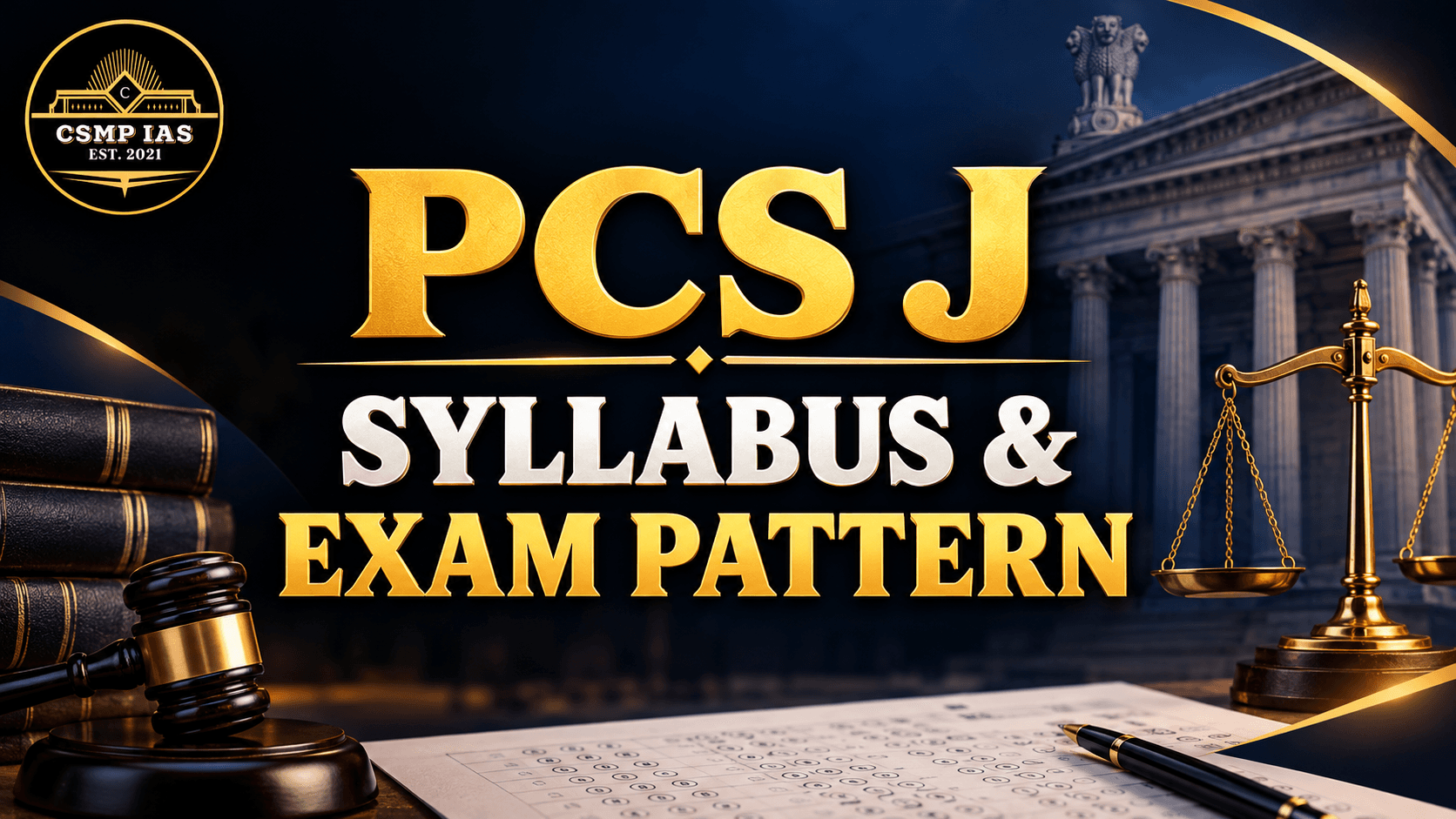
UP PCS J Syllabus 2026: Exam Pattern, Prelims and Mains Syllabus
The UP PCS J exam selects Civil Judges (Junior Division) in Uttar Pradesh. It is conducted by the Uttar Pradesh Public Service Commission (UPPSC). It is a law-focused exam, which sets it apart from the general UP PCS administrative exam. This post covers the exam type, stage-wise pattern and syllabus.
1. Exam Overview
Detail | Information |
|---|---|
Conducting body | Uttar Pradesh Public Service Commission (UPPSC) |
Post | Civil Judge (Junior Division) |
Stages | Prelims, Mains, Interview |
Prelims type | Objective (MCQ), screening only |
Mains type | Descriptive (written) |
Interview | 100 marks |
Educational qualification | Law degree (LL.B.) and enrollment as an advocate, as per the notification |
The exam is a three-stage process: Prelims, Mains and Interview. Final selection is based on Mains marks plus Interview marks. Prelims marks are not counted in the final merit. They only decide who gets to write Mains.
2. Stage-wise Exam Pattern at a Glance
Stage | Papers | Total Marks | Nature |
|---|---|---|---|
Prelims | 2 | 450 | Objective, qualifying |
Mains | 6 | 1000 | Descriptive |
Interview | 1 | 100 | Personality test |
Final merit | Mains + Interview | 1100 |
3. Prelims Exam
Pattern
Paper | Subject | Marks |
|---|---|---|
Paper I | General Knowledge | 150 |
Paper II | Law | 300 |
Total | 450 |
Prelims covers General Knowledge and law subjects such as the Constitution, IPC, CPC, CrPC and the Evidence Act, with objective questions.
Paper I: General Knowledge syllabus
Indian history and the national movement
Indian and world geography
Indian polity and governance
Economy and basic economic concepts
General science and everyday technology
Current affairs (national and international)
Uttar Pradesh: history, culture, geography, administration
Sports, awards, books and important days
Paper II: Law syllabus
Area | Key Topics |
|---|---|
Constitutional law | Fundamental Rights, DPSP, Fundamental Duties, Union and State powers, Judiciary, Emergency provisions, Amendments |
Criminal law | Penal law (IPC and the new BNS), Criminal Procedure (CrPC and the new BNSS) |
Civil law | Civil Procedure Code, Limitation Act, Specific Relief Act |
Evidence | Indian Evidence Act and the new Bharatiya Sakshya Adhiniyam |
Contract and commercial law | Contract Act, Sale of Goods Act, Partnership Act, Negotiable Instruments Act |
Property law | Transfer of Property Act, Easements Act |
Personal laws | Hindu law, Muslim law |
Others | Law of Torts, Jurisprudence, Public interest topics |
Tip: Questions on the new criminal laws (BNS, BNSS, BSA) are now a priority. Read the current notification to see how the commission treats old and new codes.
4. Mains Exam
The Mains exam is descriptive and carries 1000 marks across six papers.
Paper | Subject | Marks |
|---|---|---|
Paper I | General Knowledge | 200 |
Paper II | English Language | 100 |
Paper III | Hindi Language | 100 |
Paper IV | Law-I (Substantive Law) | 200 |
Paper V | Law-II (Procedure and Evidence) | 200 |
Paper VI | Law-III (Penal, Revenue and Local Laws) | 200 |
Total | 1000 |
Mains syllabus, paper by paper
Paper I: General Knowledge (200)
Same broad areas as Prelims, but expect descriptive answers. Focus on current affairs, constitutional and social issues, and UP-specific topics.
Paper II: English (100)
Essay writing, précis, comprehension, grammar and translation.
Paper III: Hindi (100)
निबंध, सारांश लेखन, अनुवाद, पत्र/आवेदन लेखन और व्याकरण।
Paper IV: Law-I (Substantive Law)
Constitution of India
Law of Contract and Sale of Goods
Partnership and Negotiable Instruments
Specific Relief
Law of Torts
Hindu law and Muslim law
Transfer of Property and Easements
Paper V: Law-II (Procedure and Evidence)
Code of Civil Procedure
Code of Criminal Procedure / BNSS
Law of Evidence / BSA
Limitation Act
Related procedural statutes (court fees, stamp, registration)
Paper VI: Law-III (Penal, Revenue and Local Laws)
Indian Penal Code / Bharatiya Nyaya Sanhita
UP revenue laws (land revenue and tenancy)
UP local laws (such as rent control and urban building laws)
Note: Treat the exact list of Acts in Papers IV to VI as indicative. Always match it against the current official UPPSC notification, since the commission can add, remove or replace statutes.
5. Interview (100 Marks)
The Interview tests:
Legal knowledge and clarity of concepts
Judicial temperament and ethics
Communication and decision-making
Awareness of current legal developments
Your final rank is based on Mains plus Interview marks.
6. Prelims vs Mains Compared
Feature | Prelims | Mains |
|---|---|---|
Type | Objective MCQs | Descriptive |
Marks | 450 | 1000 |
Counts in final merit | No | Yes |
Focus | Factual recall, speed | Depth, application, writing |
Language papers | None | English and Hindi |
Prep approach | Read widely, practice MCQs | Write answers daily |
7. Preparation Strategy
Start with the Bare Acts. Both papers are heavily Act-based. Read sections, not just notes.
Treat the three new criminal laws seriously. Prepare BNS, BNSS and BSA alongside the older codes until the notification clarifies.
Solve previous year papers. They reveal repeat topics and the commission’s style.
Practice answer writing from day one. Do not wait for Prelims to end.
Do not skip the language papers. English and Hindi carry 200 marks together and are often neglected.
Follow current affairs and UP-specific GK every day for 20 to 30 minutes.
Take regular mock tests for Prelims and timed answer-writing for Mains.
8. Conclusion
UP PCS J rewards candidates who combine strong legal fundamentals with consistent writing practice. Prelims is a filter, but the Mains and Interview decide your rank, so build your preparation around Mains from the beginning.
Important: Exam dates and notification details for 2026 were still marked “to be announced” on most sources I checked. Exam patterns and syllabi can also change between cycles. Verify marks, negative marking and the Act list on the official UPPSC website (uppsc.up.nic.in) before you finalize your plan.