
CSMP IAS : India's Premier Coaching Institute for IAS / PCS
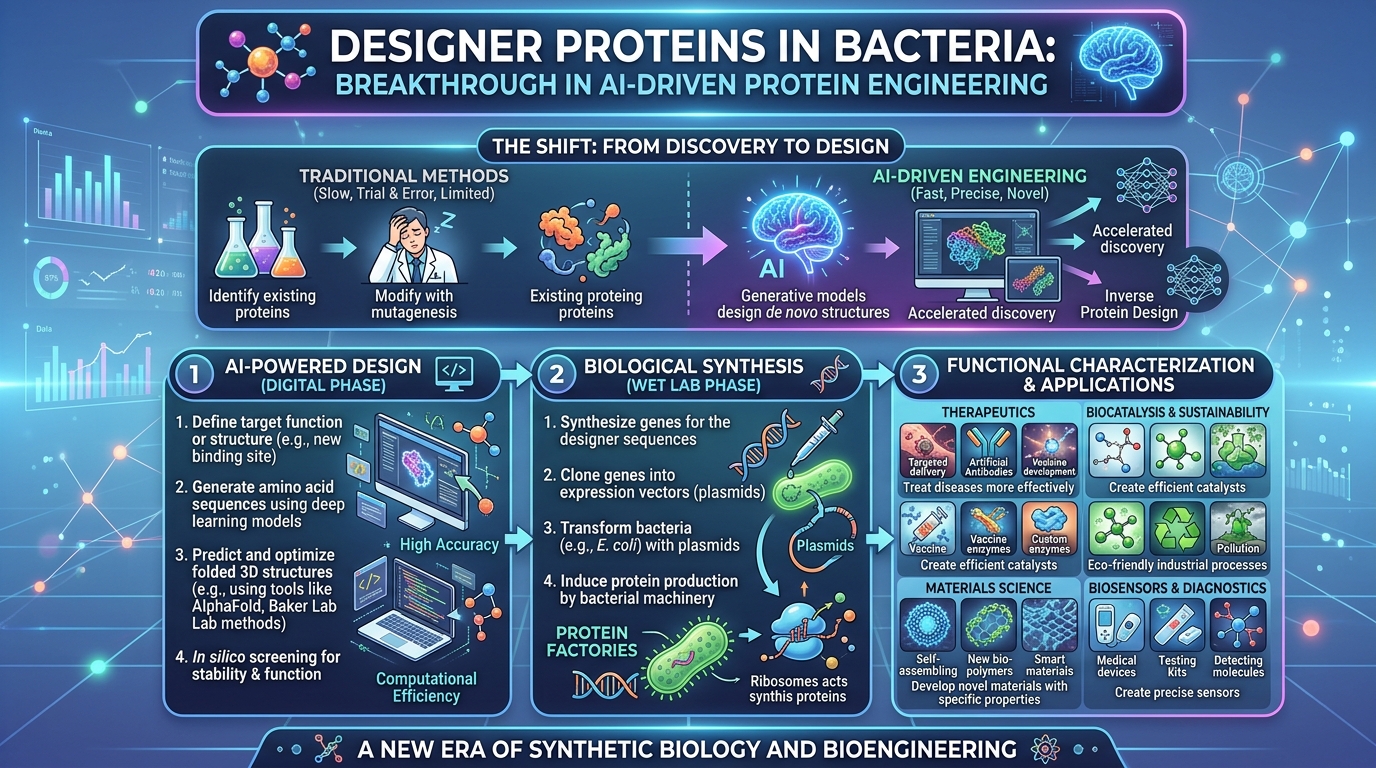
Designer Proteins in Bacteria: Breakthrough in AI-Driven Protein Engineering
Table of Contents
Scientists have developed a groundbreaking method to engineer bacteria to produce designer proteins using artificial amino acids. This innovative approach leverages a bacterial transporter as a “Trojan horse,” allowing artificial amino acids to enter cells efficiently. By enabling precise insertion of multiple artificial amino acids, this discovery opens new avenues for advanced protein engineering, targeted medicines, and biotechnology tools. The breakthrough in designer proteins showcases how understanding cellular transport mechanisms can revolutionize synthetic biology and medical research.
Why in the News?
- A new scientific study has discovered a method to use bacteria to produce special proteins containing artificial amino acids.
- The research was carried out by scientists from ETH Zurich (Switzerland) and Technical University of Munich (Germany).
- The findings were published in the scientific journal Nature.
- The study explains how scientists turned a bacterial nutrient gate into a “Trojan horse” to carry artificial amino acids inside bacterial cells.
- This discovery could help scientists make designer proteins for medicines and biotechnology.
What are the Key Highlights?
- Proteins and Amino Acids
- Proteins are essential molecules in all living organisms.
- They perform many functions such as building tissues, carrying signals, and supporting chemical reactions.
- All natural proteins are made from 20 natural amino acids.
- Artificial Amino Acids
- Scientists can create thousands of artificial amino acids in laboratories.
- These artificial amino acids can have new chemical properties.
- Example:
- An artificial amino acid called p-azido-L-phenylalanine can allow scientists to attach a drug to a protein at a specific position.
- Problem Faced by Scientists
- Cells normally use only natural amino acids.
- Artificial amino acids find it difficult to enter the cell.
- The cell membrane blocks them because:
- Artificial amino acids are water-loving.
- The membrane interior is water-repelling.
- Earlier Methods to Solve the Problem
- Scientists tried three main approaches:
- High concentration method
- Large amounts of artificial amino acids were added to the culture medium.
- Some molecules slowly entered the cell by passive diffusion.
- Peptide smuggling method
- Scientists engineered membrane proteins to carry small peptides across the membrane.
- Once inside, enzymes broke peptides into amino acids.
- Internal production method
- Scientists engineered metabolic pathways in cells.
- The cell produced artificial amino acids internally.
- However, these methods worked only for certain amino acids and were not universal.
- New Discovery: Transporter as a Trojan Horse
- Scientists discovered that bacteria use a specific transporter molecule to import small peptides as nutrients.
- This transporter normally carries small fragments of proteins into the cell.
- Engineering the Transporter
- Researchers engineered an ABC transporter, a membrane protein that imports molecules into the cell.
- The transporter was modified using directed evolution, a method where scientists repeatedly mutate and select better versions.
- How the System Works
- Scientists attached an artificial amino acid to short peptides.
- The peptide had:
- Natural amino acids on the sides
- Artificial amino acid hidden in the middle.
- The transporter carried the peptide into the cell.
- Inside the cell:
- Enzymes cut the peptide.
- The artificial amino acid was released.
- The cell’s ribosome then used this artificial amino acid to make proteins.
- Experiment in Bacteria
- The method was tested in the bacterium Escherichia coli.
- Scientists modified parts of the transporter that hold the cargo.
- Mutated versions could import 10 times more artificial amino acids than the normal transporter.
- This efficiency was twice as high as previous methods.
- Improving the System
- Natural peptides already exist in lab culture media.
- These peptides compete with artificial ones for the transporter.
- Scientists solved this by:
- Repeatedly selecting bacteria that imported artificial peptides best.
- Gradually improving the transporter.
- The final system worked even in crowded conditions.
- Multiple Artificial Amino Acids
- The researchers showed that two different artificial amino acids can be inserted into one protein.
- This allows a protein to have two engineered features at different positions.
- Future Research
- Scientists are now trying to design a similar system in human cells.
- The goal is to produce human-like artificial proteins for medical treatment.
What are the Significance?
Designer Proteins for Medicine
- Scientists can create proteins with special functions.
- Example:
- An antibody carrying a drug molecule at a precise location.
- This can improve targeted therapies for diseases.
Development of Advanced Biotech Tools
- Artificial amino acids allow proteins to gain new chemical abilities.
- These proteins can act as:
- Sensors
- Drug carriers
- Molecular tools for research.
More Efficient Protein Engineering
- The engineered transporter increases the amount of artificial amino acids entering cells.
- This makes production of modified proteins simpler and more reliable.
Production of Multifunctional Proteins
- The system can insert multiple artificial amino acids in one protein.
- This allows the creation of multifunctional proteins with different engineered features.
Expanding Synthetic Biology
- The discovery strengthens the field of synthetic biology.
- Scientists can design biological systems to produce new molecules not found in nature.
Potential Applications in Human Cells
- If the system works in human cells:
- It may help create new therapeutic proteins.
- It may enable advanced drug delivery systems.
Challenges
Difficulty in Transporting Artificial Molecules
- Artificial amino acids do not easily cross the cell membrane.
- Even with engineered transporters, efficiency may vary.
Competition with Natural Peptides
- Culture media already contains many natural peptides.
- These peptides compete for the same transporter system.
Limited Use in Other Organisms
- The method currently works mainly in bacteria like Escherichia coli.
- It may not easily work in complex organisms or human cells.
Technical Complexity
- Engineering transporters and metabolic systems requires advanced biotechnology tools.
- This can make the process expensive and technically difficult.
Biosafety Concerns
- Creating organisms that produce artificial molecules may raise:
- Environmental concerns
- Biosafety issues.
Way Forward
Improving Transport Efficiency
- Scientists should continue improving engineered transporters.
- This can allow more artificial molecules to enter cells.
Expanding to Human Cells
- Research should focus on adapting the system for human cells.
- This will allow development of therapeutic proteins for medicine.
Better Laboratory Media Design
- Scientists can design culture media that reduce competition from natural peptides.
- This will improve uptake of artificial amino acids.
Developing Universal Systems
- Researchers should create general methods that work for many artificial amino acids.
- This will expand applications across biotechnology.
Strengthening Biosafety Frameworks
- Clear regulations and monitoring are needed to ensure:
- Safe use of engineered organisms
- Responsible biotechnology research.
Conclusion
The new research demonstrates how understanding natural cellular systems can allow scientists to redesign biological processes for innovative purposes. By creatively modifying molecular transport systems in bacteria, researchers have opened new possibilities for building complex biological molecules with novel functions. Such developments may transform biotechnology and medicine by enabling precise control over the structure and capabilities of proteins.
Relevant Articles:
Empowering Women in AI Learning in India: Closing the Digital Gender Gap
Musi Riverfront Development in Hyderabad: Urban Renewal Amid Controversy
IRIS Dena Incident and The Shaping of AI Geopolitics
Read Also:
West Asia Crisis 2026: Iran-Israel-US Conflict and Strategic Implications for India
Project Cheetah in India: Successful Reintroduction and Wildlife Conservation
Affordable Cancer Medicines in India: Customs Duty Exemption Reduces Treatment Costs
Designing proteins | National Institutes of Health (NIH)