
CSMP IAS : India's Premier Coaching Institute for IAS / PCS
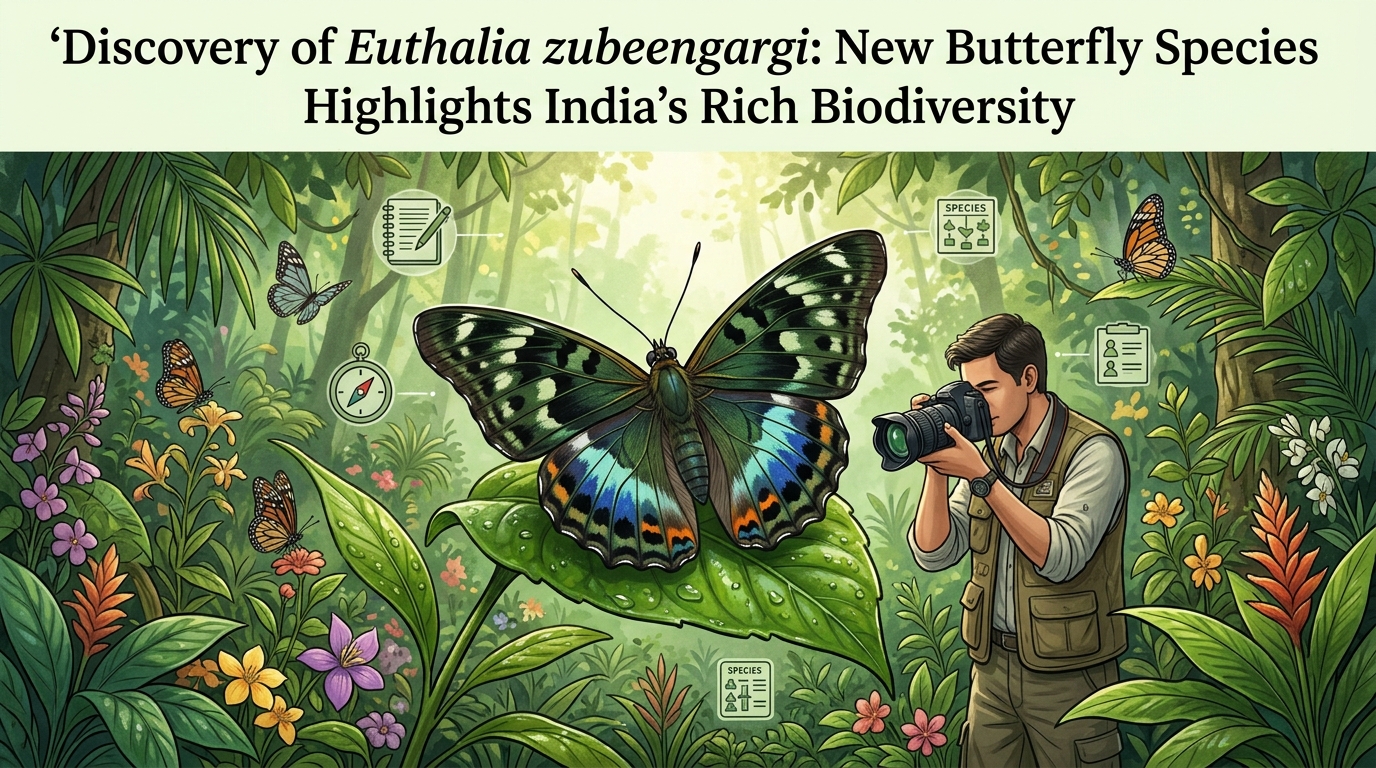
Discovery of Euthalia Zubeengargi: New Butterfly Species Highlights India’s Rich Biodiversity
Table of Contents
The discovery of Euthalia zubeengargi, a new butterfly species in Arunachal Pradesh, highlights India’s rich biodiversity and the ecological importance of Northeast India. Named after cultural icon Zubeen Garg, this finding not only adds to scientific knowledge but also connects biodiversity conservation with cultural recognition.
Why in the News?
- A new species of butterfly has been discovered in the forests of Arunachal Pradesh, which is a biodiversity-rich region in Northeast India.
- This discovery has gained attention because new species discoveries are becoming rare and scientifically important in modern times.
- The species has been named Euthalia zubeengargi to honor Zubeen Garg, who is a well-known cultural icon of Assam.
- He is famous for his contributions to music, cinema, and regional culture in Northeast India.
- The naming became sensitive because the artist passed away recently.
- This led to emotional reactions among fans and brought wider public attention to the discovery.
- The event highlights the intersection of science, culture, and society.
- It shows how scientific naming can sometimes carry emotional and social meanings beyond biology.
What are the Key Highlights Related to Euthalia Zubeengargi?
Researchers Involved
- The discovery was made by Roshni Upadhyaya from RIMT University.
- She is a scholar involved in biological and environmental research.
- The co-researcher was Kalesh Sadasivan from Travancore Natural History Society.
- This organization works on wildlife research and conservation in India.
- Their collaboration shows how academic institutions and conservation groups can work together.
- Such collaborations are important for field-based discoveries.
Scientific Naming
- The butterfly has been scientifically named Euthalia zubeengargi.
- Scientific names follow the binomial nomenclature system, which uses two names: genus and species.
- The genus is Euthalia.
- This genus belongs to a group of butterflies commonly found in tropical regions.
- Species naming often honors individuals.
- In this case, the name recognizes cultural contribution rather than scientific work.
- Naming rules are governed by international standards.
- These are maintained by the International Code of Zoological Nomenclature.
Habitat and Location of Euthalia Zubeengargi
- The butterfly was found in semi-evergreen forests.
- These forests remain green throughout most of the year.
- The altitude of discovery was between 600 and 750 meters.
- This indicates that the species prefers mid-elevation habitats.
- Such habitats are common in Northeast India.
- They support rich biodiversity due to favorable climate and rainfall.
Physical Features of Euthalia Zubeengargi
- The butterfly has earthy brown wings.
- This helps it blend into forest surroundings.
- It has pale spots on its wings.
- These markings are useful for identification.
- Camouflage is an important survival strategy.
- It helps butterflies avoid predators.
Observation Details
- Only two male individuals were recorded.
- This suggests that the species may be rare or difficult to observe.
- One specimen was collected.
- Specimens are used for scientific study and classification.
- Another was photographed in the wild.
- Photography helps in documentation without harming the organism.
- Limited observation creates challenges for further research.
- Scientists need more data to understand behavior and population.
Scientific Publication
- The discovery was published in the journal Entomon.
- This is a quarterly journal focused on insect studies.
- The journal is published by the Association for Advancement of Entomology.
- It is a recognized platform for scientific communication.
- Publication ensures that the discovery is officially recorded.
- It allows other scientists to review and build upon the findings.
What are the Significance of Euthalia Zubeengargi?
Biodiversity Discovery
- The discovery highlights the richness of biodiversity in Northeast India.
- Regions like Arunachal Pradesh are considered biodiversity hotspots.
- Biodiversity means the variety of life forms in an area.
- It includes plants, animals, and microorganisms.
- Discovering new species helps in understanding ecosystems.
- It shows how different species interact with each other.
- It also indicates that many species are still undiscovered.
- This makes scientific exploration important.
Conservation Importance
- Rare species need protection to survive.
- Limited population makes them vulnerable to extinction.
- Forest ecosystems must be preserved.
- Deforestation can destroy habitats.
- Conservation helps maintain ecological balance.
- Each species plays a role in the ecosystem.
- For example, butterflies help in pollination.
- This supports plant reproduction and biodiversity.
Cultural Recognition
- Naming the species after Zubeen Garg connects science with society.
- It brings public attention to scientific discoveries.
- Cultural recognition increases awareness.
- People feel more connected to biodiversity.
- It also honors contributions beyond science.
- It shows respect for cultural icons.
- This approach can inspire interest in conservation.
- Public engagement is important for environmental protection.
Scientific Contribution
- The research adds to the field of Entomology.
- Entomology studies insects and their role in ecosystems.
- It improves classification systems.
- Scientists can better understand relationships between species.
- It contributes to evolutionary studies.
- It helps trace how species have evolved over time.
- Such discoveries also support ecological research.
- They help understand habitat requirements and adaptations.
Challenges Associated with Euthalia Zubeengargi
Limited Observation
- Only two individuals were found.
- This makes it difficult to estimate population size.
- Behavioral patterns are unknown.
- Scientists cannot study feeding or breeding habits properly.
- Lack of data limits scientific understanding.
- More observations are needed for accurate conclusions.
Habitat Threats
- Forest areas are under pressure from human activities.
- These include logging, agriculture, and infrastructure development.
- Climate change affects ecosystems.
- Changes in temperature and rainfall can impact species survival.
- Habitat fragmentation reduces living space.
- It isolates populations and reduces genetic diversity.
Lack of Awareness
- Local communities may not know about the species.
- This can lead to accidental harm.
- Awareness about biodiversity is often limited.
- People may not understand ecological importance.
- Education and outreach are necessary.
- They help build conservation support.
Scientific Limitations
- Research in remote areas is difficult.
- Accessibility issues make fieldwork challenging.
- Funding for biodiversity research is limited.
- This affects long-term studies.
- Lack of trained experts can slow progress.
- Specialized knowledge is required for taxonomy.
Way Forward
Detailed Research
- Scientists should conduct more field surveys.
- This will help locate more individuals.
- Long-term monitoring is required.
- It helps understand population trends.
- Use of modern tools like DNA analysis can help.
- It improves accuracy in classification.
Habitat Protection
- Forest conservation should be strengthened.
- Protected areas should be expanded.
- Community participation is important.
- Local people should be involved in conservation.
- Sustainable practices should be promoted.
- This reduces environmental damage.
Public Awareness
- Awareness campaigns should be conducted.
- These can be done through schools and media.
- Educational programs can increase knowledge.
- People should learn about biodiversity importance.
- Cultural connections can be used effectively.
- Naming species after known figures can attract attention.
Policy Support
- Government should create supportive policies.
- These should focus on biodiversity conservation.
- Legal protection should be provided to rare species.
- This prevents exploitation and harm.
- Funding for research should be increased.
- It supports scientific exploration and conservation efforts.
Use of Technology
- Remote sensing and GIS can help in habitat mapping.
- These tools provide accurate environmental data.
- Digital databases can store biodiversity information.
- This helps in research and policy-making.
- Citizen science can be encouraged.
- People can report sightings and contribute data.
Conclusion
The discovery of Euthalia zubeengargi reminds us that nature still holds many secrets waiting to be uncovered. It highlights the importance of combining science, culture, and conservation to protect our natural heritage. Continuous efforts in research, awareness, and policy support are essential to ensure that such rare and valuable species are preserved for the future.
Relevant Articles:
Controversial Transgender Rights Amendment Bill 2026 Raises Concerns Over Inclusion and Democracy
Controversial Transgender Rights Amendment Bill 2026 Raises Concerns Over Inclusion and Democracy
U.S. Forced Labour Probe Raises Concerns for Global Trade and India
Read Also:
India–Canada Relations Strengt
hen with Strategic Economic and Energy Partnership
Economic Stabilisation Fund Boosts India’s Crisis Preparedness and Fiscal Stability
New butterfly species recorded in Arunachal named after …