
CSMP IAS : India's Premier Coaching Institute for IAS / PCS
GDP Base Year Revision India 2022–23: New National Accounts Statistics and Economic Reassessment
Table of Contents
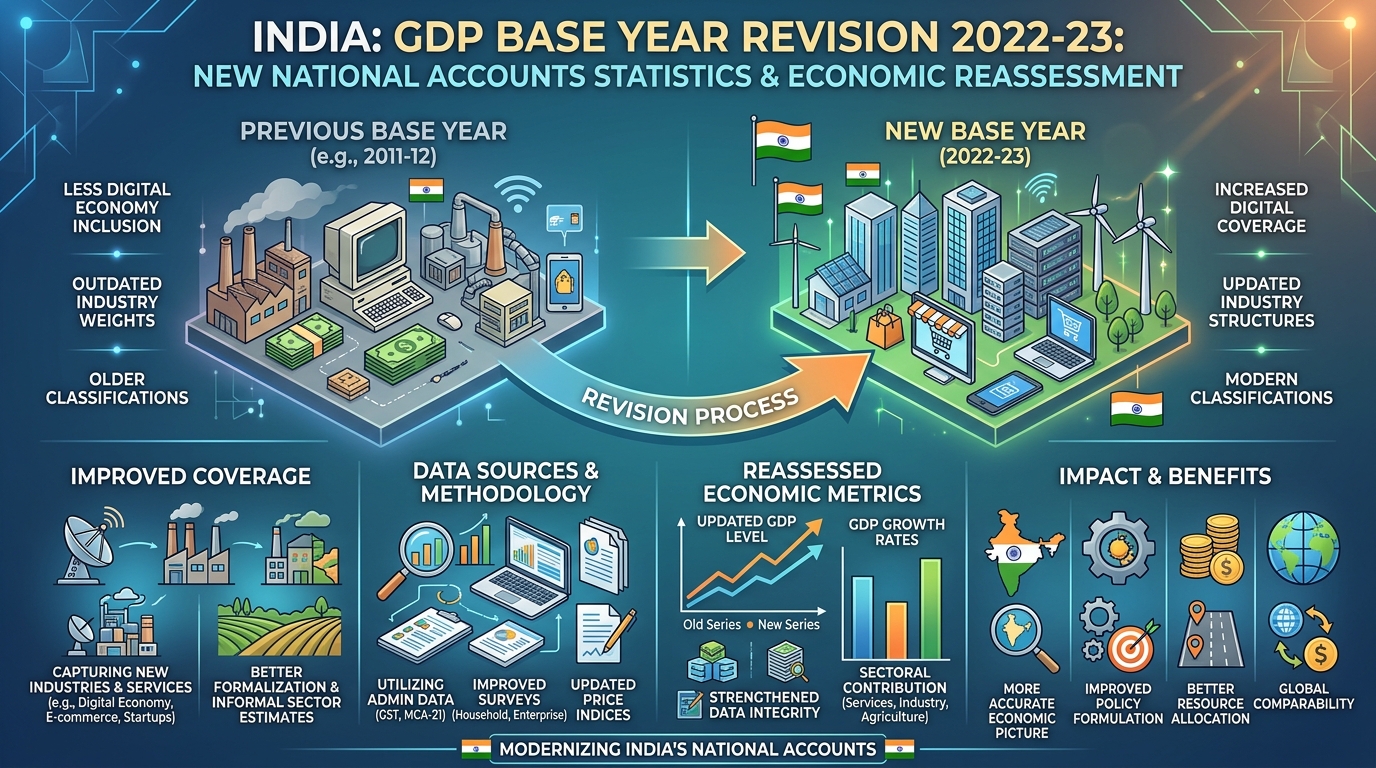
GDP Base Year Revision India 2022–23 has been released by the National Statistical Office under the National Accounts Statistics framework, updating India’s economic measurement system after 11 years. The revised GDP series reflects structural changes in the economy, improved data coverage, and recalibrated estimates of production, while raising debates on transparency and accuracy of earlier growth figures.
Why in the News?
- India has released a new series of Gross Domestic Product (GDP) estimates with 2022–23 as the base year.
- The revision was prepared by the National Statistical Office under the National Accounts Statistics framework.
- The previous GDP series had 2011–12 as the base year and was released in 2015.
- The revision has gained attention because:
- It came after 11 years.
- Earlier GDP estimates had faced serious criticism from economists and international institutions such as the International Monetary Fund.
What are the Key Highlights?
- Meaning of GDP
- Gross Domestic Product is the total value of all final goods and services produced in a country during a year.
- It is the most common measure of the size of an economy.
- Method of estimation
- GDP estimates are prepared using:
- Data on physical production
- Data on prices of goods and services
- These estimates follow the global framework of the UN System of National Accounts.
- GDP estimates are prepared using:
- Need for GDP base year revision
- The base year of GDP is revised every five to ten years.
- Revision helps capture:
- Changes in production patterns
- Changes in prices
- New economic activities.
- Reduction in GDP size
- In the new series, the absolute size of GDP has decreased by about 3–4% compared to the previous series.
- This means the economy appears slightly smaller than earlier estimates suggested.
- Growth rate changes
- Annual GDP growth rates between the old and new series are broadly similar.
- The difference is usually within one percentage point.
- Changes in sectoral composition
- The share of agriculture and industry has increased slightly.
- The share of the services sector has decreased slightly.
- Manufacturing sector changes
- Manufacturing’s share in GDP increased slightly:
- From 14.3% to about 14.7%.
- However, the absolute size of the manufacturing sector has declined slightly by around 1.5–1.6%.
- Manufacturing’s share in GDP increased slightly:
- Change in private corporate sector share
- The share of the non-financial private corporate sector has declined.
- It fell from 35.4% to 33.9% in 2022–23.
- Increase in informal or household sector
- The household or informal sector share has increased slightly.
- The increase is largely due to agriculture-related activities.
- Correction of earlier estimates
- Some experts believed that the previous GDP series overestimated economic growth.
- The reduction in GDP size in the new series may represent a correction of earlier estimates.
What is the Significance?
Improving Accuracy of Economic Data
- The revision improves accuracy in measuring the economy.
- It reflects current production patterns and price structures.
Better Economic Policy Planning
- Accurate GDP estimates help the government design:
- Fiscal policies
- Investment policies
- Development programs.
Understanding Structural Changes in the Economy
- The new data shows changes in:
- Agriculture
- Industry
- Services sectors.
- This helps understand how the economy is evolving.
Enhancing International Credibility
- Reliable economic statistics improve India’s credibility in global institutions such as the International Monetary Fund.
Assessing Development Targets
- GDP estimates are used to track major economic goals such as:
- Achieving a $5 trillion economy target.
Challenges
Doubts About Earlier GDP Estimates
- The 2011–12 GDP series was widely criticised.
- Some economists argued that growth rates were overestimated.
Decline in Estimated GDP Size
- The new revision shows a smaller GDP size than earlier reported.
- This may affect perceptions of economic performance.
Lack of Full Methodological Transparency
- Detailed explanations about the methods used in the revision are still awaited.
- Without clarity, doubts may continue.
Concerns Raised by International Institutions
- The International Monetary Fund gave India a “C” grade for the quality of national accounts statistics.
- This raised concerns about data reliability.
Possible Impact of Methodological Changes
- Changes in GDP estimates may occur due to:
- New datasets
- New statistical methods
- Different estimation ratios.
- This makes interpretation difficult.
Way Forward
Increase Transparency in Statistical Methods
- The government should publish detailed methodological explanations.
- This will improve confidence in GDP estimates.
Strengthen Statistical Institutions
- Institutions such as the National Statistical Office should receive:
- More resources
- Better data systems.
Improve Data Collection Systems
- Better data from:
- Businesses
- Informal sector
- Agricultural sector
- will improve accuracy of national accounts.
Enhance Independent Review and Validation
- GDP estimates should be reviewed by independent experts and academic institutions.
- This ensures credibility and transparency.
Align with Global Best Practices
- India should continue following global standards such as the UN System of National Accounts.
- This will improve international comparability of economic statistics.
Conclusion
Reliable economic statistics are essential for understanding the true condition of a country’s economy. Continuous improvement in statistical methods, data systems, and institutional transparency will strengthen trust in national economic indicators and support informed decision-making for long-term development.
Relevant Articles:
Earthquake Zoning Map India: BIS Withdrawal of Revised Seismic Hazard Framework
Women in Agriculture: Invisible Labour and Rural Gender Gap in Farming Sector
Global AI Rivalry: Security Risks and Strategic Threats in Artificial Intelligence
Read Also:
Natural Gas Supply Prioritisation in India: Ensuring Energy Security Amid Global Crisis
Designer Proteins in Bacteria: Breakthrough in AI-Driven Protein Engineering
Empowering Women in AI Learning in India: Closing the Digital Gender Gap
India’s Revised GDP Estimates and the New Measurement …