
CSMP IAS : India's Premier Coaching Institute for IAS / PCS
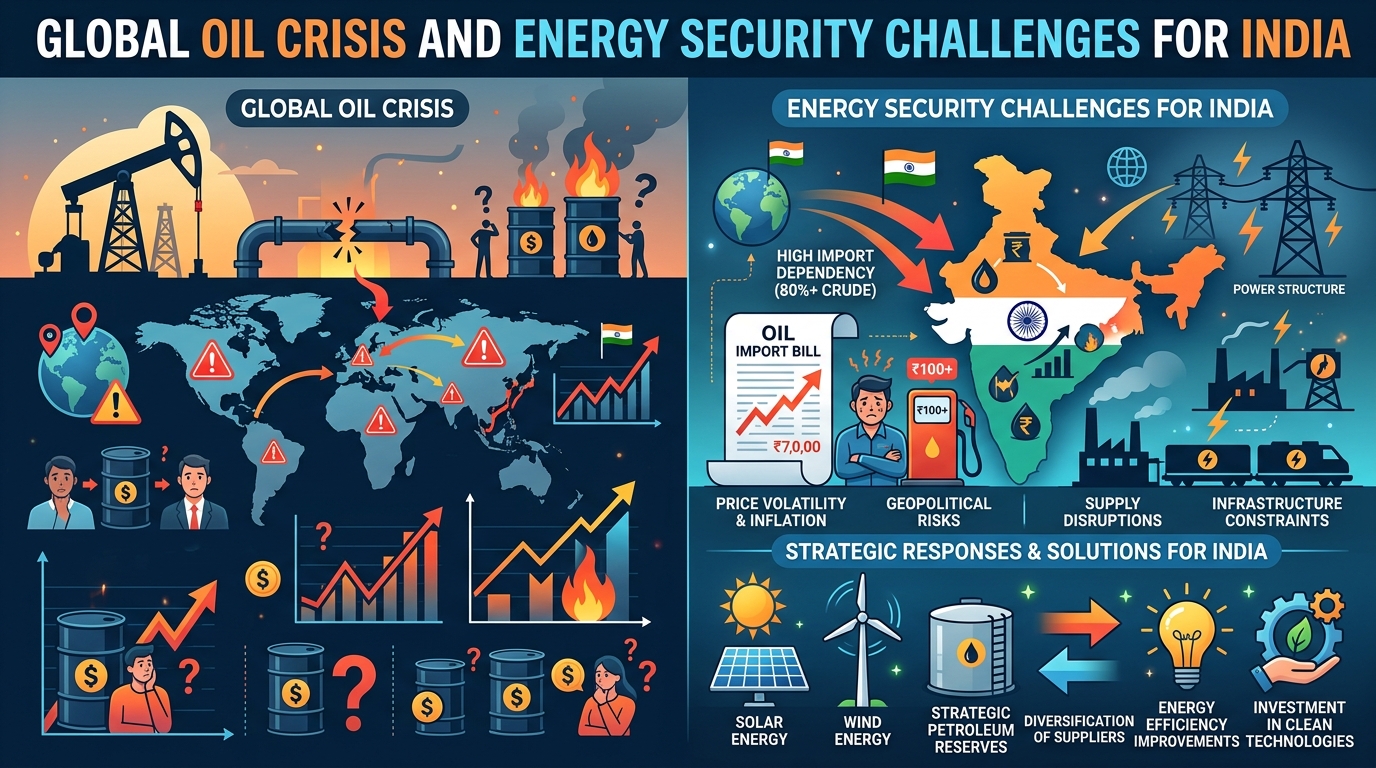
Global Oil Crisis and Energy Security Challenges for India
Table of Contents
The global oil crisis has become a major concern as crude oil prices have surged due to rising geopolitical tensions in West Asia. This situation is creating serious energy security challenges for India, which depends heavily on oil imports.
Why in the News?
- Crude oil prices have recently increased sharply and reached around 118 dollars per barrel, which shows a major disturbance in the global energy market.
- Prices have more than doubled since mid-December 2025, when Brent crude oil was around 57.56 dollars per barrel, which indicates a sudden and strong upward trend.
- The main reason behind this rise is the conflict in West Asia, especially tensions involving countries like Iran and Israel, which are affecting oil supply.
- Even though prices have slightly reduced, they are still above 100 dollars, which shows that the situation remains unstable.
- This situation highlights that geopolitical tensions are now playing a very important role in deciding oil prices, rather than only demand and supply.
What are the Key Highlights?
Geopolitical Impact
- Geopolitics means how politics between countries affects global events, and it is now directly influencing oil prices.
- Conflicts in West Asia are reducing oil production and transportation, which is creating supply shortages.
- Rivalries between major powers are also affecting decisions related to oil production and trade.
- Unlike earlier situations, the current crisis is not just about fear in the market but about actual reduction in oil supply.
Vulnerability of Maritime Routes
- Maritime routes are sea paths used for transporting oil across the world, and they are extremely important for global trade.
- Around 20 percent of global oil passes through the Strait of Hormuz, which is one of the most important chokepoints.
- Around 10 percent of oil passes through the Bab el-Mandeb and the Suez Canal.
- A chokepoint means a narrow route where disruption can stop a large amount of supply.
- Even a small conflict in these areas can increase shipping costs, insurance costs, and delays in delivery.
Oil as a Political Tool for Global Oil Crisis
- Oil is no longer just a fuel but also a tool used by countries to gain political advantage.
- Countries may reduce or increase supply to influence other nations.
- For example, after the Russia-Ukraine War, Russia started exporting more oil to Asian countries instead of Europe.
- This led to longer trade routes and more complex payment systems.
Role of Financial Markets in Global Oil Crisis
- Oil is also traded in financial markets like shares, which means it is treated as a financial asset.
- Futures and options are contracts where people trade oil for future delivery based on expected prices.
- Prices are now influenced by expectations and speculation, not just actual supply.
- Strategic Petroleum Reserves are large storage of oil kept by countries to use during emergencies.
- For example, G-7 countries released oil from reserves to reduce panic and stabilize prices.
Influence of Major Powers
- Large countries have strong control over oil markets through policies and demand.
- The United States influences prices by releasing oil reserves and using diplomacy.
- China is increasing demand because of its growing economy.
- The Organization of the Petroleum Exporting Countries manages oil supply by controlling production levels.
- However, geopolitical risks are now more powerful than production decisions in deciding prices.
Continuing Relevance of Oil
- Oil is still very important despite the growth of renewable energy sources.
- It is widely used in transport, aviation, and industries like petrochemicals.
- Global oil demand is more than 105 million barrels per day, which shows its continued importance.
- Countries like India are expected to increase their oil demand in the future.

What are the Significance?
Energy Security
- Energy security means having reliable and affordable access to energy resources.
- It now includes not only physical supply but also financial stability and political factors.
- Countries must prepare for sudden disruptions and ensure stable supply systems.
Maritime Security
- Maritime security means protecting sea routes that are used for trade.
- Chokepoints like the Strait of Hormuz are very important for global oil movement.
- Any disruption in these routes can directly increase oil prices and disturb global trade.
Economic Impact
- High oil prices increase the cost of imports for countries that depend on foreign oil.
- Countries like India face higher inflation due to increased fuel costs.
- Rising fuel prices increase transportation and production costs, which affect the entire economy.
Strategic Importance
- Oil has become a strategic resource that influences global politics and international relations.
- Countries use oil reserves and supply decisions to protect their national interests.
- Strategic planning is required to manage risks and ensure stability.
Challenges
Supply Disruption
- Conflicts in West Asia are directly reducing oil production and supply.
- Attacks or tensions near chokepoints can block transportation routes.
Price Volatility
- Oil prices are changing very rapidly due to geopolitical news and market speculation.
- Financial markets increase this instability through speculative trading.
Complex Trading and Logistics
- Oil trade has become more complicated due to longer routes and higher risks.
- Insurance costs and legal issues are increasing the difficulty of trade.
Energy Transition
- Countries are trying to shift to renewable energy, but oil demand is still high.
- Balancing current dependence on oil with future energy transition is difficult.
Way Forward
Diversification of Supply
- Countries should import oil from multiple regions to reduce dependence on a single area.
- This reduces risk if one region faces conflict or disruption.
Strengthening Strategic Reserves
- Governments should increase oil storage capacity for emergency situations.
- Strategic reserves can be used to control prices and ensure supply stability.
Maritime Awareness
- Countries should improve monitoring and protection of important sea routes.
- Investment in naval strength can help secure oil transportation.
Financial and Commercial Preparedness
- Countries should develop expertise in oil trading and financial tools.
- Hedging strategies can reduce the impact of price fluctuations.
Diplomacy and Global Cooperation
- Strong international relations can help reduce conflicts and ensure stable trade.
- Cooperation with oil-producing countries and organizations is necessary.
Conclusion
The global oil market is changing from a simple supply system into a complex network influenced by politics, finance, and security. Countries must build strong systems that can handle uncertainty and sudden disruptions. A balanced approach that combines energy security, economic planning, and international cooperation will help nations remain stable in an unpredictable global environment.
Relevant Articles:
SC Status and Religion Debate in India: Supreme Court Clarifies Reservation Rules
India Heart Attack Care Crisis: Delays in Treatment Increasing Preventable Deaths
Magnetic Field Discovery: New Study Reveals Longer Earth Reversal Duration
Read Also:
HALEU-Thorium Debate: Nuclear Fuel Controversy Challenges India’s Energy Strategy
Captive Power Boost: Electricity Rules Amendment 2025 Strengthens India’s Energy Sector
NavIC Crisis: IRNSS-1F Atomic Clock Failure Weakens India’s Navigation System
Oil prices reflect geopolitical risks, not only supply