CSMP IAS : India's Premier Coaching Institute for IAS / PCS
Great Nicobar Project: Development, Ecology, and the Question of Justice
Table of Contents
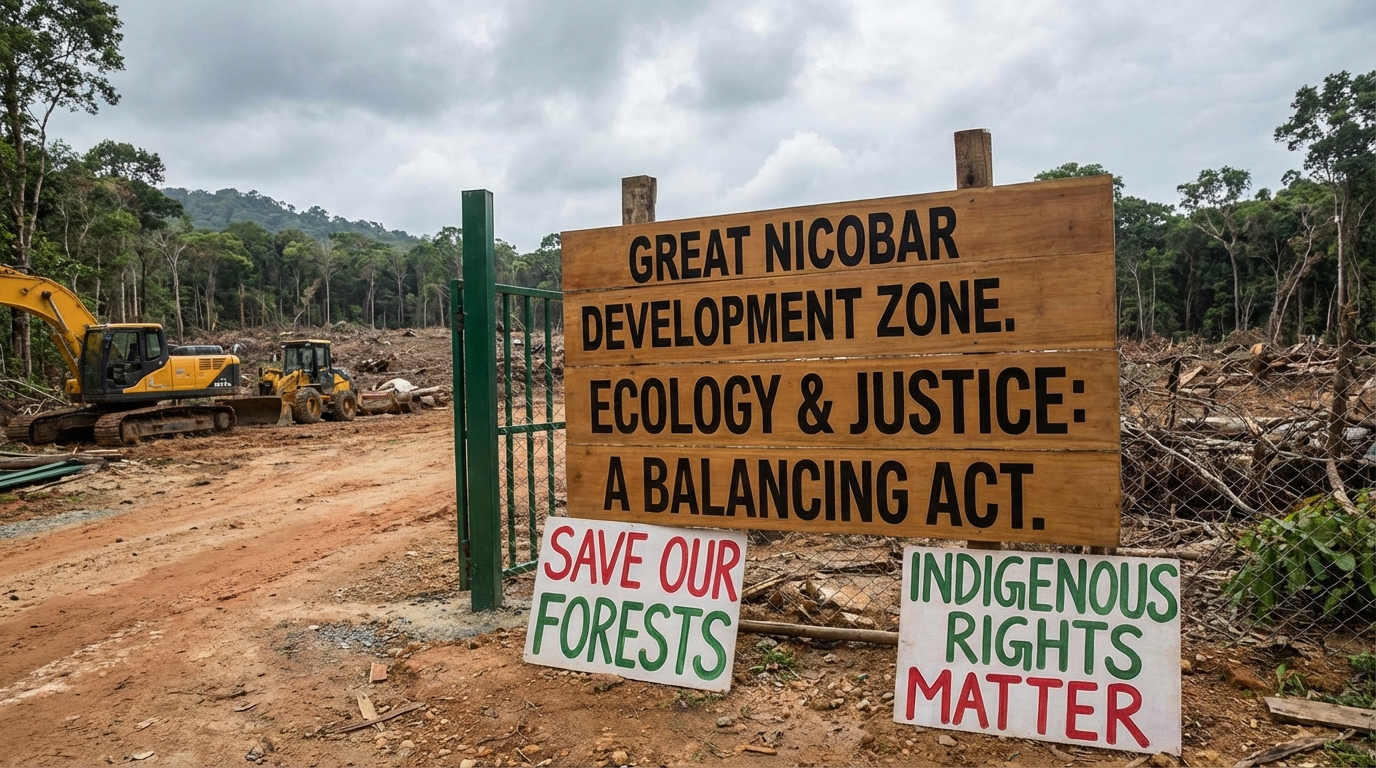
The Great Nicobar Project has become a major topic of debate after approval by the National Green Tribunal (NGT), raising serious concerns about its environmental and social impact. While the government highlights its strategic and economic importance, experts and activists warn about large-scale deforestation, threats to marine biodiversity, and risks to tribal communities. The Great Nicobar Project reflects a complex challenge where development goals must be balanced with ecological protection and justice for indigenous people.
Why in the News?
- The National Green Tribunal (NGT), Kolkata bench, has approved the project, saying that the environmental safeguards (measures to protect nature) are in place.
- The NGT said that the project has strategic importance and that the government does not need to share all details publicly for security reasons.
- Environmental groups and independent scientists have raised serious concerns about biodiversity loss and tribal rights.
What are the Key Highlights?
- The project is located on Great Nicobar Island.
- The Union Environment Ministry has already given environment and preliminary forest clearance.
- Nearly nine lakh trees across 130 sq. km may be cut.
- Concerns include:
- Loss of tropical forest biodiversity.
- Damage to leatherback turtle nesting sites.
- Harm to coral reefs.
- Questions were raised about the rights of the Shompen and the Nicobarese tribes under the Forest Rights Act.
- Some members of the Tribal Council alleged pressure to sign land “surrender certificates.”
- Critics say that independent concerns were not fully examined.
Historical Context
- In the early 20th century, the British Phosphate Commissioners carried out large-scale phosphate mining in Nauru and Banaba.
- By 1945, Banaba became physically devastated and uninhabitable.
- Native Banabans were relocated to Rabi Island, over 2,000 km away.
- Today, Banaba remains ecologically damaged.
- This example shows that economic development can permanently harm remote ecosystems and native communities.
| Who were the British Phosphate Commissioners?They were a joint venture of the UK, Australia, and New Zealand. Their main business: mining phosphate from small islands in the Pacific Ocean. Phosphate is a mineral used mainly for fertilizers, so it was very valuable for agriculture. |
What are the Significances?
1. Strategic Importance
- The island is located near important sea routes. A trans-shipment port can strengthen India’s maritime presence. The project may enhance national security in the Indian Ocean region.
2. Economic Development
- The project may generate employment. Infrastructure development can improve connectivity. It may boost trade and regional growth.
3. Environmental Concerns
- The island has rich and unique biodiversity. Large-scale tree cutting may cause irreversible ecological damage. Coral reefs and marine life may suffer long-term harm.
4. Tribal Rights and Justice
- The Shompen and Nicobarese tribes depend on forests for livelihood. Any violation of community rights under the Forest Rights Act raises legal and moral questions. Allegations of coercion weaken trust in governance.
5. Governance and Transparency
- The NGT emphasized strategic secrecy. Limited transparency may reduce public trust. Independent scientific review appears limited.
6. Development vs Environment Debate
- The project reflects the classic conflict between growth and conservation. It raises the question: Should economic logic alone guide decisions in fragile regions?
Challenges
1. Massive Deforestation
- Nearly nine lakh trees may be cut. Loss of forest cover can affect climate and biodiversity.
2. Biodiversity Loss
- Tropical forests host rare species. Damage may be permanent.
3. Threat to Marine Ecosystems
- Leatherback turtle nesting grounds may be disturbed. Coral reefs may be harmed by construction.
4. Tribal Displacement Risks
- Land diversion may affect tribal communities. Alleged coercion undermines free consent.
5. Weak Independent Review
- The NGT relied heavily on the government’s appraisal. Independent scientific concerns were not deeply examined.
6. Long-Term Uncertainty
- Environmental damage may be irreversible. Benefits may not reach local communities equally.
Way Forward
1. Strengthen Independent Environmental Review
- Conduct transparent and scientific impact assessments. Involve independent experts and local communities.
2. Protect Tribal Rights
- Ensure full compliance with the Forest Rights Act. Guarantee free, prior, and informed consent.
- Avoid any form of coercion.
3. Minimise Ecological Damage
- Reduce tree felling wherever possible. Use eco-friendly construction methods. Protect turtle nesting zones and coral reefs.
4. Transparent Governance
- Share as much information as possible without harming security. Build trust through public consultation.
5. Phased and Monitored Development
- Implement the project in stages. Continuously monitor environmental impact. Stop or modify activities if damage exceeds limits.
6. Learn from Global History
- Avoid repeating mistakes like those seen in Banaba. Balance development with long-term ecological sustainability.
Conclusion
Large infrastructure projects in fragile regions require careful judgment and responsible action. Progress must not weaken the foundations of ecology and justice. Decisions taken today will shape both the natural landscape and the moral legacy left for future generations.
Relevant Articles:
Loggerhead Turtle Climate Impact: Alarming Study Reveals Survival Threat
AgriPV in India: Powerful Solar Farming Revolution Unlocks Farmer Growth
Read Also:
India LNG Crisis: West Asia Conflict Threatens Fertilizer Supply
Ayurveda Global Expansion: Budget 2026 & India–EU FTA Unlock Massive Opportunities
Mahad Satyagraha and the Fight for Equality
PM shares an article on the Great Nicobar Island Project …