
CSMP IAS : India's Premier Coaching Institute for IAS / PCS
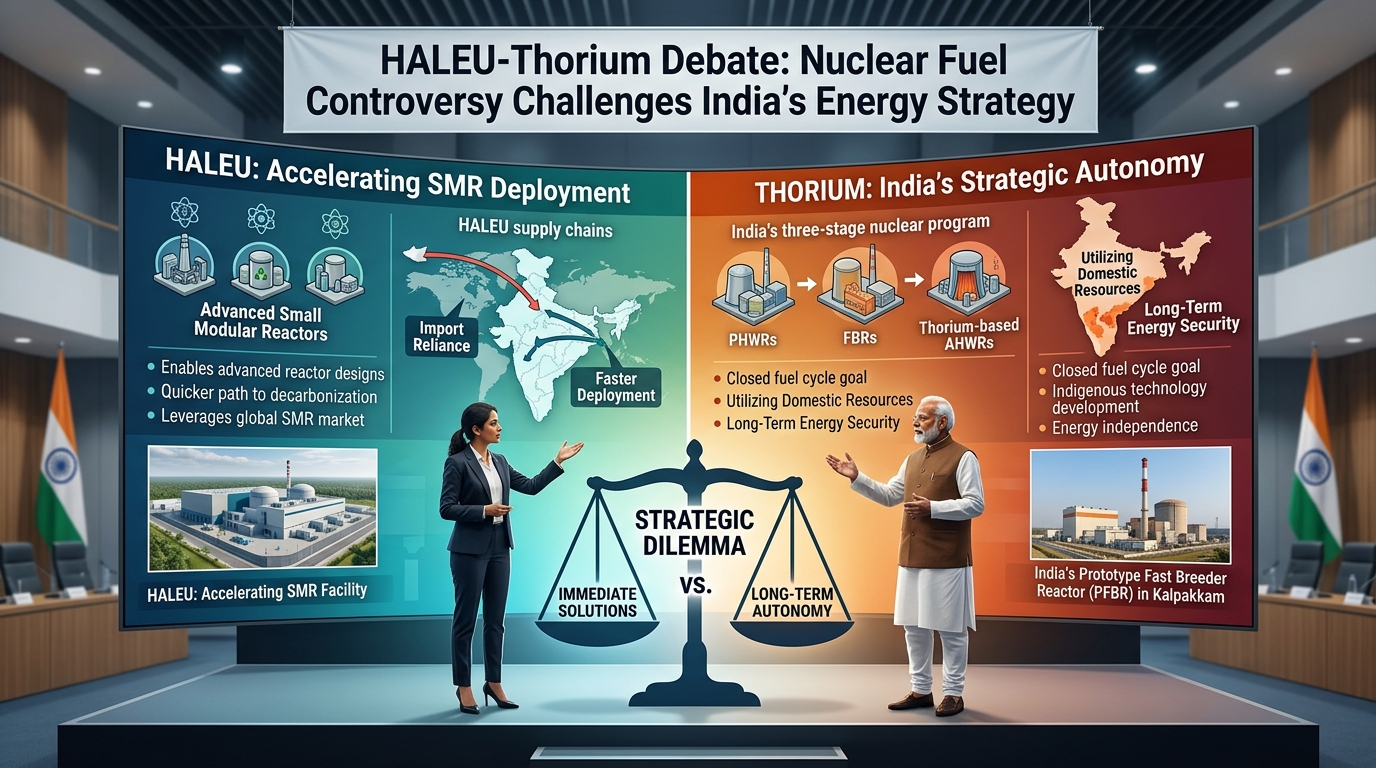
HALEU-Thorium Debate: Nuclear Fuel Controversy Challenges India’s Energy Strategy
Table of Contents
The HALEU-Thorium Debate has emerged as a major issue in India’s nuclear energy sector after a study by the Bhabha Atomic Research Centre raised concerns about its suitability in existing reactors. While HALEU-Th fuel promises higher efficiency and lower waste, experts have expressed differing views on its safety and compatibility, making this debate crucial for India’s long-term nuclear energy strategy and thorium utilization goals.
Why in the News?
- A research paper published in the journal Current Science has created a major debate among nuclear scientists.
- The study was conducted by scientists from the Bhabha Atomic Research Centre.
- The paper concluded that a nuclear fuel mix called HALEU-Thorium (HALEU-Th) may not be suitable for India’s present reactors.
- The conclusion has been criticised by leading nuclear experts such as Anil Kakodkar.
- Other global experts like Koroush Shirvan have also questioned the methodology of the study.
- The issue has become important because:
- India is expanding its nuclear energy capacity.
- India has one of the largest thorium reserves in the world.
- Nuclear energy is seen as a clean and reliable source of electricity to reduce carbon emissions.
- This debate is not only scientific but also strategic:
- It affects India’s long-term nuclear policy.
- It influences international collaboration and technology choices.
What are the Key Highlights?
Study by BARC Scientists
- Scientists from the Bhabha Atomic Research Centre carried out a detailed study of nuclear fuel combinations.
- They used advanced computer simulations to understand reactor behavior.
- The focus was on Pressurised Heavy Water Reactor (PHWRs), which form the backbone of India’s nuclear power system.
- Concept Understanding: Why PHWRs are Important
- PHWRs use natural uranium as fuel and heavy water as moderator.
- They are suitable for countries like India with limited uranium resources.
- They allow gradual transition to advanced nuclear fuel cycles.
Three Fuel Combinations Tested
- The study tested three major fuel types:
- Natural Uranium Fuel
- It contains around 7 kg of uranium-235 and 993 kg of uranium-238.
- This is the current standard fuel in India.
- It has moderate efficiency but is well understood and safe.
- HALEU-Thorium Fuel
- It contains higher uranium-235 along with thorium.
- It is designed to improve efficiency and reduce waste.
- It represents an advanced fuel concept.
- Slightly Enriched Uranium
- It contains a slightly higher proportion of uranium-235 compared to natural uranium.
- It offers better performance than natural uranium but is less advanced than HALEU.
Role of Different Nuclear Materials
- Uranium-235
- It is the main fissile material.
- It undergoes nuclear fission and releases energy.
- Uranium-238
- It is not directly fissile.
- It converts into plutonium-239 after neutron absorption.
- Thorium-232
- It is abundant in India.
- It converts into uranium-233 after neutron absorption.
- Concept Understanding: Fissile vs Fertile Materials
- Fissile materials can directly undergo fission.
- Fertile materials need conversion before they can produce energy.
Meaning of HALEU
- HALEU stands for High Assay Low Enriched Uranium.
- Enrichment levels:
- Natural uranium has about 0.7% U-235.
- Conventional reactors use 3–4% enrichment.
- HALEU has 5–20% enrichment.
- Importance of HALEU
- Provides more energy per unit fuel.
- Improves reactor efficiency.
- Reduces frequency of refueling.
Study Results of the HALEU-Thorium
- The HALEU-Th fuel showed strong technical performance:
- Higher Burn-up
- Burn-up reached around 50 gigawatt-days per tonne.
- This means more energy extracted from fuel.
- Lower Radioactive Waste
- Only about 14% waste compared to traditional fuel.
- This is a major environmental advantage.
- Concept Understanding: Burn-up
- Burn-up indicates how efficiently fuel is used.
- Higher burn-up means better utilization of nuclear material.
Problem Identified by the Study
- The study highlighted a serious safety concern:
- Reduced Shutdown Rod Effectiveness
- Shutdown rods control or stop nuclear reactions.
- Their effectiveness may be reduced by about 26%.
- Safety Concern
- Reduced effectiveness can delay emergency shutdown.
- This can increase risk in extreme situations.
- Conclusion of Study
- HALEU-Th fuel is not a simple replacement for existing PHWRs.
Reaction from Clean Core Thorium Energy
- The company Clean Core Thorium Energy disagreed with the study.
- It developed ANEEL fuel:
- ANEEL stands for Advanced Nuclear Energy for Enriched Life.
- It is based on HALEU-Th technology.
Fuel Testing in the United States
- ANEEL fuel was tested at the Idaho National Laboratory.
- Results
- High burn-up was achieved.
- This suggests high efficiency and energy output.
Link with India’s Nuclear Sector Reform
- The debate coincides with the SHANTI Act 2025.
- Importance of the Act
- It allows private and foreign participation.
- It aims to expand nuclear capacity.
Possible Collaboration with NTPC
- Clean Core Thorium Energy signed an agreement with NTPC Limited.
- Purpose
- To explore use of ANEEL fuel in India.
- Testing is yet to begin.
Criticism and Support from Experts
- Anil Kakodkar
- He supported the advantages of HALEU-Th fuel.
- He highlighted reduced waste and lower costs.
- Koroush Shirvan
- He criticised the study’s methodology.
- He suggested withdrawal of the paper.
- Ravi Grover
- He supported the study.
- He said simulations were reliable.
India’s Long-Term Nuclear Strategy
- India follows a three-stage programme:
- Stage 1
- Use natural uranium in PHWRs.
- Stage 2
- Use plutonium in fast breeder reactors.
- Stage 3
- Use thorium-based reactors.
- Current Progress
- India is preparing a fast breeder reactor in Kalpakkam.
- This marks transition to Stage 2.

What are the Significance?
Importance of Thorium for India
- India has large thorium reserves.
- Uranium reserves are limited.
- Importance
- Thorium provides long-term energy security.
- Reduces import dependence.
Potential Reduction in Nuclear Waste
- HALEU-Th fuel produces less waste.
- Importance
- Reduces environmental risks.
- Lowers storage and disposal costs.
Higher Energy Output
- Higher burn-up improves efficiency.
- Importance
- More electricity from same fuel.
- Reduces fuel requirement.
Expansion of Nuclear Energy
- India targets 100 GW nuclear capacity by 2047.
- Importance
- Supports growing energy demand.
- Helps reduce carbon emissions.
Opportunities for International Collaboration
- Collaboration with global companies is possible.
- Importance
- Improves technology access.
- Enhances research quality.
Boost to Nuclear Innovation
- Scientific debate encourages innovation.
- Importance
- Leads to better fuel designs.
- Improves safety systems.
Strengthening Energy Security
- Nuclear energy provides stable power.
- Importance
- Reduces dependence on fossil fuels.
- Ensures continuous supply.
Contribution to Climate Goals
- Nuclear power is a low-carbon energy source.
- Importance
- Helps India meet climate commitments.
- Supports sustainable development.
Challenges
Technical Compatibility with Existing Reactors
- HALEU-Th may not suit current PHWRs.
- Problem
- Reactor modifications may be needed.
- Safety concerns may arise.
Scientific Disagreement
- Experts have conflicting views.
- Problem
- Creates policy uncertainty.
- Slows decision-making.
Dependence on Imported Technology
- HALEU technology is foreign-based.
- Problem
- Limits self-reliance.
- Creates strategic risks.
High Cost of HALEU Fuel
- HALEU fuel is expensive.
- Problem
- Increases cost of nuclear energy.
- Limits widespread adoption.
Lack of Testing Facilities
- India has limited advanced testing facilities.
- Problem
- Slows innovation.
- Delays implementation.
Disruption of Nuclear Programme
- New fuels may affect existing plans.
- Problem
- May delay a three-stage programme.
- Creates planning challenges.
Safety and Regulatory Concerns
- New fuels require strict safety checks.
- Problem
- Regulatory approval may take time.
- Safety validation is complex.
Way Forward
Conduct Controlled Fuel Testing
- India should test HALEU-Th fuel carefully.
- Benefit
- Provides real-world data.
- Confirms safety and efficiency.
Strengthen Nuclear Research Infrastructure
- Develop advanced research facilities.
- Benefit
- Improves innovation capacity.
- Supports long-term growth.
Continue the Three-Stage Programme
- Follow existing nuclear strategy.
- Benefit
- Ensures stable development.
- Utilizes thorium effectively.
Promote International Collaboration
- Collaborate with global institutions.
- Benefit
- Accelerates technology development.
- Enhances knowledge sharing.
Ensure Cost-Effective Fuel Supply
- Focus on reducing costs.
- Benefit
- Makes nuclear power affordable.
- Encourages adoption.
Encourage Scientific Debate
- Support open discussion.
- Benefit
- Improves research quality.
- Leads to better policies.
Develop Indigenous Technology
- Invest in domestic fuel development.
- Benefit
- Reduces dependence on imports.
- Strengthens self-reliance.
Strengthen Regulatory Framework
- Improve safety and approval processes.
- Benefit
- Ensures safe adoption of new technologies.
- Builds public confidence.
Conclusion
The debate around HALEU-Thorium fuel highlights how complex decisions in nuclear energy require a careful balance between innovation, safety, cost, and long-term national strategy. India’s future success in nuclear energy will depend on its ability to combine scientific research, technological independence, and strategic planning while adapting to new global developments in clean energy.
Relevant Articles:
Captive Power Boost: Electricity Rules Amendment 2025 Strengthens India’s Energy Sector
NavIC Crisis: IRNSS-1F Atomic Clock Failure Weakens India’s Navigation System
Discovery of Euthalia Zubeengargi: New Butterfly Species Highlights India’s Rich Biodiversity
Read Also:
Controversial Transgender Rights Amendment Bill 2026 Raises Concerns Over Inclusion and Democracy
Illegal Sand Mining Crisis in Chambal Sanctuary Raises Environmental Concerns
U.S. Forced Labour Probe Raises Concerns for Global Trade and India
parliament question: thorium-based power projects