
CSMP IAS : India's Premier Coaching Institute for IAS / PCS
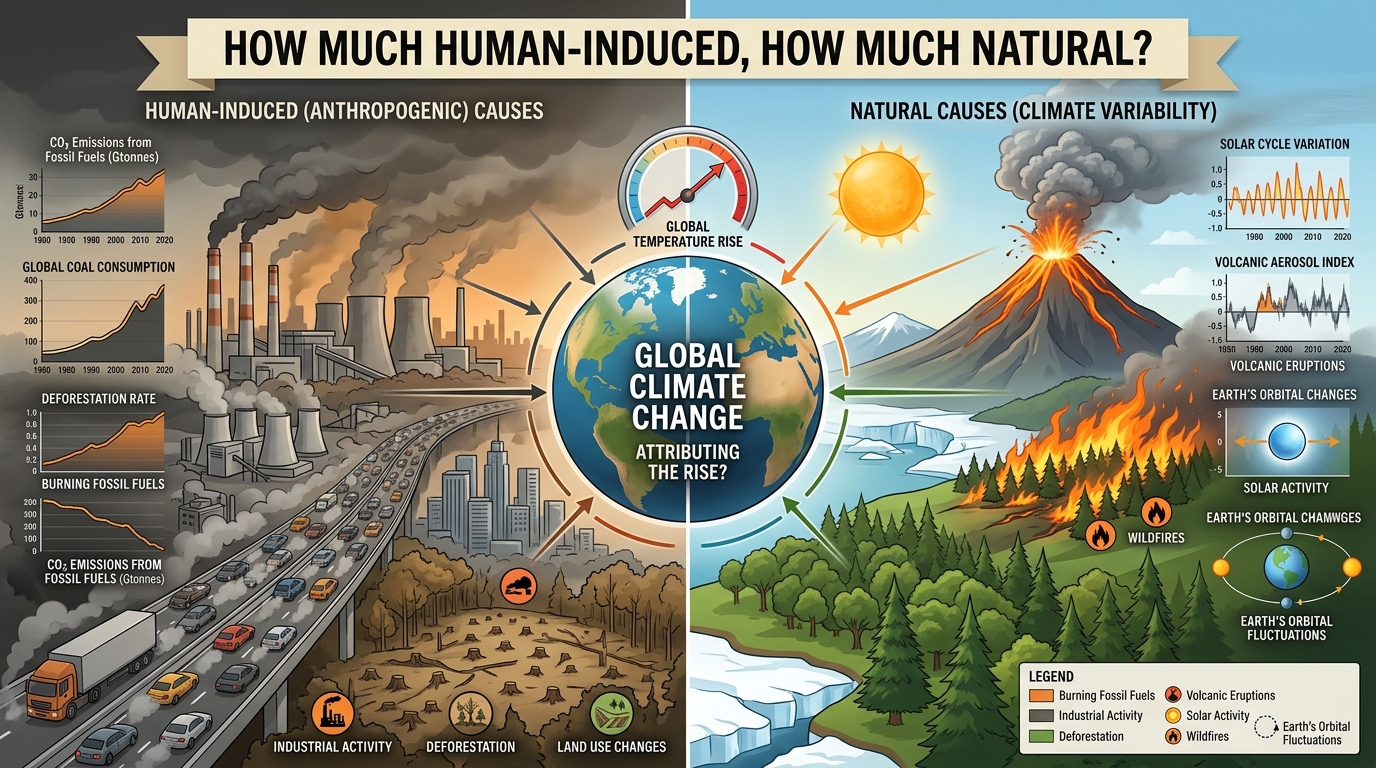
How Much Human-Induced, How Much Natural
Human-Induced vs Natural Causes is a critical debate in understanding environmental change in the modern world. While natural processes like volcanic eruptions and climate cycles have always shaped the Earth, human activities such as industrialization, deforestation, and pollution have significantly accelerated these changes.
Approach to the Essay: How Much Human-Induced, How Much Natural
To write on the topic “How much Human-Induced, How much Natural”, we need a balanced, analytical, and scientific approach:
1. Understand the Core Idea
- The topic is open-ended but mainly relates to environmental changes, especially climate change, disasters, and ecological imbalance.
- It asks us to examine the extent of human contribution versus natural processes.
2. Define Key Terms
- Human-Induced: Changes caused by human activities like industrialization, deforestation, pollution.
- Natural: Changes caused by natural processes like volcanic eruptions, solar cycles, tectonic activity.
3. Central Theme
- Focus on climate change, natural disasters, and environmental degradation.
4. Balanced Structure
- First explain natural factors
- Then explain human-induced factors
- Then compare their relative contribution
5. Multiple Dimensions
- Environmental: climate, biodiversity
- Economic: development vs sustainability
- Political: global responsibility
- Social: human vulnerability
- Scientific: evidence and data
6. Examples
- Floods, droughts, cyclones, global warming, forest fires
7. Argument
- Natural processes exist, but human actions have intensified and accelerated them.
8. Way Forward
- Sustainable practices, global cooperation
9. Conclusion
- Emphasize responsibility and balance

Essay: How Much Human-Induced, How Much Natural
“Nature can exist without humans, but humans cannot exist without nature.”
The question of how much of the changes in our environment are human-induced and how much are natural is very important in today’s world. We are living in a time when the Earth is facing serious challenges such as climate change, global warming, natural disasters, and loss of biodiversity. Some people argue that these changes are part of the Earth’s natural processes. Others believe that human activities are mainly responsible. The truth lies in understanding the balance between natural forces and human actions.
The Earth has always gone through natural changes. These changes are caused by natural processes such as volcanic eruptions, solar radiation, plate tectonics, and ocean currents. For example, volcanic eruptions release gases and ash into the atmosphere, which can affect the climate. Similarly, changes in the Earth’s orbit and tilt influence long-term climate patterns. These natural factors have shaped the Earth’s environment for millions of years.
Natural disasters like earthquakes, tsunamis, cyclones, and floods have also occurred throughout history. These events are part of the Earth’s natural system. For instance, earthquakes are caused by the movement of tectonic plates, and cyclones are formed due to natural weather patterns. Therefore, it is clear that nature has its own powerful forces that operate independently of human actions.
However, in recent times, human activities have increased rapidly. The growth of industries, urbanization, and population has led to large-scale changes in the environment. One of the most important human-induced factors is the burning of fossil fuels such as coal, oil, and gas. This releases greenhouse gases like carbon dioxide into the atmosphere. These gases trap heat and lead to global warming.
Another major factor is deforestation. Forests are cut down for agriculture, construction, and industrial use. Trees play a crucial role in absorbing carbon dioxide and maintaining the balance of the ecosystem. When forests are destroyed, this balance is disturbed. This not only contributes to climate change but also leads to the loss of biodiversity.
Pollution is another human-induced problem. Air pollution, water pollution, and soil pollution have increased due to human activities. Factories release harmful chemicals into the air and water. Plastic waste is polluting oceans and harming marine life. These actions have a direct impact on the environment and human health.
Human activities have also intensified natural disasters. For example, floods can occur naturally due to heavy rainfall. However, poor urban planning, deforestation, and blocking of drainage systems make floods more severe. Similarly, droughts can be worsened by overuse of water resources and poor agricultural practices. This shows that while disasters may have natural causes, their impact is often increased by human actions.
From a scientific perspective, studies show that the current rate of climate change is much faster than natural changes in the past. This indicates a strong human influence. The rise in global temperatures, melting of glaciers, and rising sea levels are largely linked to human activities. Therefore, while natural factors exist, human actions play a dominant role in recent environmental changes.
The issue also has an economic dimension. Economic development has improved living standards, but it has also led to environmental damage. Industries aim to maximize profits, often ignoring environmental costs. This creates a conflict between development and sustainability. Developing countries face a challenge in balancing growth with environmental protection.
The political dimension is equally important. Climate change is a global problem that requires cooperation among countries. There are debates about responsibility, as developed countries have contributed more to pollution in the past. Developing countries argue for their right to grow. This creates tension in global climate negotiations.
From a social perspective, environmental changes affect people differently. Poor and vulnerable communities suffer the most from disasters and climate change. They have fewer resources to adapt and recover. This raises issues of equity and justice. Ethical responsibility demands that stronger nations and communities support weaker ones.
The environmental dimension clearly shows that human activities are putting pressure on natural systems. The Earth’s capacity to absorb waste and regenerate resources is limited. When this limit is crossed, it leads to imbalance. Protecting the environment is not just an option but a necessity for survival.
The question “how much human-induced and how much natural” does not have a simple answer. Natural processes are always present, but human activities have significantly increased the scale and speed of environmental changes. In many cases, human actions act as a multiplier, making natural events more severe.
The way forward is to reduce human impact on the environment. This can be done through sustainable development, use of renewable energy, conservation of forests, and reduction of pollution. Governments should make strong policies, and individuals should adopt eco-friendly practices. Education and awareness are also important.
In conclusion, both natural processes and human activities play a role in environmental changes. However, in the present context, human influence has become more significant. We cannot control natural forces, but we can control our actions. Therefore, it is our responsibility to reduce the negative impact of human activities and protect the environment for future generations.
“The greatest threat to our planet is the belief that someone else will save it.”
UPPCS Essay 2025:
India’s Foreign Policy: From Non-Alignment to Multipolar Diplomacy
Organic Farming: Necessity or Compulsion
The Issue of Ethics in a Changing Global Economy
The Implications of Development and the Environment
Indian Women in the 21st Century: From Dreams to Reality
Global Consciousness of the New India
The Future of Literature in the Age of Artificial Intelligence
Are humans causing or contributing to global warming?
