
CSMP IAS : India's Premier Coaching Institute for IAS / PCS
India–Bangladesh Relations: India–Bangladesh Relations Shift Towards People-to-People Diplomacy Boosting Regional Stability
Table of Contents
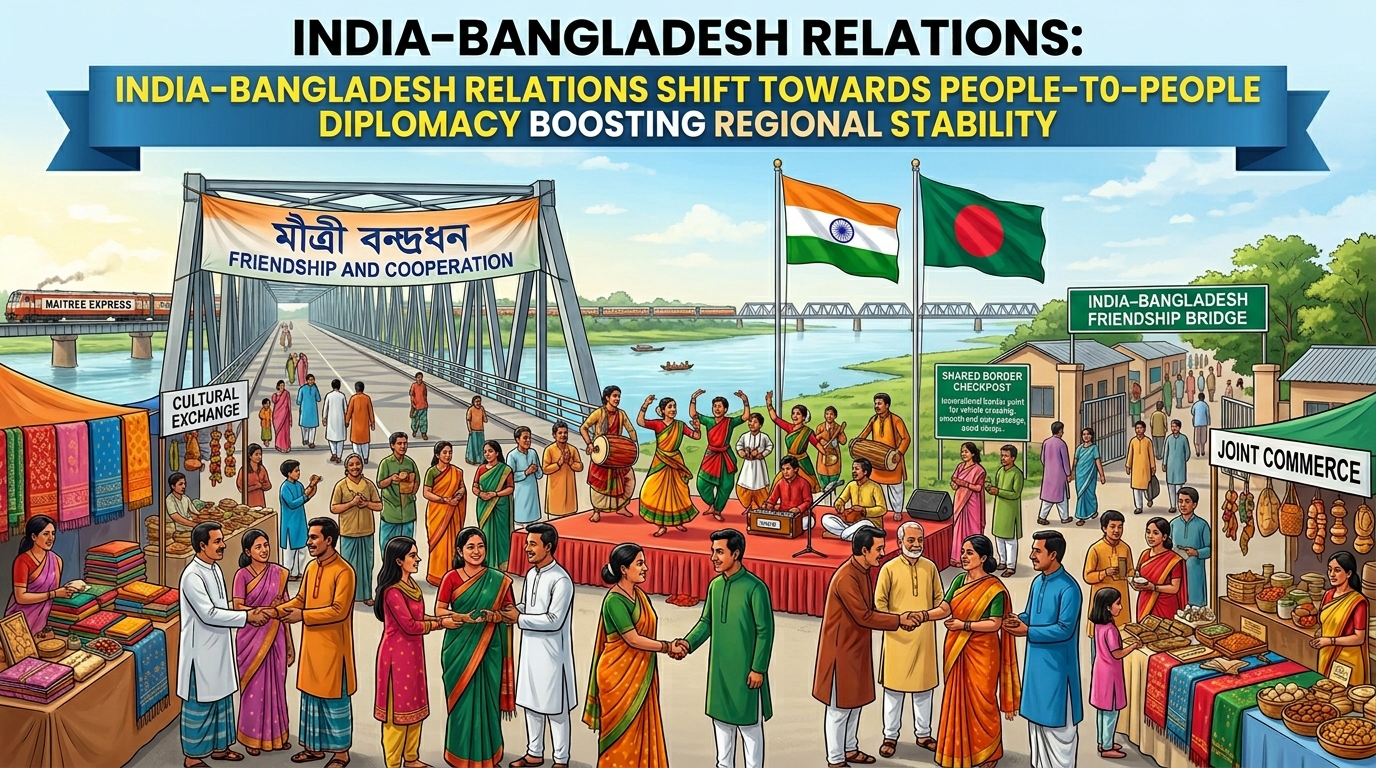
India–Bangladesh Relations are witnessing a significant positive shift as both countries move towards strengthening people-to-people diplomacy. This approach emphasizes cultural exchange, trade connectivity, educational cooperation, and institutional engagement beyond political leadership. The evolving framework of India–Bangladesh Relations highlights regional stability, improved energy cooperation, and deeper economic integration in South Asia.
Why is this in the News?
New diplomatic direction in India–Bangladesh relations
- Bangladesh has announced that it wants to strengthen its relationship with India through “People-to-People Ties”.
- This means the focus will not only remain on governments and political leaders but also on citizens, students, businesses, and cultural groups.
- The statement was given by Humayun Kobir, Foreign Affairs Adviser to Bangladesh’s current government led by Prime Minister Tarique Rahman.
Context of recent diplomatic engagement
- The statement came after a high-level meeting between Indian High Commissioner Pranay Verma and Prime Minister Tarique Rahman.
- The discussion included energy cooperation, trade and connectivity issues, and regional stability concerns.
- Bangladesh emphasized that it wants to avoid repeating “past mistakes” in bilateral relations.
What are the Key Highlights?
Understanding People-to-People Relations
- People-to-people ties refer to direct connections between citizens of two countries.
- These connections include educational exchanges between students and universities, cultural interactions such as festivals, arts, and sports, tourism and travel between countries, and business and trade partnerships at private level.
- This approach reduces over-dependence on political leadership and ensures continuity even when governments change.
Why Bangladesh is focusing on this approach
- Bangladesh believes earlier relations were over-dependent on individual leaders and vulnerable to political instability.
- By focusing on citizens and institutions, Bangladesh aims to ensure long-term stability in relations, reduce political fluctuations affecting diplomacy, and build stronger grassroots-level connections.
Political transition in Bangladesh and its impact
- Bangladesh underwent a major political shift after a student-people movement in August 2024 and the fall of the previous government led by Sheikh Hasina.
- This transition has led to a reorientation of foreign policy priorities and a redefinition of India–Bangladesh relations.
- The current leadership suggests that relations should not be influenced by “personal equations” and institutional diplomacy should be strengthened.
India–Bangladesh diplomatic engagement
- The meeting between Indian High Commissioner and Bangladesh leadership signals continued diplomatic engagement despite political change.
- Both sides discussed energy cooperation, water-sharing issues, and trade and connectivity challenges.
- Bangladesh Foreign Minister Khalilur Rahman is scheduled to visit India, marking an important diplomatic engagement after the political transition.
Energy cooperation between India and Bangladesh
- The India-Bangladesh Friendship Pipeline transports petroleum products, mainly diesel, from India to Bangladesh.
- It ensures stable fuel supply, reduced energy import costs, and strengthened regional energy security.
- India recently supplied 5,000 metric tonnes of high-speed diesel to Bangladesh, helping it manage energy shortages and rising fuel demand.
- Bangladesh is currently facing energy stress due to global price fluctuations, import dependency, and increased domestic demand.
Trade, connectivity, and economic relations
- India and Bangladesh share strong trade relations involving garments, textiles, agricultural products, machinery, petroleum products, and food items.
- Bangladesh is expected to raise concerns about restrictions on use of Indian seaports and airports for export shipments.
- These restrictions impact export speed, transport costs, and competitiveness of goods, making trade facilitation essential.
Ganga Water Treaty and water-sharing issues
- The Ganga Water Treaty regulates sharing of Ganga river water during dry seasons.
- It is crucial for irrigation, agriculture, and drinking water supply in Bangladesh.
- Bangladesh seeks timely renewal and fair implementation due to climate change impacts and water scarcity challenges.
Border security and human rights concerns
- Bangladesh has raised concerns about firing incidents along the border and emphasizes arrest and legal prosecution instead of lethal force.
- India maintains that border actions are necessary to prevent smuggling and illegal cross-border activities.
- The India–Bangladesh border is long and porous, creating challenges such as smuggling, illegal migration, and human trafficking.

What is the Significance?
Strengthening regional stability in South Asia
- India and Bangladesh share a long border, deep historical links, and strong economic interdependence.
- Stable relations contribute to peace in South Asia, reduced border tensions, and stronger regional cooperation.
Economic integration and development
- Energy cooperation ensures reliable fuel supply and reduces dependency on global markets.
- Trade and connectivity improvements lead to lower logistics costs and stronger supply chains.
Shift from personality-based to institutional diplomacy
- Earlier relations depended on individual leaders and political equations.
- The new approach focuses on institutions, long-term agreements, and stable diplomatic frameworks.
- This ensures continuity despite political transitions.
Regional connectivity and economic corridors
- Connectivity supports Northeast India’s access to markets and Bangladesh’s export efficiency.
- It promotes BIMSTEC cooperation and Bay of Bengal regional integration.
Challenges in India–Bangladesh Relations
Political instability and policy shifts
- Political transitions can disrupt foreign policy continuity and delay projects.
- Trust deficit issues sometimes complicate negotiations.
Border management challenges
- Managing security while respecting human rights remains difficult.
- Issues include smuggling, trafficking, and illegal crossings across a porous border.
Trade and connectivity barriers
- Infrastructure limitations and administrative delays increase costs.
- Regulatory restrictions create uncertainty for businesses.
Energy vulnerability
- Bangladesh’s dependence on imported energy exposes it to global price shocks.
- Geopolitical tensions can indirectly affect supply chains.
Water-sharing tensions
- Climate change affects river flows and increases competition for water resources.
- Agriculture dependency makes negotiations sensitive.
Way Forward
Strengthening people-to-people engagement
- Promote student exchanges, scholarships, tourism, and cultural festivals.
- Simplify visa processes and improve cross-border mobility.
Enhancing trade and connectivity
- Expand rail, road, and port infrastructure.
- Improve customs coordination and reduce trade barriers.
Strengthening energy cooperation
- Expand pipeline capacity and explore renewable energy cooperation.
- Develop cross-border electricity sharing mechanisms.
Improving border management
- Use technology-based surveillance and joint coordination mechanisms.
- Strengthen intelligence sharing between both countries.
Strengthening water cooperation
- Use scientific water management and climate adaptation strategies.
- Modernize treaty frameworks based on current environmental realities.
Institutionalizing diplomacy
- Maintain regular high-level dialogue mechanisms.
- Build long-term agreements in trade, energy, and connectivity.
Conclusion
India and Bangladesh share a deeply interconnected relationship shaped by geography, history, and economics. The shift toward people-to-people diplomacy reflects an effort to build a more stable and inclusive partnership beyond political cycles. Strengthening institutional cooperation, improving connectivity, and resolving sensitive issues like border management and water sharing will be key to ensuring long-term peace, stability, and regional development in South Asia.
Relevant Articles:
Brain Science, Ego Dissolution and Self Awareness
Climate Change as a Public Health Crisis in India
Read More:
China Energy Strategy Success: How China Avoided Global Oil Crisis Impact
WTO Crisis: Trade Multilateralism Faces Serious Breakdown
English Translation of Press Statement by Prime Minister …
