
CSMP IAS : India's Premier Coaching Institute for IAS / PCS
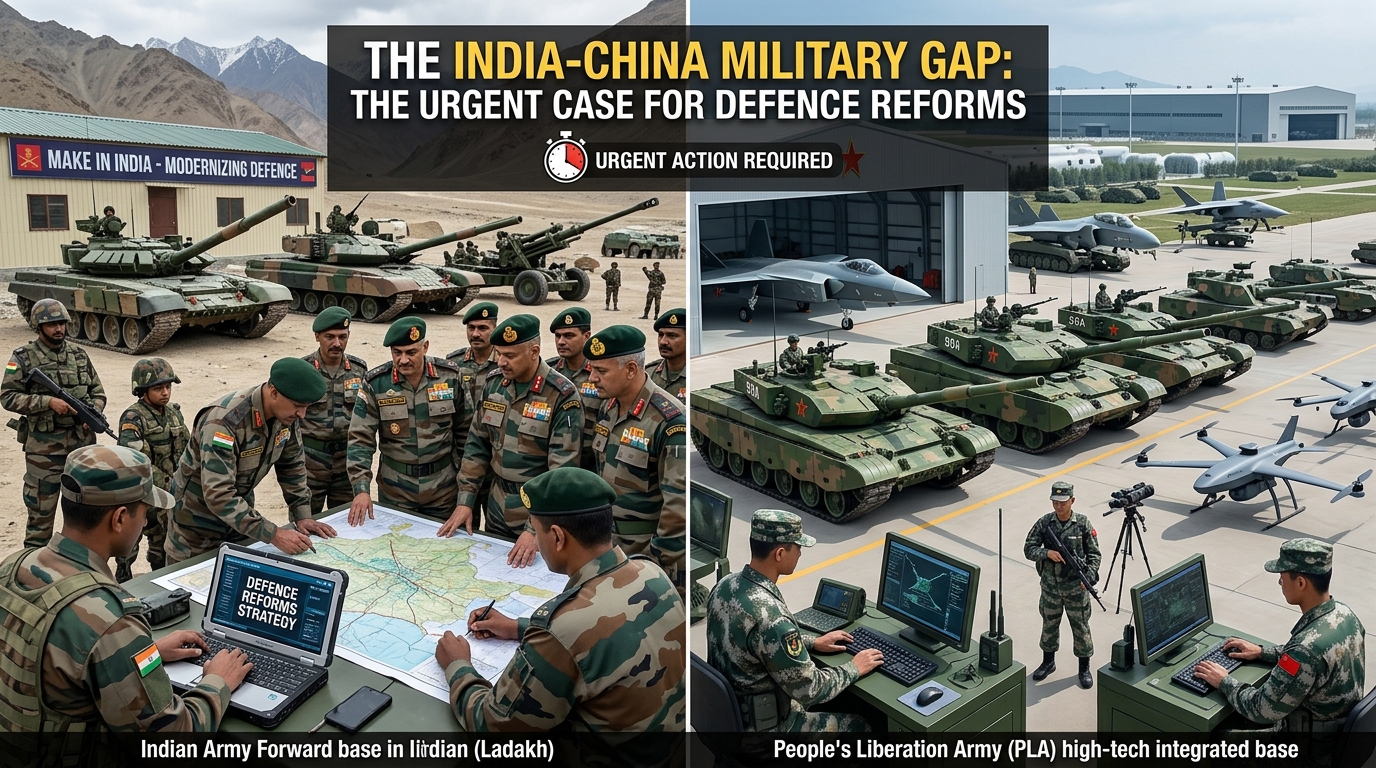
India China Military Gap: Urgent Need for Defence Reforms
Table of Contents
The India China Military Gap has become a major concern for national security as China continues to strengthen its military capabilities faster than India. Experts highlight that without urgent defence reforms, technological upgrades, and a strong industrial base, India may struggle to match China’s growing power.
Why in the News?
- A recent strategic discussion has highlighted the growing military gap between China and India.
- Experts have argued that China’s military, especially the People’s Liberation Army, poses a serious challenge to India’s defence preparedness.
- The debate focuses on how India should respond to this challenge through a strong defence-industrial strategy.
- There is increasing concern that if India does not act quickly, the capability gap between the two countries may widen further.
- The issue is also important because modern warfare is changing rapidly due to new technologies such as cyber warfare, drones, and space systems.
- This has raised an important question about how India should choose between buying weapons, building its own systems, and investing in future technologies.
What are the Key Highlights?
- China currently has an advantage in military capability due to:
- Strong industrial base
- Large-scale production capacity
- Advanced technologies
- India faces challenges in:
- Defence production at scale
- Speed of procurement
- Integration of modern technologies
- Three possible strategies for India have been discussed:
- Bold Strategy
- Invest heavily in new and emerging technologies
- High risk but high reward
- Conservative Strategy
- Upgrade existing military systems
- Low risk but limited impact
- Middle Path Strategy
- Combine old systems with new enabling technologies
- Focus on improving coordination and effectiveness
- Bold Strategy
- The concept of multi-domain warfare has been highlighted:
- Warfare across land, air, sea, cyber, and space
- Importance of enabling layers:
- Command and Control (C2)
- Intelligence, Surveillance, and Reconnaissance (ISR)
- Strike capabilities
- Logistics and infrastructure
- India’s defence challenges include:
- Weak defence-industrial base
- Slow procurement process
- Limited private sector participation
What are the Significance?
Strategic Significance of the China Challenge
- China’s military rise directly affects India’s security.
- It creates pressure on India’s borders.
- It increases the risk of conflict in the region.
- The presence of the People’s Liberation Army near India’s borders makes preparedness essential.
Importance of Defence Industrial Base
- A strong defence industry is necessary for national security.
- It ensures self-reliance in weapons production.
- It reduces dependence on imports.
- Without a strong industrial base:
- India cannot produce weapons quickly.
- It may face shortages during war.
Significance of Technological Transformation
- Modern warfare is driven by technology.
- Drones, cyber systems, and space tools are becoming important.
- Technology evolves faster than military doctrines.
- This creates confusion in decision-making.
- Countries that adapt quickly gain an advantage.
Role of Enabling Layers in Warfare
- Enabling layers improve the effectiveness of military forces.
- They connect different parts of the military.
- Key layers include:
- Command and Control (C2)
- Ensures quick decision-making
- ISR systems
- Provide real-time information about the enemy
- Logistics
- Ensure continuous supply of resources
- Command and Control (C2)
- These layers help in:
- Faster response
- Better coordination
- Improved combat outcomes
Significance of Multi-Domain Operations
- Multi-domain operations involve fighting across multiple areas.
- Land, air, sea, cyber, and space
- This approach:
- Increases flexibility
- Enhances military power
- However, it requires:
- Strong coordination
- Advanced technology
Importance of Missile and Drone Capabilities
- Missiles and drones are key tools in modern warfare.
- They can strike targets from long distances.
- China has a large inventory of missiles.
- It can produce more quickly.
- India needs to:
- Increase its production capacity
- Improve its strike capabilities
Significance of C4ISR Systems
- C4ISR systems are critical for battlefield awareness.
- They include communication, intelligence, and surveillance systems.
- These systems help:
- Detect enemy movement
- Plan effective attacks
- Weak C4ISR systems can:
- Reduce military effectiveness
- Increase risks during conflict
Role of Logistics in Prolonged Conflict
- Logistics is essential for sustaining military operations.
- It includes supply chains, infrastructure, and transportation.
- In a long war:
- Strong logistics ensures continuity.
- Weak logistics can lead to failure.
Importance of Nuclear Deterrence
- Nuclear capability acts as a deterrent against major conflicts.
- It prevents escalation of war.
- India must maintain:
- Credible nuclear capability
- Strategic balance
Significance of Private Sector Participation
- Private companies can improve efficiency.
- They can produce weapons faster.
- Increased participation can:
- Boost innovation
- Reduce costs
- This requires a change in mindset:
- Trust in private sector capabilities
What are the Challenges of India China Military Gap?
Weak Defence Industrial Capacity
- India’s defence industry faces structural issues.
- Limited production capacity
- Slow manufacturing processes
- This affects:
- Availability of weapons
- War readiness
Slow Procurement Process
- Defence procurement in India is time-consuming.
- Multiple approvals are required
- This leads to:
- Delays in acquiring modern equipment
- Reduced effectiveness
echnological Gap with China
- China is ahead in several areas.
- Cyber warfare
- Space capabilities
- Electronic warfare
- This creates:
- A capability gap
- Strategic disadvantage
Limited Scale of Production
- India cannot produce weapons in large numbers quickly.
- This is critical during war.
- China’s advantage:
- Ability to produce at scale
Vulnerability in C4ISR Systems
- India’s C4ISR systems are still developing.
- Limited integration
- Inadequate coverage
- This reduces:
- Situational awareness
- Decision-making speed
Risk of Prolonged Conflict
- In a long war:
- India may face shortages
- Logistics may be strained
- This increases:
- Risk of defeat
- Economic pressure
Dependence on Imports
- India depends on foreign countries for defence equipment.
- This creates vulnerability
- During conflict:
- Supplies may be disrupted
What is the Way Forward?
Strengthening Defence Industrial Base
- India should expand its defence industry.
- Increase production capacity
- Encourage domestic manufacturing
- Collaboration with the private sector is essential.
Reforming Procurement System
- Simplify defence procurement procedures.
- Reduce delays
- Improve efficiency
- Ensure:
- Faster decision-making
- Timely delivery of equipment
Investing in Emerging Technologies
- Focus on new technologies.
- Artificial intelligence
- Cyber systems
- Space capabilities
- This will:
- Improve military effectiveness
- Reduce the capability gap
Building Strong C4ISR Systems
- Develop advanced communication and surveillance systems.
- Improve integration
- Enhance real-time monitoring
- This will:
- Strengthen battlefield awareness
- Improve coordination
Increasing Missile and Drone Production
- Invest in missile and drone capabilities.
- Increase inventory
- Improve strike capacity
- Ensure:
- Readiness for future conflicts
Enhancing Logistics and Infrastructure
- Develop strong logistics systems.
- Build infrastructure near borders
- Improve supply chains
- This will:
- Support long-term military operations
Promoting Multi-Domain Integration
- Integrate different military domains.
- Land, air, sea, cyber, and space
- Improve coordination among forces.
Encouraging Private Sector Participation
- Provide incentives to private companies.
- Long-term contracts
- Stable policies
- This will:
- Increase efficiency
- Promote innovation
Smart Defence Spending
- Focus on quality over quantity.
- Invest in key capabilities
- Ensure:
- Effective use of resources
Conclusion
The evolving nature of warfare demands careful thinking, steady planning, and timely action. India’s future security will depend on how effectively it adapts to change, builds internal strength, and creates systems that can respond to uncertainty. The path ahead requires clarity of vision and coordination across institutions so that the country can remain secure in an increasingly complex global environment.
Relevant Aricles:
Strait of Hormuz Crisis: Global Energy Security and India’s Strategic Response
Persian Gulf Ecosystem Crisis: Marine Biodiversity Under Threat and Conservation Efforts
India New Climate Goals 2035: Ambitious NDC Targets for Non-Fossil Energy Expansion
Read Also:
Four-Year Undergraduate Programme India: Higher Education Reform and Academic Flexibility Debate
GDP Base Year Revision India 2022–23: New National Accounts Statistics and Economic Reassessment
Earthquake Zoning Map India: BIS Withdrawal of Revised Seismic Hazard Framework
ministry of defence; year end review – 2025