
CSMP IAS : India's Premier Coaching Institute for IAS / PCS
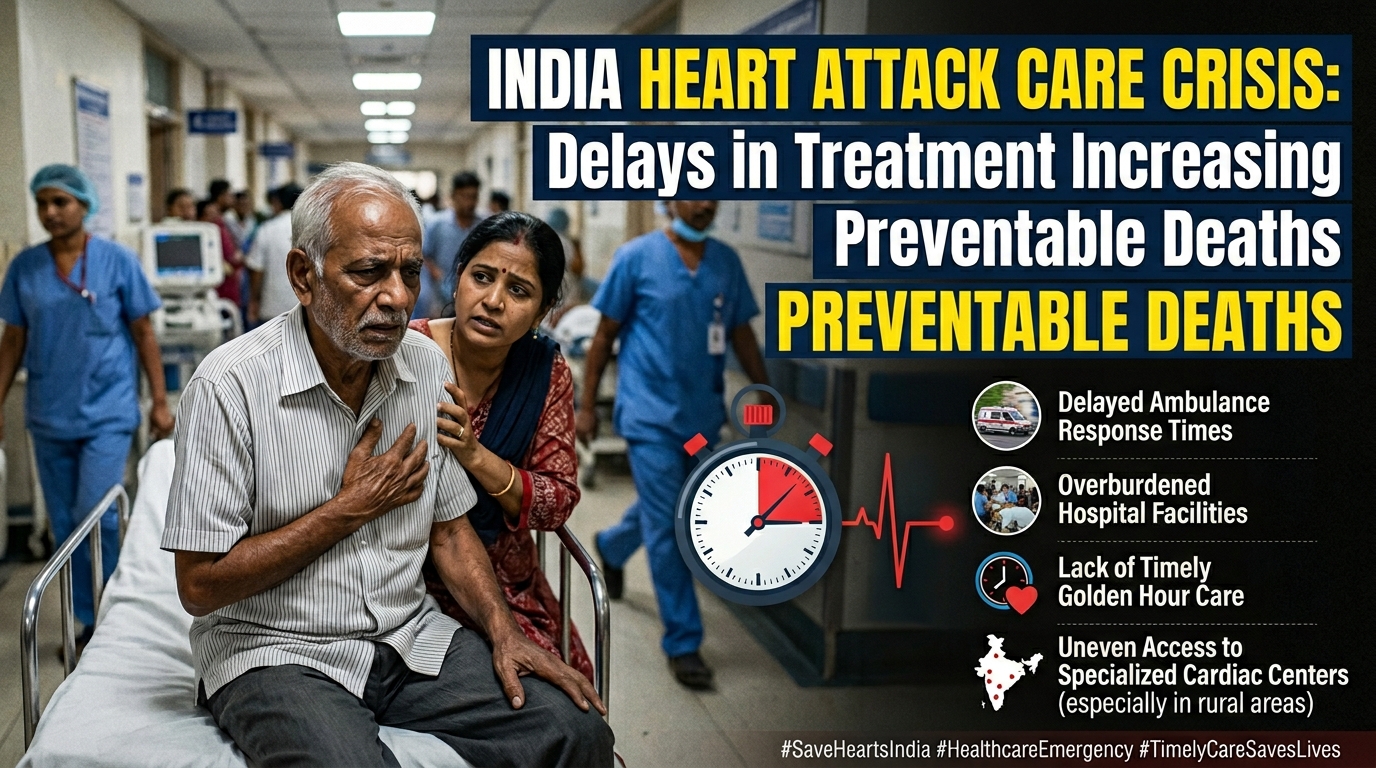
India Heart Attack Care Crisis: Delays in Treatment Increasing Preventable Deaths
Table of Contents
India Heart Attack Care Crisis is becoming a major public health concern as delays in diagnosis, lack of healthcare infrastructure, and high treatment costs continue to increase preventable deaths. Despite medical advancements, millions of patients in rural and remote areas struggle to access timely emergency cardiac care, making heart disease the leading cause of death in India.
Why in the News?
- A recent case from Uttarakhand highlights serious delays in heart attack treatment in rural India.
- A farmer named Jassu Ram Khanna experienced chest pain but reached proper treatment only after several hours due to lack of nearby facilities and specialists.
- This case reflects a larger national problem where many patients do not get timely care during heart attacks.
- Heart disease is the leading cause of death in India, causing around 28–29 lakh deaths every year.
What are the Key Highlights?
Delay in Diagnosis and Treatment
- Heart attack patients need very quick diagnosis and treatment to survive.
- Experts recommend that an ECG test should be done and interpreted within 10 minutes of first medical contact.
- In reality, patients often reach hospitals after 6 hours or more.
- In hilly areas, delays can extend up to 12 hours due to distance and poor transport.
“Time is Muscle” Concept
- The phrase “time is muscle” means that delay in treatment causes permanent damage to heart muscles.
- The heart needs a continuous blood supply to function properly.
- If blood flow is not restored quickly, heart muscle cells start dying.
- The most critical time for treatment is within 1–3 hours after a heart attack.
Lack of Basic Diagnostic Facilities
- Primary Health Centres (PHCs), which are the first contact point in rural areas, often do not have ECG machines.
- ECG (Electrocardiogram) is a simple test that records the electrical activity of the heart.
- Because of this, patients are referred to distant centres for basic diagnosis.
Unequal Distribution of Cardiac Facilities
- Advanced treatment like angioplasty requires special facilities called cath labs.
- A cath lab is a specialised hospital room where doctors treat blocked heart arteries.
- India has around 2,500 cath labs.
- Most of them are located in cities and in states like Maharashtra, Tamil Nadu, Gujarat, Kerala, and Delhi.
- Around 90% of these facilities are in the private sector.
Shortage of Specialists
- India has fewer than 0.45 cardiologists per 100,000 people.
- A cardiologist is a doctor who specialises in heart diseases.
- Most cardiologists work in big cities, leaving rural areas underserved.
High Cost of Treatment
- Many patients depend on private hospitals due to lack of public facilities.
- This leads to very high out-of-pocket expenses.
- Nearly half of heart patients face catastrophic health expenditure.
- This means they spend a large part of their income on treatment.
Problems in Government Schemes
- Schemes like Ayushman Bharat PM-JAY are meant to reduce financial burden.
- However, patients sometimes face denial of treatment in private hospitals.
- This forces patients to travel long distances to public hospitals.

What are the Significance?
Saving Lives Through Timely Treatment
- Early diagnosis and treatment can significantly reduce deaths due to heart attacks.
- If treated within the golden hour, survival chances increase greatly.
Reducing Long-Term Disability
- Quick treatment prevents permanent heart damage.
- This helps patients return to normal life and reduces disability.
Strengthening Public Health System
- Improving emergency cardiac care will strengthen the overall healthcare system.
- It will make healthcare more accessible and reliable for citizens.
Economic Benefits
- Reducing treatment delays lowers healthcare costs in the long run.
- It prevents expensive complications and repeated hospital visits.
Promoting Health Equity
- Better rural healthcare ensures equal access for all citizens.
- It reduces the gap between urban and rural health services.
Challenges
Lack of Awareness
- Many people do not recognise symptoms of a heart attack.
- Symptoms include chest pain, shortness of breath, sweating, and discomfort in arms or jaw.
- A study showed that only 11% of patients reached a proper facility within one hour.
Poor Healthcare Infrastructure
- Many PHCs do not have ECG machines or trained staff.
- This delays early diagnosis and referral.
Limited Access to Specialists
- Cardiologists are concentrated in urban areas.
- Rural patients do not get expert care in time.
Transport and Geographic Barriers
- Patients in remote areas face long travel distances.
- Poor roads and lack of ambulances worsen the situation.
High Treatment Costs
- Private hospitals charge high fees for procedures like angioplasty.
- Many families face financial crisis due to medical expenses.
Underutilisation of Alternative Treatments
- Thrombolysis is a treatment that dissolves blood clots using medicines.
- Non-specialist doctors often hesitate to use it due to fear of complications.
Weak Implementation of Insurance Schemes
- Patients face rejection or delays under government schemes.
- This reduces trust in public healthcare support systems.
Way Forward
Strengthening Primary Healthcare
- PHCs should be equipped with ECG machines and trained staff.
- Early diagnosis at the village level can save crucial time.
Improving Emergency Response Systems
- Ambulance services should be improved and made widely available.
- Fast transport can reduce delays in reaching hospitals.
Expanding Cardiac Infrastructure
- More cath labs should be set up in rural and semi-urban areas.
- Public sector investment should be increased.
Increasing Number of Specialists
- More cardiologists should be trained and encouraged to work in rural areas.
- Incentives can be provided for rural postings.
Promoting Awareness
- Public awareness campaigns should educate people about heart attack symptoms.
- People should be encouraged to seek immediate medical help.
Effective Use of Technology
- Telemedicine can connect rural doctors with specialists in cities.
- This can help in quick diagnosis and treatment decisions.
Strengthening Insurance Schemes
- Government schemes should ensure timely and fair treatment.
- Strict monitoring is needed to prevent denial of services.
Encouraging Use of Thrombolysis
- Training should be provided to doctors for safe use of clot-dissolving drugs.
- This can act as a life-saving alternative when angioplasty is not available.
Conclusion
India’s heart attack care system clearly shows that survival often depends on where a person lives rather than the availability of medical science. Improving early response, strengthening rural healthcare, and ensuring affordable treatment can change this situation. A coordinated effort between government, healthcare providers, and society is needed to ensure that every patient gets timely and effective care regardless of location.
Magnetic Field Discovery: New Study Reveals Longer Earth Reversal Duration
HALEU-Thorium Debate: Nuclear Fuel Controversy Challenges India’s Energy Strategy
Captive Power Boost: Electricity Rules Amendment 2025 Strengthens India’s Energy Sector
Read Also:
NavIC Crisis: IRNSS-1F Atomic Clock Failure Weakens India’s Navigation System
Discovery of Euthalia Zubeengargi: New Butterfly Species Highlights India’s Rich Biodiversity
Controversial Transgender Rights Amendment Bill 2026 Raises Concerns Over Inclusion and Democracy
Heart disease kills 28.6 lakh Indians every year and yet, …