
CSMP IAS : India's Premier Coaching Institute for IAS / PCS
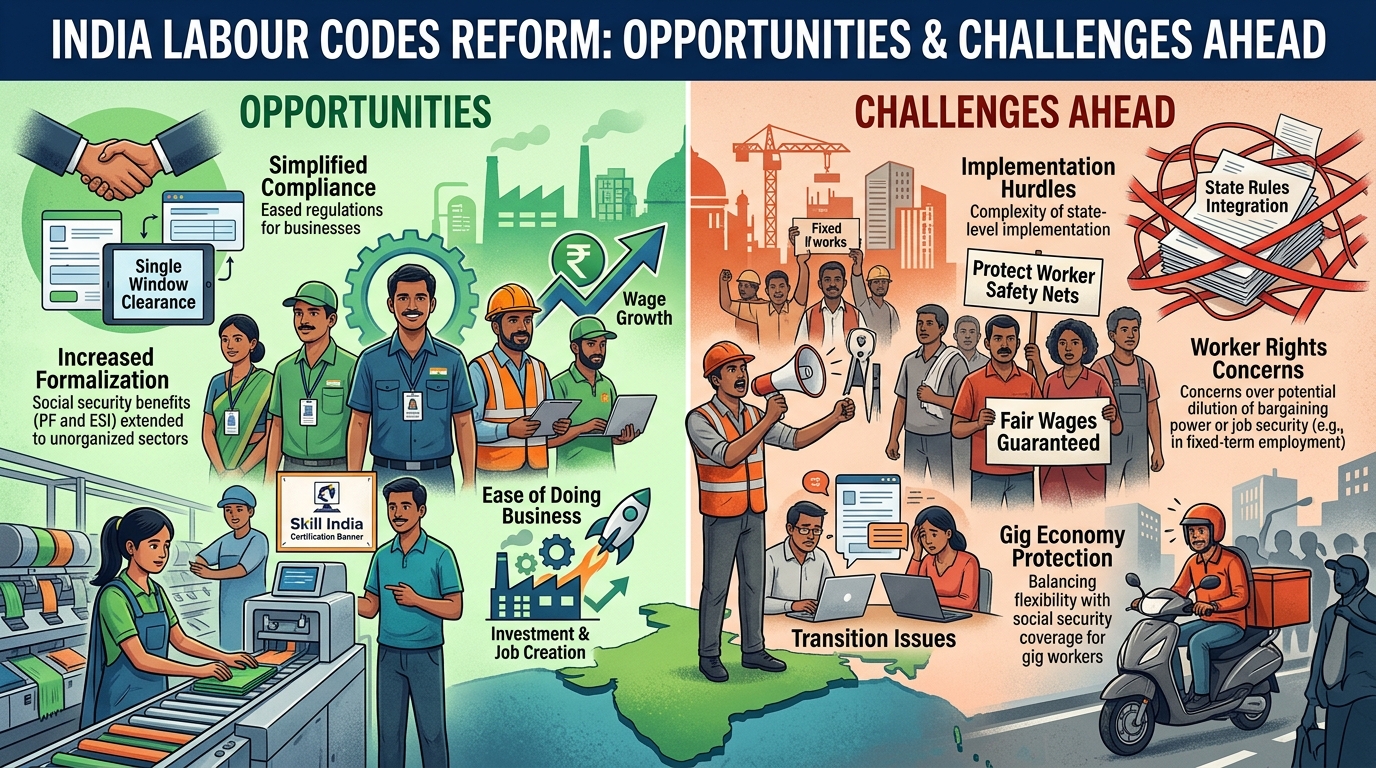
India Labour Codes Reform: Opportunities and Challenges in India Labour Codes Reform
Table of Contents
The India Labour Codes Reform has emerged as a major policy initiative aimed at transforming the country’s labour market. With new draft rules released in December 2025, the government seeks to improve job creation, increase formal employment, boost female workforce participation, and support economic growth. However, concerns remain regarding implementation, worker protection, and the rise of contract-based jobs. This topic is highly relevant for aspirants preparing for UPSC, UPPCS, and UPPSC exams.
Why in the News?
- India recently released draft rules for its new labour codes in December 2025.
- These codes are presented as a major reform to improve jobs, wages, and working conditions in the country.
- The government expects that the new codes will increase formal employment, create more jobs, boost female workforce participation, and contribute to economic growth by 2029-30.
What are the Key Highlights?
- Expected Benefits According to Government:
- Increase formalisation of workers from 60.4% to 75.5%.
- Generate around 77 lakh new jobs.
- Reduce overall unemployment.
- Boost female labour force participation.
- Add 1.25% to India’s GDP by 2029-30.
- Changes in Labour Codes:
- Definitions of “factory” and thresholds for contract labour have been increased.
- Fixed-term employment is encouraged as a way to expand formalisation.
- Platform companies must contribute 1%-2% of turnover for gig worker schemes.
- National Floor Wage and National Minimum Wage are introduced.
- Labour inspectors are now “Inspector-cum-Facilitators” with more focus on helping employers comply.
Significance of India Labour Codes Reform
Job Creation and Formalisation
- The codes aim to make more jobs registered and formal.
- Fixed-term contracts provide some benefits like appointment letters and gratuity.
Protection for Gig and Contract Workers
- Platform workers will have some funds and contributions from companies.
- Retraining funds are available for retrenched workers.
Wage Regulation
- National Minimum and Floor Wages aim to ensure fair pay for workers.
- Higher wages can boost spending, which helps the economy.
Simplified Compliance for Employers
- Companies will have fewer hurdles to hire and lay off workers.
- The intention is to encourage firms to formalise employment.
Challenges
High Informality
- Over 80% of India’s workers are in the informal sector.
- Informal work remains outside most protections.
Shift from Permanent to Contract Jobs
- Firms are replacing permanent workers with contract or casual workers.
- Regular employment in public sector is declining.
Loopholes in Labour Codes
- Thresholds for protections have been increased, reducing coverage.
- Rules for gig workers and retraining are vague and unclear.
- Labour inspectors now help employers, which may weaken enforcement.
Structural Issues
- Informality is profitable for firms, so simply lowering compliance costs may not improve job quality.
- Formalisation numbers may rise on paper but not in real worker benefits.
Way Forward
Strengthening Enforcement
- Ensure labour inspectors can monitor and enforce laws effectively.
- Penalties for violations should discourage rule-breaking.
Expand Coverage
- Reduce thresholds so more workers get protection.
- Include informal sector and gig workers under key protections.
Clear Guidelines for Funds and Benefits
- Define how platform contributions and retraining funds will be used.
- Ensure workers can access benefits and skills training.
Promote True Job Security
- Encourage permanent employment with social security.
- Limit excessive use of fixed-term contracts.
Conclusion
The new labour codes have the potential to reshape India’s labour market, but many challenges remain. Without proper enforcement, clear rules, and focus on real job security, the intended benefits may remain largely on paper. A balanced approach that protects workers while supporting business growth is essential for meaningful formalisation.
Relevant Articles:
Western Media Double Standards: Bias in Global Politics
India China Military Gap: Urgent Need for Defence Reforms
Strait of Hormuz Crisis: Global Energy Security and India’s Strategic Response
Read Also:
Persian Gulf Ecosystem Crisis: Marine Biodiversity Under Threat and Conservation Efforts
India New Climate Goals 2035: Ambitious NDC Targets for Non-Fossil Energy Expansion
Four-Year Undergraduate Programme India: Higher Education Reform and Academic Flexibility Debate
India’s Labour Reforms: Simplification, Security, and …