
CSMP IAS : India's Premier Coaching Institute for IAS / PCS
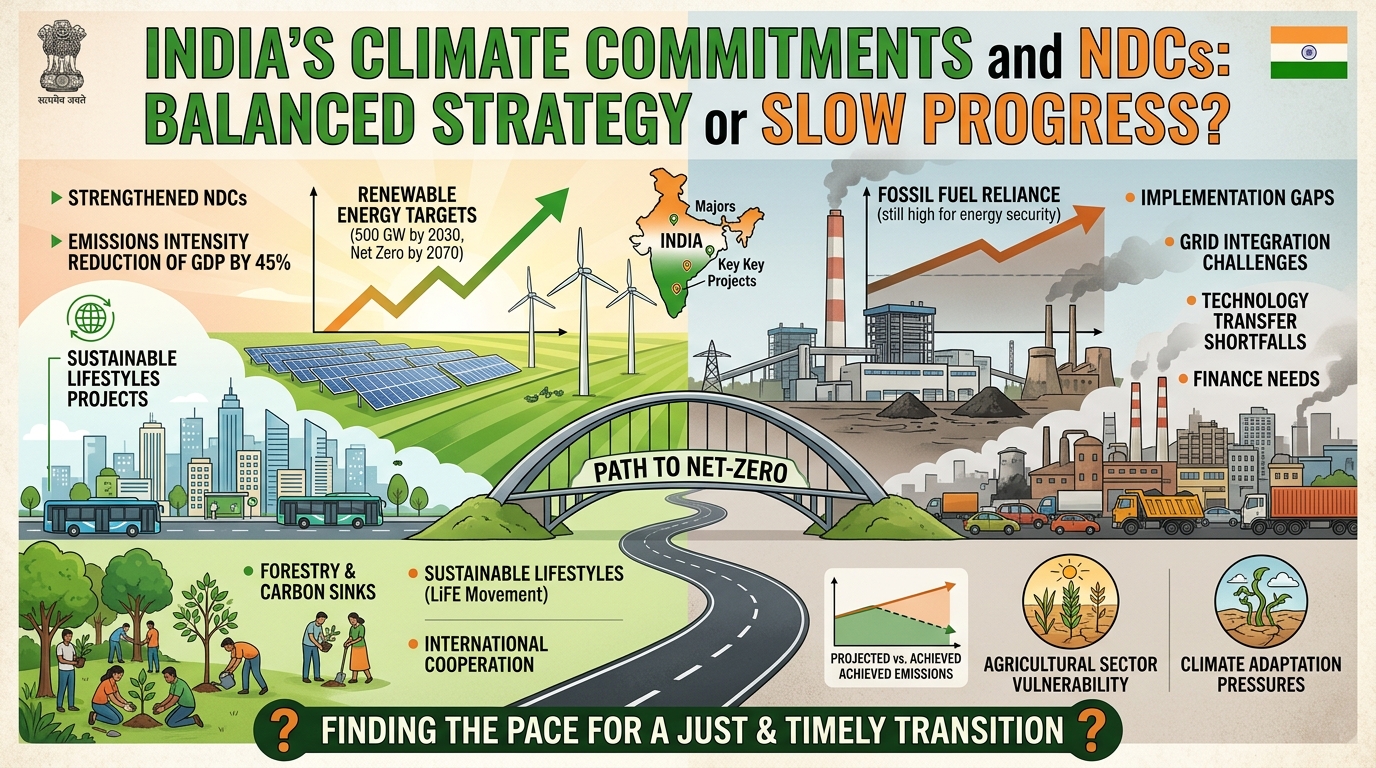
India’s Climate Commitments and NDCs: Balanced Strategy or Slow Progress
Table of Contents
India’s Climate Commitments and NDCs have become a key part of global climate discussions under the Paris Agreement. India has adopted a balanced and practical approach by setting targets for reducing emissions intensity, increasing renewable energy, and creating carbon sinks. However, debates continue on whether these commitments are sufficient to meet global climate goals or if they reflect a cautious and slow progress strategy due to developmental constraints.
Why in the News?
- India has recently updated its Nationally Determined Contributions (NDCs), which are its climate action commitments under the Paris Agreement.
- These updates reflect India’s approach towards balancing development needs and climate responsibility.
- The government has adopted a gradual and practical approach instead of very aggressive targets.
- This approach focuses on feasibility, cost, and fairness, especially considering India’s status as a developing country.
- There is an ongoing debate globally and within India about whether:
- India’s climate commitments are adequate.
- Or whether India should do more to limit global warming to 1.5°C.
What are the Key Highlights?
1. What are Nationally Determined Contributions (NDCs)?
- Nationally Determined Contributions (NDCs) are climate action plans submitted by each country under the Paris Agreement.
- These plans include targets for reducing greenhouse gas emissions and adapting to climate change.
- NDCs are:
- Voluntary commitments, but countries are expected to update them every five years.
- Designed according to each country’s capabilities and circumstances.
- Example:
- Developed countries like the USA have different targets compared to developing countries like India.
2. India’s Three Main Climate Goals (Updated NDCs)
- India has announced three important targets under its updated NDCs:
- Reduction in Emissions Intensity
- India aims to reduce the emissions intensity of GDP by 47% below 2005 levels by 2030.
- Emissions intensity means the amount of pollution produced per unit of economic output.
- This means India will grow economically while reducing pollution per unit of growth.
- India aims to reduce the emissions intensity of GDP by 47% below 2005 levels by 2030.
- Increase in Renewable Energy Capacity
- India aims to ensure that 60% of installed electricity capacity comes from non-fossil fuel sources.
- These sources include solar, wind, hydro, and nuclear energy.
- India aims to ensure that 60% of installed electricity capacity comes from non-fossil fuel sources.
- Creation of Carbon Sink
- India aims to create an additional carbon sink of 2.5 to 3 billion tonnes of CO₂ equivalent.
- A carbon sink absorbs more carbon dioxide than it emits.
- Example: Forests act as natural carbon sinks.
- India aims to create an additional carbon sink of 2.5 to 3 billion tonnes of CO₂ equivalent.
3. India’s Development Context
- India is a lower middle-income country, and its climate policies must consider development needs.
- India still needs to:
- Reduce poverty
- Improve infrastructure
- Increase industrial growth
- India still needs to:
- Therefore, India emphasizes:
- Climate justice, which means fairness in climate action.
- Developed countries should take more responsibility because they have historically emitted more carbon.
4. Structural Constraints in Climate Action
- India faces several structural challenges, which affect its climate commitments:
- Economic Constraints
- Clean energy technologies are often expensive.
- India must balance between affordable energy and clean energy.
- Energy Dependence on Coal
- Coal is still the main source of electricity in India.
- Switching away from coal is difficult and costly.
- Development Needs
- India is still growing, so energy demand is increasing rapidly.
5. Steps Taken by India for Climate Action
- India has taken several important steps:
- Renewable Energy Expansion
- India is rapidly increasing solar and wind energy capacity.
- Electric Vehicles (EVs)
- Promotion of electric vehicles to reduce pollution from transport.
- Green Hydrogen Mission
- Development of green hydrogen as a clean fuel.
- Energy Efficiency
- Introduction of mandatory standards for industries to reduce energy use.
- Carbon Capture Technologies
- Efforts are being made to capture and store carbon emissions.
6. Debate on Adequacy of India’s NDCs
- Some experts argue that:
- India’s targets are not enough to meet global goals of limiting warming to 1.5°C.
- Others argue that:
- India is already doing more than its fair share.
- Developed countries are not fulfilling their responsibilities.

What are the Significance?
1. Significance for Climate Action
- India’s NDCs contribute to global efforts to reduce climate change.
- They show India’s commitment to a low-carbon future.
2. Significance for Sustainable Development
- Climate policies promote:
- Clean energy
- Efficient industries
- Sustainable growth
- This ensures that development does not harm the environment.
3. Significance for Global Leadership
- India is emerging as a leader among developing countries.
- It promotes the idea of climate justice globally.
4. Significance for Energy Transition
- The shift towards renewable energy will:
- Reduce dependence on fossil fuels.
- Improve energy security.
5. Significance for Innovation
- Climate action encourages:
- New technologies like green hydrogen.
- Innovation in energy storage and efficiency.
6. Significance for Environmental Protection
- Reduction in emissions will:
- Improve air quality.
- Reduce global warming.
Challenges
1. High Cost of Green Transition
- Transitioning to clean energy requires huge investment.
- Renewable energy infrastructure and storage systems are expensive.
2. Dependence on Coal
- Coal remains the backbone of India’s power sector.
- Reducing its use may affect energy supply and jobs.
3. Limited Energy Storage Capacity
- Renewable energy is not constant.
- Storage technologies like batteries are still costly and limited.
4. Infrastructure Constraints
- Large-scale renewable projects face challenges such as:
- Land acquisition
- Environmental concerns
- Water usage
5. Lack of Climate Finance
- India needs financial support from developed countries.
- However, such funding has been inadequate.
6. Development vs Environment Conflict
- Rapid industrial growth increases emissions.
- Balancing growth and sustainability is difficult.
7. Global Inequality
- Developed countries have historically emitted more carbon.
- Yet developing countries face pressure to reduce emissions.
Way Forward
1. Increase Investment in Green Technology
- India should invest more in:
- Renewable energy
- Battery storage
- Clean technologies
2. Strengthen International Cooperation
- Developed countries should:
- Provide finance and technology support.
3. Promote Energy Efficiency
- Industries and households should adopt:
- Energy-saving practices
- Efficient technologies
4. Diversify Energy Sources
- India should reduce dependence on coal by:
- Expanding solar, wind, and nuclear energy.
5. Improve Policy Framework
- Policies should support:
- Innovation
- Private sector participation
- Sustainable development
6. Focus on Sustainable Urbanisation
- Cities should adopt:
- Clean transport
- Green buildings
- Efficient infrastructure
7. Encourage Public Participation
- Citizens should be encouraged to:
- Use clean energy
- Reduce waste
- Adopt sustainable lifestyles
Conclusion
India’s climate commitments reflect a careful balance between development and environmental responsibility. The path ahead requires cooperation, innovation, and practical policymaking to ensure that growth remains sustainable while contributing meaningfully to global climate goals.
Relevant Articles:
Women’s Reservation Act and Delimitation Debate: Balancing Representation and Federal Fairness
Sabarimala Case and Religious Freedom Debate: Supreme Court Examines Women’s Entry and Rights
Read More:
Urban Tuberculosis Crisis in India: Why Health for All Is Still a Distant Goal
India commits to reduce Emissions Intensity of its GDP …
