
CSMP IAS : India's Premier Coaching Institute for IAS / PCS
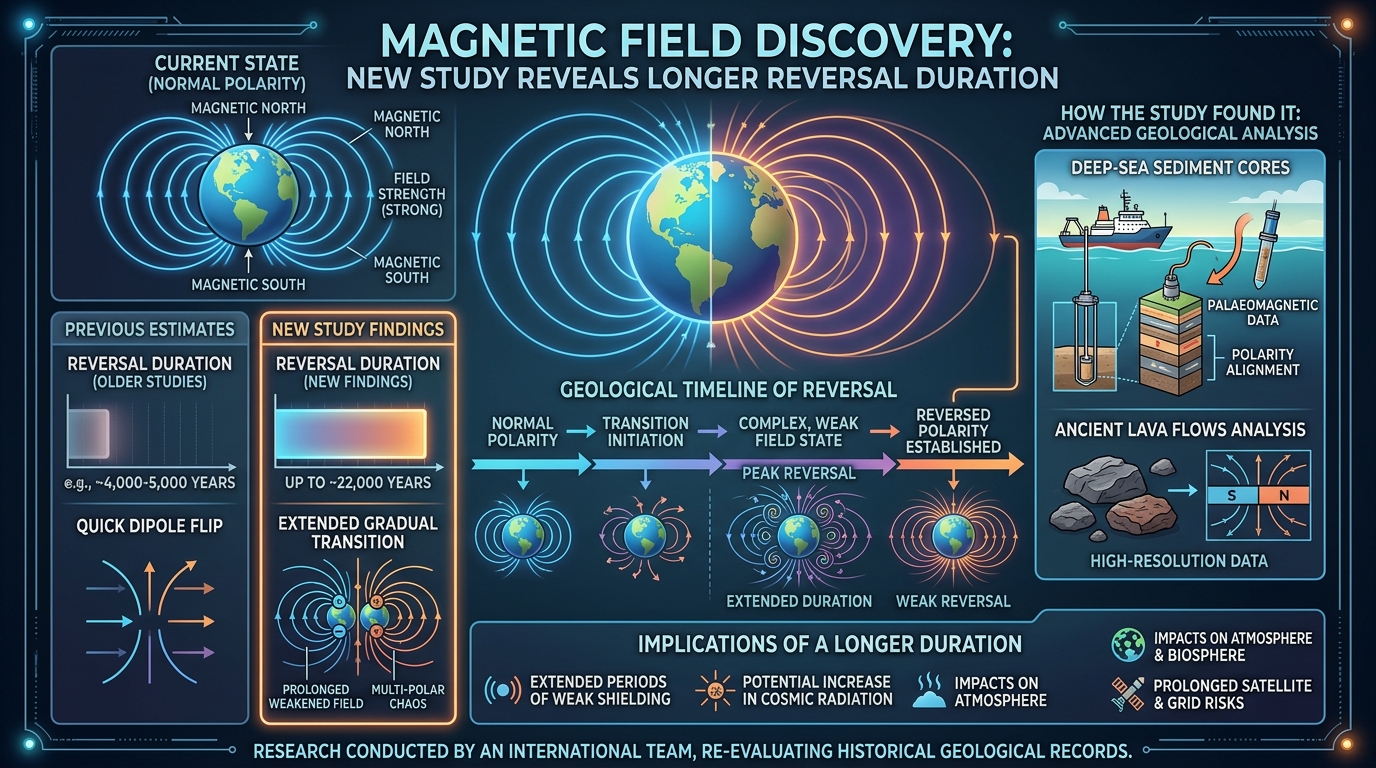
Magnetic Field Discovery: New Study Reveals Longer Earth Reversal Duration
Table of Contents
The Magnetic Field Discovery from a recent study published in Communications Earth & Environment has revealed that Earth’s magnetic field reversals may last much longer than previously believed. This breakthrough finding improves our understanding of the Geodynamo and highlights the complex nature of Earth’s internal processes, which play a crucial role in protecting life and maintaining planetary stability.
Why in the News?
- A new study published in the journal Communications Earth & Environment has provided important new insights into the behaviour of Earth’s magnetic field.
- The research has challenged earlier scientific understanding about how long magnetic field reversals take.
- Earlier, scientists believed that a magnetic reversal happens within about 10,000 years.
- However, the new study suggests that some reversals may last tens of thousands of years, even up to 70,000 years.
- This discovery is important because:
- The Earth’s magnetic field plays a crucial role in protecting life on Earth.
- Understanding its changes helps scientists study Earth’s past and future.
- It improves knowledge about deep Earth processes.
What are the Key Highlights?
Role of Earth’s Magnetic Field
- The Earth’s magnetic field is like a protective shield around the planet.
- It is generated deep inside the Earth.
- Functions of the magnetic field:
- It protects the Earth from harmful solar radiation coming from the Sun.
- It deflects charged particles from space, which are called solar wind.
- It helps in navigation systems used by ships and aircraft.
- Biological Importance:
- Many animals like birds, turtles, and whales use the magnetic field for navigation.
- This ability is called magnetoreception.
Magnetic Field Reversal
- Sometimes, the Earth’s magnetic poles switch places.
- The north magnetic pole becomes south and vice versa.
- This process is called a magnetic reversal.
- Concept Understanding:
- Magnetic reversal is a natural process.
- It has occurred many times in Earth’s history.
- It does not happen suddenly but over a long period.
Earlier Understanding
- Scientists earlier believed that magnetic reversals were relatively fast.
- The estimated duration was around 10,000 years.
- Basis of Earlier Belief:
- Limited geological records.
- Simplified models of Earth’s interior.
New Research Findings
- The new study provides a different understanding:
- Key Findings:
- Some reversals lasted up to 70,000 years.
- One reversal lasted about 18,000 years.
- Another lasted about 70,000 years.
- Meaning of the Finding:
- Magnetic reversals are slower and more complex than previously thought.
- The process involves instability and gradual changes.
Study of Earth’s History
- Scientists studied deep-sea sediment cores.
- These sediments were formed about 40 million years ago.
- Geological Period:
- The sediments belong to the Eocene period.
- The Eocene period is known for warm climate and important evolutionary changes.
- Location of Study:
- Sediments were collected from the North Atlantic Ocean.
How the Evidence Was Recorded
- Tiny magnetic minerals are present in ocean sediments.
- When these particles settle, they align with Earth’s magnetic field.
- Process of Recording:
- Each layer of sediment preserves the direction and strength of the magnetic field at that time.
- Over millions of years, these layers form a natural record.
- Concept Understanding:
- This process is called paleomagnetism.
- It helps scientists study ancient magnetic fields.
Methods Used in the Study
- Scientists used advanced techniques to study the sediments:
- X-ray Scanning
- It helps identify structure and composition of sediments.
- Magnetic Measurements
- It helps measure the strength and direction of ancient magnetic fields.
- Importance of Methods:
- These techniques allow accurate reconstruction of Earth’s magnetic history.
Findings on Reversal Duration
- The study identified different durations of reversals:
- Shorter Reversal
- One reversal lasted about 18,000 years.
- Longer Reversal
- Another reversal lasted about 70,000 years.
- Complex Behaviour
- The long reversal showed instability.
- The magnetic field changed direction multiple times before stabilizing.
Simulation Studies
- Scientists used computer models to simulate Earth’s core processes.
- Findings from Simulation:
- Magnetic reversals are a natural part of the geodynamo process.
- They are rare but expected events.
- Concept Understanding: Geodynamo
- The Geodynamo is the process that generates Earth’s magnetic field.
- It occurs due to movement of liquid iron in the outer core.
Weak Magnetic Field During Reversal
- During a reversal, the magnetic field becomes weaker.
- Duration of Weakness:
- The field can remain weak for thousands of years.
- It may last up to 70,000 years.
- Importance:
- A weaker field reduces protection from solar radiation.
Possible Effects
- Increased Solar Radiation
- More radiation may reach Earth’s surface.
- Impact on Atmosphere
- The atmosphere may experience changes in composition.
- Climate Effects
- Changes in radiation may influence climate patterns.
- Biological Impact
- Increased radiation may affect living organisms.

What are the Significance?
Understanding Earth’s Geodynamo
- The Earth’s magnetic field is generated by the geodynamo process.
- Importance
- Studying reversals helps understand how the core works.
- It explains how magnetic fields are created and maintained.
Better Knowledge of Earth’s Geological History
- Sediments provide a record of past magnetic fields.
- Importance
- Helps reconstruct Earth’s history.
- Provides information about ancient environments.
Insights into Planetary Protection
- The magnetic field protects Earth from harmful radiation.
- Importance
- Understanding changes helps assess risks.
- Helps prepare for future magnetic changes.
Understanding Environmental Changes
- Weak magnetic fields may affect environment.
- Importance
- May influence climate patterns.
- May impact ecosystems and biodiversity.
Improvement in Scientific Models
- New findings improve computer models.
- Importance
- Helps simulate Earth’s processes accurately.
- Improves predictions.
Relevance for Space Science
- Magnetic field behaviour is important for space studies.
- Importance
- Helps understand other planets.
- Useful for studying Mars, which lacks a strong magnetic field.
Importance for Navigation Systems
- Navigation systems depend on magnetic field.
- Importance
- Changes in field affect navigation accuracy.
- Important for aviation and shipping.
Challenges
Limited Geological Data
- Magnetic records are not available everywhere.
- Problem
- Older records are rare.
- Data gaps affect research accuracy.
Difficulty in Deep-Sea Research
- Collecting sediment cores is difficult.
- Problem
- Requires expensive equipment.
- Needs specialized ships and technology.
Uncertainty in Predictions
- Scientists cannot predict reversals accurately.
- Problem
- Timing of next reversal is unknown.
- Behaviour of magnetic field is complex.
Limited Understanding of Core Processes
- The Earth’s core is inaccessible.
- Problem
- Direct observation is not possible.
- Scientists rely on indirect data.
Complexity of Magnetic Behaviour
- Magnetic field changes are irregular.
- Problem
- Difficult to model accurately.
- Requires advanced computation.
High Cost of Research
- Research requires advanced tools and facilities.
- Problem
- Funding limitations can slow progress.
Way Forward
Expand Geological Data Collection
- Scientists should collect more sediment samples.
- Benefit
- Improves data availability.
- Enhances accuracy of studies.
Improve Research Technology
- Advanced tools should be developed.
- Benefit
- Better data analysis.
- Higher precision in measurements.
Strengthen Global Scientific Collaboration
- International cooperation is needed.
- Benefit
- Data sharing improves research quality.
- Reduces duplication of effort.
Develop Better Simulation Models
- Improve computer models of Earth’s core.
- Benefit
- Better predictions.
- Improved understanding of processes.
Study Impacts on Environment and Life
- More research is needed on environmental effects.
- Benefit
- Helps understand climate impacts.
- Protects ecosystems.
Increase Funding for Earth Sciences
- Governments should invest more in research.
- Benefit
- Supports innovation.
- Improves scientific knowledge.
Promote Interdisciplinary Research
- Collaboration between geology, physics, and climate science is important.
- Benefit
- Provides comprehensive understanding.
- Improves research outcomes.
Conclusion
The new findings about Earth’s magnetic field reversals reveal that the planet’s internal processes are more dynamic and complex than previously understood. Continuous research, better technology, and global cooperation will play a key role in uncovering these hidden processes and helping humanity better understand the long-term behaviour of our planet.
Relevant Articles:
HALEU-Thorium Debate: Nuclear Fuel Controversy Challenges India’s Energy Strategy
Captive Power Boost: Electricity Rules Amendment 2025 Strengthens India’s Energy Sector
NavIC Crisis: IRNSS-1F Atomic Clock Failure Weakens India’s Navigation System
Read Also:
Discovery of Euthalia Zubeengargi: New Butterfly Species Highlights India’s Rich Biodiversity
Controversial Transgender Rights Amendment Bill 2026 Raises Concerns Over Inclusion and Democracy
Illegal Sand Mining Crisis in Chambal Sanctuary Raises Environmental Concerns
Flip Flop: Why Variations in Earth’s Magnetic Field Aren’t …