
CSMP IAS : India's Premier Coaching Institute for IAS / PCS
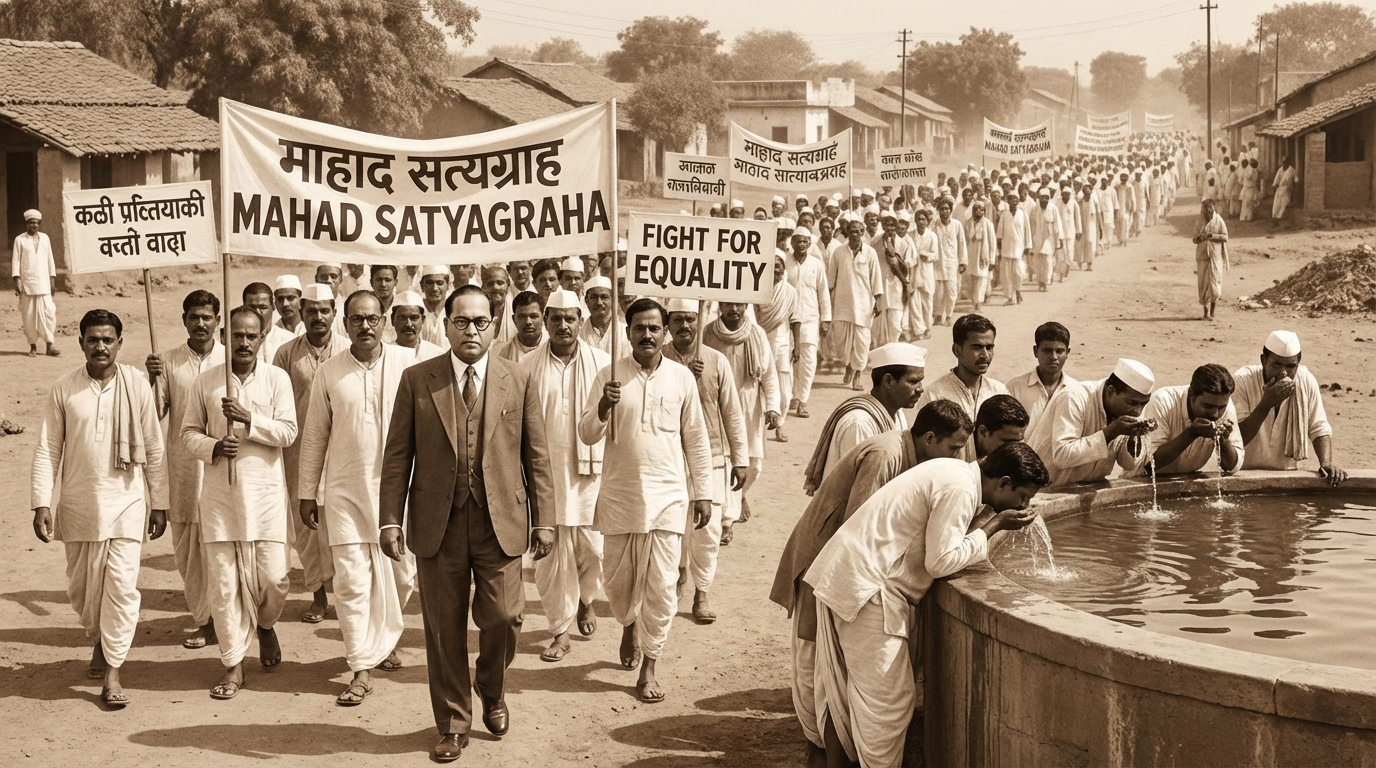
Mahad Satyagraha and the Fight for Equality
Introduction: The Mahad Satyagraha was a powerful movement led by Bhimrao Ramji Ambedkar to demand equal rights for all people, especially access to public water. It showed the deep injustice of caste discrimination in India and marked an important step toward social equality and human dignity.
Table of Contents
Why in the News?
- The upcoming 100th anniversary of the Mahad Satyagraha has brought renewed attention to issues of caste discrimination and social equality in India.
- The centenary will be observed on March 20, 2027.
- Discussions have started about how India should remember this historic movement.
- The life and struggles of Bhimrao Ramji Ambedkar are again being widely discussed.
- His early experiences of caste discrimination are being highlighted.
- His role in shaping modern India is being revisited.
- There is a growing debate on whether India has truly achieved social equality.
- Many scholars and activists are asking if untouchability has really ended.
- There is concern that discrimination still exists in hidden forms.
What are the Key Highlights?
Childhood Experiences of Discrimination
- Bhimrao Ramji Ambedkar faced deep caste discrimination during his childhood.
- He was not allowed to drink water freely in school.
- A peon had to pour water from a height.
- If the peon was absent, he could not drink water at all.
- He was not allowed to drink water freely in school.
- This experience is described in his writings:
- Waiting for a Visa
- The episode known as “No Peon, No Water”
- During a journey, he and his siblings were denied water at a railway station.
- They were considered “untouchable.”
- Even public facilities were not accessible to them.
Education and Transformation
- Despite discrimination, Ambedkar pursued higher education abroad.
- He studied at Columbia University.
- He studied at London School of Economics.
- He trained in law at Gray’s Inn.
- His education shaped his thinking on equality and justice.
- He returned to India with a vision for social reform.
The Mahad Satyagraha (1927)
- On March 20, 1927, Ambedkar led thousands to the Chavdar tank in Mahad.
- The tank was a public water source.
- Dalits were not allowed to use it despite legal permission.
- Important legal background:
- Bole Resolution allowed access to public water sources.
- Mahad Municipality opened the tank in 1924.
- However, social resistance prevented implementation.
- Ambedkar and his followers drank water from the tank.
- This was a symbolic act of equality.
- It was not just about water, but about dignity and rights.
Violence and Social Backlash
- After the protest, violence broke out.
- Upper castes attacked the participants.
- People were beaten in streets and villages.
- The tank was “purified” using cow dung and urine.
- This showed deep social prejudice.
Burning of Manusmriti
- On December 25, 1927, Ambedkar publicly burned the Manusmriti.
- This was a symbolic rejection of caste-based inequality.
- It marked a shift from protest to ideological challenge.
Legal Battle (1927–1937)
- Upper caste groups filed a case to stop Dalits from using the tank.
- A temporary injunction was granted in 1927.
- Ambedkar respected the court order.
- He believed in constitutional methods.
- The case continued for 10 years.
- Courts repeatedly rejected claims of exclusive rights.
- Final judgement:
- Narhari Damodar Vaidya v. Bhimrao Ramji Ambedkar
- The court ruled that the tank was public property.
- Dalits had full rights to use it.
Comparison with Salt March
- Mahatma Gandhi led the Salt March.
- It protested against British rule.
- Differences between movements:
- Salt March targeted colonial power.
- Mahad Satyagraha targeted social inequality within India.
- Mahad demanded change in society.
- It required people to question their own beliefs.
Influence on the Constitution
- Ambedkar later became the chief architect of the Indian Constitution.
- Key provisions influenced by Mahad:
- Article 15
- Prohibits discrimination based on caste.
- Ensures access to public places.
- Article 17
- Abolishes untouchability.
- Makes it a punishable offence.
- Article 15
What are the Significance?
Assertion of Human Dignity
- The Mahad Satyagraha was a fight for basic human dignity.
- It showed that access to water is a human right.
- It challenged the idea that some people are “untouchable.”
Beginning of Social Revolution
- The movement marked the beginning of organised anti-caste struggle.
- It gave confidence to oppressed communities.
- It inspired future movements for equality.
Transformation of Rights into Action
- Legal rights existed before the satyagraha.
- But they were not implemented.
- Mahad showed that:
- Rights must be claimed actively.
- Social change requires action.
Foundation of Constitutional Values
- The movement influenced key constitutional principles.
- Equality
- Justice
- Liberty
- It shaped India’s democratic framework.
Challenge to Social Hierarchy
- It directly questioned caste hierarchy.
- It demanded equal treatment for all.
- It exposed deep-rooted discrimination.
Role of Law and Justice
- The legal battle showed the importance of courts.
- Law can support justice.
- But justice may take time.
Inspiration for Modern India
- The movement continues to inspire social justice efforts.
- It reminds India of its unfinished tasks.
Challenges
Persistence of Caste Discrimination
- Caste discrimination still exists in many forms.
- Social exclusion continues in villages and cities.
Hidden Forms of Untouchability
- Untouchability is often indirect today.
- It appears in social practices and attitudes.
Inequality in Access to Resources
- Many communities still lack equal access to:
- Water
- Education
- Employment
Manual Scavenging
- Manual scavenging still exists in some areas.
- It reflects deep social inequality.
Weak Implementation of Laws
- Laws exist but enforcement is weak.
- Many cases go unreported.
Social Resistance to Change
- Traditional beliefs slow down reform.
- Many people resist equality measures.
Way Forward
Strengthening Legal Enforcement
- Laws must be implemented strictly.
- Authorities should take strong action against discrimination.
Promoting Social Awareness
- Awareness campaigns should be conducted.
- People must understand the importance of equality.
Improving Education
- Education should promote:
- Equality
- Respect for all communities
Economic Empowerment
- Marginalised communities need better opportunities.
- Employment and skill development should be increased.
Ending Manual Scavenging
- Strict action is needed to eliminate this practice.
- Rehabilitation programs should be strengthened.
Encouraging Social Reform
- Society must change its mindset.
- Equality should become a shared value.
Commemorating the Centenary
- The 100th anniversary should be widely observed.
- It should promote reflection and action.
Conclusion
The story of Mahad is not only about a struggle in the past but also about a responsibility in the present. It calls upon society to build a future where dignity is not decided by birth but guaranteed by humanity.
Relevant Articles:
Alarming Tuberculosis (TB): Women at Risk
NATO Crisis Over Iran War
India’s West Asia Policy Reset
Read Also:
AHAAR–L Framework: Comprehensive Counter-Terror Strategy for India
Lok Sabha Approves 2026-27 Agriculture Budget