CSMP IAS : India's Premier Coaching Institute for IAS / PCS
Musi Riverfront Development in Hyderabad: Urban Renewal Amid Controversy
Table of Contents
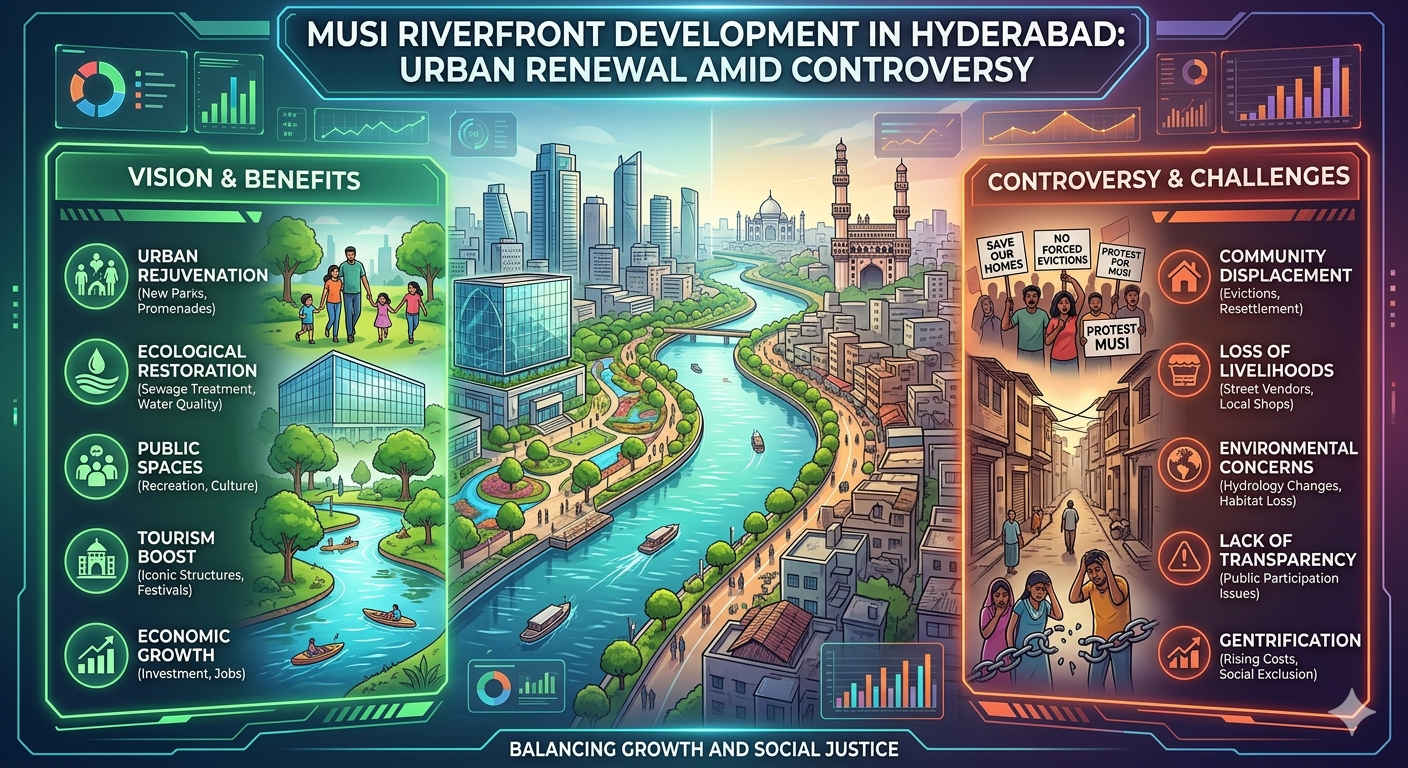
The Musi Riverfront Development Project in Hyderabad aims to transform the 55-km urban stretch of the Musi River into a clean, vibrant ecological and cultural hub. While the initiative promises improved flood management, pollution control, and recreational spaces, it has sparked controversy due to resident evictions and land acquisition conflicts. Balancing urban development with environmental sustainability and social justice remains the key challenge of this ambitious project.
Why in the News?
- The Musi River is at the centre of a major urban development proposal by the Government of Telangana.
- The government plans to transform the river into a clean and permanent water channel and develop a riverfront with recreational and commercial facilities.
- However, the project has become controversial due to evictions of residents living on the riverbed and land acquisition notifications.
- Protests have been organised by a coalition called Musi Jan Andolan, which includes residents, activists, and voluntary organisations.
What are the Key Highlights?
Background of the Musi River
- The Musi River flows for about 260 km and passes through about 55 km inside the city of Hyderabad.
- The river is formed by the confluence of two rivulets, Musa and Esi.
- These rivulets originate from the Ananthagiri Hills.
- For most of the year, the river looks like an open sewage channel, except during the monsoon season.
Historical Flood Control Measures
- In 1908, severe floods caused large-scale destruction in Hyderabad.
- After this disaster, the last ruler of the Asaf Jahi Dynasty, Mir Osman Ali Khan, built two reservoirs:
- Osman Sagar
- Himayat Sagar
- These reservoirs act as flood control structures for the Musi River.
Earlier Attempts at River Development
- Different governments have tried to develop the Musi River:
- Telugu Desam Party government in 1997–98.
- Bharat Rashtra Samithi government in 2017.
- The current Indian National Congress government is now pursuing the project.
Main Components of the River Rejuvenation Project
- The project proposes riverfront development along both sides of the 55-km stretch of the river inside Hyderabad.
- The Detailed Project Report (DPR) is still not approved yet.
Key planned measures include:
- Ensuring year-round water flow
- About 2.5 TMCFT of water will be diverted from the Godavari River.
- Water will be transported through Mallanna Sagar Reservoir, located about 72 km from Hyderabad.
- This water will fill the twin reservoirs and be released gradually into the Musi River.
- Sewage treatment
- The government plans to build 39 new Sewage Treatment Plants (STPs).
- These will be added to the existing 31 STPs to treat sewage entering the river.
- Urban development
- Development of leisure spaces, parks, shopping areas, and heritage structures along the riverbanks.
- Cultural landmark
- A large cultural complex called Gandhi Sarovar is proposed at the confluence of Musa and Esi rivers.
- It will include the world’s tallest statue of Mahatma Gandhi.
Implementation Progress
- In October 2024, the Telangana government formed a consortium of five companies to prepare the Detailed Project Report (DPR).
- At the same time, evictions and relocation of slum residents living along the riverbed began.
- Due to strong protests, the government decided to start the project first in less populated stretches along Musa and Esi rivers covering 21 km.
- The first phase of the project has received in-principle funding approval from the Asian Development Bank, but final approval is still pending.
What are the Significance?
Urban River Restoration
- The project aims to restore the ecological health of the Musi River.
- It can reduce pollution and sewage discharge into the river.
Improved Urban Environment
- Cleaning the river can improve air quality, water quality, and public health in Hyderabad.
- It may reduce the bad smell and unhygienic conditions near the river.
Flood Management
- Better river management and controlled water flow can reduce flood risks in Hyderabad.
Economic Development
- Riverfront development can promote tourism, recreation, and commercial activities.
- It may create employment opportunities in services and tourism.
Cultural and Heritage Promotion
- The proposed Gandhi Sarovar cultural precinct can become an important cultural and heritage landmark for the city.
Challenges
Displacement of Residents
- Many people have lived on the riverbanks for decades.
- Evictions without proper consultation have caused fear of displacement and loss of livelihood.
Lack of Transparency
- The Detailed Project Report has not been made public yet.
- Critics say the project is moving forward without sufficient public information or debate.
Land Acquisition Conflicts
- Recent land acquisition notifications have included private residential properties, including a gated community near the confluence area.
- This has created new protests from middle-class residents.
Social Justice Concerns
- Activists argue that residents are treated as obstacles rather than partners in river rejuvenation.
Environmental Uncertainty
- Diverting water from the Godavari River raises questions about sustainability and ecological impact.
Way Forward
Ensure Transparent Planning
- The government should publish the Detailed Project Report and allow public consultation.
Inclusive Development Approach
- Residents living along the river should be included as stakeholders in planning and implementation.
Fair Rehabilitation and Resettlement
- Displaced families must receive adequate housing, compensation, and livelihood support.
Environmental Impact Assessment
- A detailed environmental impact study should be conducted before large-scale water diversion and construction.
Phased and Balanced Development
- The project should proceed gradually, starting with pollution control and sewage treatment, before major construction activities.
Conclusion
The Musi Riverfront Development Project represents an ambitious attempt to transform a polluted urban river into a vibrant ecological and cultural space. However, long-term success will depend on balancing environmental restoration, urban development, and the rights of communities who have historically lived along the river. A transparent and inclusive approach will be essential to ensure that the project benefits both the city and its people.
Recent Articles:
IRIS Dena Incident and The Shaping of AI Geopolitics
West Asia Crisis 2026: Iran-Israel-US Conflict and Strategic Implications for India
Project Cheetah in India: Successful Reintroduction and Wildlife Conservation
Read Also:
Affordable Cancer Medicines in India: Customs Duty Exemption Reduces Treatment Costs
India–Canada Economic Partnership 2026
Viksit Bharat Rural Employment Mission: Transforming India’s Rural Jobs Landscape
musi riverfront development corporation ltd