CSMP IAS : India's Premier Coaching Institute for IAS / PCS
NavIC Crisis: IRNSS-1F Atomic Clock Failure Weakens India’s Navigation System
Table of Contents
The NavIC system, developed by the Indian Space Research Organisation, is facing a major setback after the failure of the atomic clock on IRNSS-1F. This NavIC crisis has reduced the number of operational satellites and raised serious concerns about India’s independent navigation capability. As an alternative to the Global Positioning System, NavIC plays a critical role in strategic autonomy, civilian applications, and national security, making this failure highly significant for India’s space programme.
Why in the News?
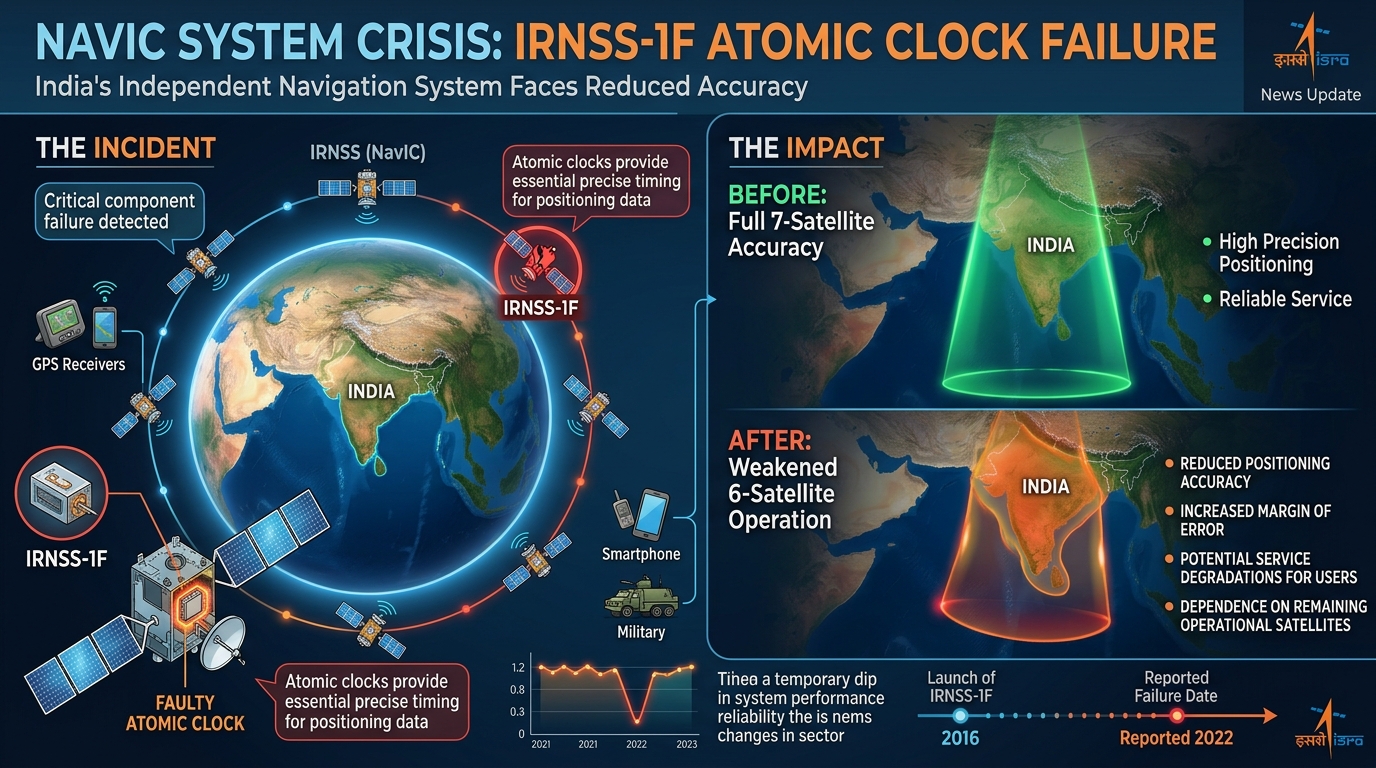
- The last working atomic clock on the satellite IRNSS-1F of India’s navigation system NavIC stopped working on 13 March 2026.
- This information was officially announced by the Indian Space Research Organisation.
- This failure has reduced the number of satellites that can provide accurate navigation services.
- This development has raised serious concerns about the strength and reliability of NavIC (Navigation with Indian Constellation).
- NavIC is India’s own regional satellite navigation system.
- It works as an alternative to foreign systems like the Global Positioning System (GPS).
- The failure is important because:
- It weakens India’s independent navigation capability.
- It affects civilian and military applications.
- It highlights technical and policy challenges in India’s space programme.
What are the Key Highlights?
Failure of the Atomic Clock
- The atomic clock on IRNSS-1F stopped functioning on 13 March 2026.
- Atomic clocks are the most critical component of navigation satellites.
- They provide extremely accurate time, which is required for position calculation.
- Without a functioning atomic clock:
- The satellite cannot provide accurate navigation data.
- Errors in location can increase significantly, sometimes by several meters or more.
- Concept Understanding: How Navigation Works
- Satellites send signals with precise time stamps.
- A receiver calculates distance using the time delay of signals.
- Even a tiny error in time leads to a large error in position.
- A time error of 1 microsecond can cause an error of about 300 meters.
Mission Life of the Satellite
- IRNSS-1F was launched in March 2016.
- Its design mission life was 10 years.
- It completed its mission life on 10 March 2026.
- Even after clock failure:
- The satellite will still provide one-way broadcast messaging services.
- These services are useful for alerts such as disaster warnings.
- Concept Understanding: Mission Life
- Every satellite is designed for a fixed duration.
- After that, components begin to degrade due to harsh space conditions like radiation and temperature extremes.
NavIC Satellite Constellation
- NavIC is India’s regional navigation system developed by ISRO.
- It is also known as IRNSS (Indian Regional Navigation Satellite System).
- Satellite details:
- A total of 9 satellites have been launched since 2013.
- 8 satellites reached their intended orbit successfully.
- The last satellite in the original constellation, IRNSS-1I, was launched in 2018.
- Structure of NavIC Constellation
- It includes Geostationary Satellites (GEO) and Geosynchronous Satellites (GSO).
- GEO satellites stay fixed over one point on Earth.
- GSO satellites move in a figure-eight pattern over India.
Current Operational Status
- In July 2025, information obtained through RTI revealed serious issues:
- Five satellites became completely defunct.
- In these satellites, all three atomic clocks stopped working.
- Five satellites became completely defunct.
- Among the remaining satellites:
- One satellite has only one working clock.
- According to Union Minister for Space Jitendra Singh:
- Earlier, four satellites were usable for navigation services.
- After IRNSS-1F failure, only three satellites remain reliable.
- Importance of Multiple Satellites
- A minimum of 4 satellites is needed for accurate 3D positioning.
- Fewer satellites reduce accuracy and reliability.
Imported Atomic Clocks
- The atomic clocks used in earlier IRNSS satellites were imported from SpectraTime.
- Characteristics of these clocks:
- Extremely high precision.
- Essential for navigation systems.
- Issues with imported technology:
- Dependence on foreign suppliers creates risks.
- Limited control over design and quality.
- Replacement becomes difficult.
Development of New Satellites
- India has started developing new-generation satellites.
- NVS-01 Satellite
- Launched in May 2023.
- It carries an indigenously developed rubidium atomic clock.
- This is a major step towards self-reliance.
- NVS-02 Satellite
- Launched in January 2025.
- It failed to reach the intended orbit.
- This delayed strengthening of NavIC.
Future Satellite Launch Plans
- ISRO plans to launch at least three more satellites by the end of 2026.
- These satellites will:
- Replace ageing satellites.
- Restore full constellation strength.
- Improve accuracy and reliability.

What are the Significance?
Strategic Autonomy in Navigation
- NavIC gives India independent navigation capability.
- It reduces dependence on foreign systems like GPS.
- Importance during conflicts:
- Foreign systems can be restricted during war or tensions.
- Example: GPS access has been selectively denied in some regions globally.
- Strategic benefit:
- Ensures uninterrupted navigation services for India.
- Strengthens national sovereignty.
Regional Navigation Capability
- NavIC provides coverage:
- Across India.
- Up to 1,500 km beyond Indian borders.
- Importance of regional coverage:
- It is sufficient for India’s strategic and economic needs.
- It supports neighboring regions and maritime zones.
- Comparison with Global Systems
- GPS, GLONASS, Galileo, and BeiDou are global systems.
- NavIC is focused on regional precision and reliability.
Support for Civilian Applications
- Navigation services are used in daily life:
- Transportation systems use navigation for route planning.
- Vehicle tracking systems help in logistics and safety.
- Disaster management:
- Helps in rescue operations.
- Provides location-based alerts.
- Mapping and surveying:
- Used in infrastructure projects.
- Helps in land record management.
- Aviation and maritime navigation:
- Ensures safe movement of aircraft and ships.
Accurate Time for Indian Systems
- Atomic clocks provide precise timing signals.
- Importance of accurate time:
- Telecom networks require synchronization.
- Financial systems depend on precise timestamps.
- Digital systems rely on accurate timing.
- Government push:
- Industries are encouraged to use NavIC for Indian Standard Time.
National Security Importance
- Independent navigation is critical for defense.
- Applications:
- Missile guidance systems require accurate positioning.
- Military operations depend on real-time navigation.
- Secure communication systems need precise timing.
- Example:
- Modern warfare relies heavily on satellite-based navigation.
Challenges due to NavIC Crisis
Satellite Ageing
- Many satellites have completed their design life.
- Ageing increases chances of failure.
- Effects of ageing:
- Component degradation.
- Reduced performance.
- Increased maintenance difficulty.
Failure of Atomic Clocks
- Atomic clocks are the core component of navigation satellites.
- Failure impact:
- Satellite becomes unusable for navigation.
- Reduces system reliability.
- Example:
- Multiple IRNSS satellites lost all three clocks.
Dependence on Imported Technology
- Earlier satellites relied on imported clocks from SpectraTime.
- Risks involved:
- Supply disruptions.
- Lack of control over technology.
- Higher costs.
Launch Failures
- NVS-02 failed to reach intended orbit.
- Impact:
- Delay in replacing old satellites.
- Increased pressure on existing satellites.
Reduced Operational Satellites
- Only three reliable satellites remain.
- Problem:
- Minimum four satellites are required for accurate positioning.
- Reduced satellites decrease accuracy.
Limited Adoption of NavIC
- NavIC is not widely used in smartphones and devices.
- Reasons:
- Lack of awareness.
- Limited chipset support.
Way Forward
Launch Replacement Satellites
- ISRO plans to launch new satellites by 2026.
- Benefits:
- Replace old satellites.
- Restore full functionality.
- Improve system reliability.
Develop Indigenous Atomic Clocks
- India has started developing rubidium atomic clocks.
- Advantages:
- Reduces import dependence.
- Improves reliability.
- Enhances technological capability.
Strengthen Satellite Constellation
- Increase number of satellites.
- Benefits:
- Better coverage.
- Higher accuracy.
- Continuous services.
Improve Testing and Reliability
- Strong testing before launch is necessary.
- Measures:
- Better quality control.
- Long-term durability checks.
- Simulation of space conditions.
Promote Adoption of NavIC
- Government can promote NavIC integration.
- Steps:
- Encourage mobile manufacturers to include NavIC chips.
- Promote use in transport and logistics.
- Integrate with public systems.
Encourage Private Sector Participation
- Private companies can contribute to innovation.
- Benefits:
- Faster development.
- Better technology solutions.
- Increased investment.
International Collaboration
- India can collaborate with friendly countries.
- Benefits:
- Technology sharing.
- Improved system integration.
- Enhanced global presence.
Conclusion
The failure of the atomic clock on IRNSS-1F highlights the urgent need to strengthen India’s satellite navigation system. A combination of timely satellite replacement, strong indigenous technology development, improved reliability measures, and wider adoption of NavIC will ensure that India maintains a stable and independent navigation capability in the future while supporting both national development and strategic interests.
Relevant Articles:
Discovery of Euthalia Zubeengargi: New Butterfly Species Highlights India’s Rich Biodiversity
Controversial Transgender Rights Amendment Bill 2026 Raises Concerns Over Inclusion and Democracy
Illegal Sand Mining Crisis in Chambal Sanctuary Raises Environmental Concerns
Read More:
U.S. Forced Labour Probe Raises Concerns for Global Trade and India
India–Canada Relations Strengthen with Strategic Economic and Energy Partnership
Economic Stabilisation Fund Boosts India’s Crisis Preparedness and Fiscal Stability
Failure of atomic clock cripples ISRO’s NavIC system