
CSMP IAS : India's Premier Coaching Institute for IAS / PCS
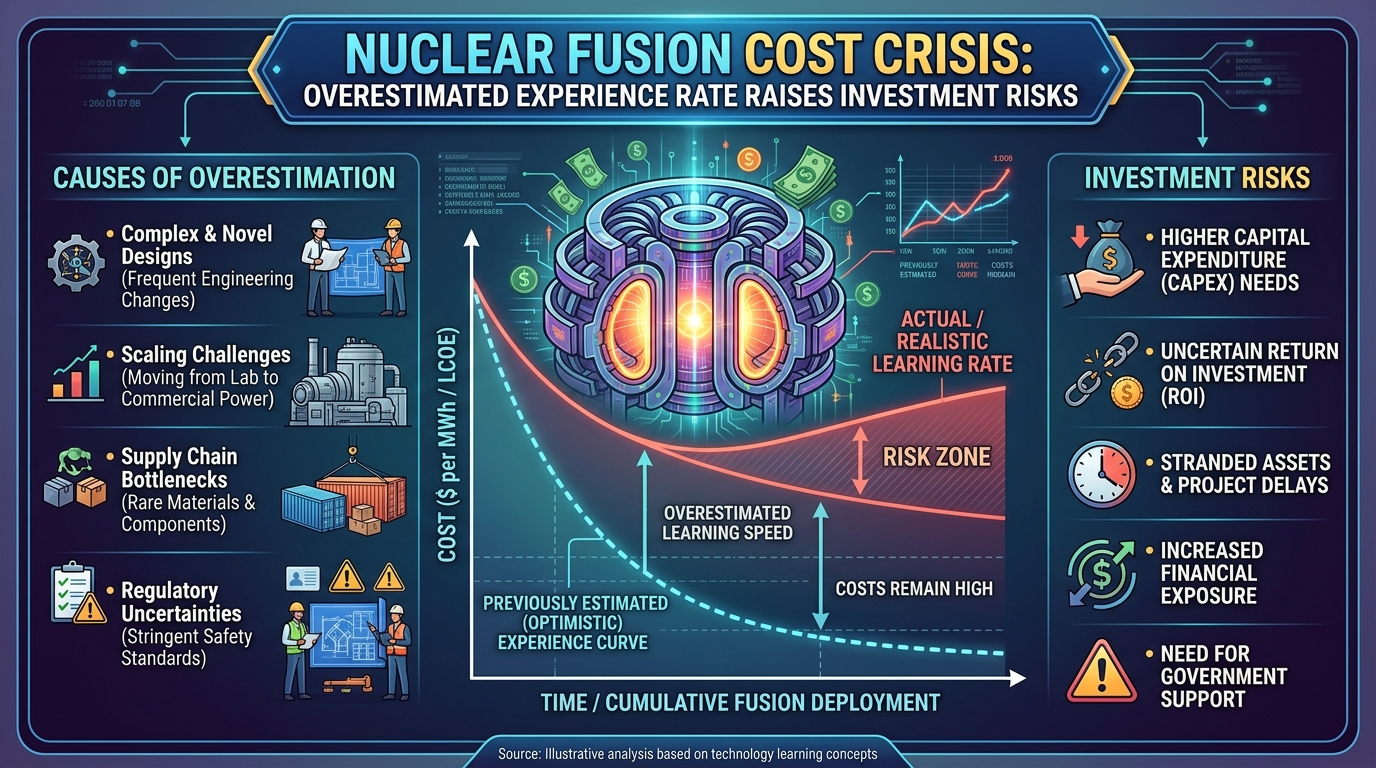
Nuclear Fusion Cost Crisis: Overestimated Experience Rate Raises Investment Risks
Table of Contents
The concept of Nuclear Fusion Cost Crisis has gained attention after a recent study published in Nature Energy highlighted serious concerns about overestimated experience rates in fusion energy. Investors around the world are putting billions into fusion projects expecting rapid cost reductions, but experts now warn that these assumptions may be unrealistic. This raises important questions about the future of clean energy investments and the risk of misallocating funds in the global fight against climate change.
Why in the News?
- Researchers have published a new study in Nature Energy that questions the economic assumptions behind nuclear fusion energy.
- The study highlights that current cost predictions for fusion energy may be too optimistic and not based on strong evidence.
- Investors across the world are investing billions of dollars in nuclear fusion.
- They believe fusion will become a cheap and reliable source of clean energy in the future.
- However, scientists warn that wrong assumptions about cost reduction may lead to poor investment decisions.
- This could divert money away from more effective climate solutions.
What are the Key Highlights?
Heavy Investment in Nuclear Fusion
- Many countries and private companies are investing large amounts in fusion technology.
- The goal is to develop a clean and sustainable energy source.
- Fusion is seen as a future solution to climate change.
- It does not produce greenhouse gases like fossil fuels.
Problem with Current Cost Models
- Economic models assume that costs will fall quickly as the technology develops.
- These assumptions are based on a concept called “experience rate.”
- Researchers found that these assumptions are not supported by real data.
- They are often based on arbitrary or unrealistic numbers.
What is Experience Rate?
- Experience rate means how much the cost of a technology decreases when its production doubles.
- For example, if the experience rate is 10%, then cost reduces by 10% every time production doubles.
Comparison with Solar and Batteries
- Solar panels and batteries have high experience rates.
- Their costs have fallen rapidly in the last decade.
- Fusion energy models assume experience rates between 8% and 20%.
- This creates an expectation of fast cost reduction.
Findings of the Study
- Researchers interviewed 28 experts in fusion technologies.
- These included experts in magnetic fusion and laser-based fusion.
- The study found that realistic experience rates for fusion are much lower.
- The actual range is between 2% and 8%.
Complexity of Fusion Technology
- Fusion reactors are extremely complex systems.
- They involve advanced physics and engineering.
- One expert said that even nuclear fission reactors are simpler compared to fusion.
Large Size of Fusion Plants
- Fusion plants need to be very large to produce useful energy.
- Even the smallest plants must produce hundreds of megawatts.
- This is required to overcome internal energy needs like heating and cooling.
Customisation of Fusion Plants
- Fusion plants cannot be mass-produced easily.
- They must be designed based on local conditions.
- Factors such as seismic risks, water availability, and regulations affect design.
Structural Design Challenges
- Magnetic fusion reactors have an “onion-like” layered structure.
- Changing one part requires redesigning the entire system.
- This increases cost and reduces efficiency in manufacturing.
Comparison with Nuclear Fission
- Fusion has a similar experience rate to traditional nuclear fission.
- Historically, fission has shown around 2% experience rate.
- This means cost reduction in fusion will be slow.
Understanding Key Concepts
What is Nuclear Fusion?
- Nuclear fusion is the process where two light atomic nuclei combine to form a heavier nucleus.
- This releases a large amount of energy.
- It is the same process that powers the Sun.
What is Nuclear Fission?
- Nuclear fission is the splitting of a heavy atomic nucleus into smaller parts.
- It also releases energy but produces radioactive waste.
Magnetic Fusion
- Magnetic fusion uses strong magnetic fields to control hot plasma.
- Plasma is a high-energy state of matter where atoms are broken into charged particles.
Inertial Fusion
- Inertial fusion uses powerful lasers to compress and heat fuel.
- This creates conditions for fusion to occur.
Capital Cost
- Capital cost means the initial investment needed to build a power plant.
- Fusion plants have very high capital costs.
Capacity Doubling
- Capacity doubling means increasing total production or number of plants by two times.
- It is used to measure cost reduction over time.

What are the Significance?
Impact on Climate Policy
- Accurate cost estimates are important for climate planning.
- Governments must invest in technologies that give the best results.
Risk of Misallocation of Funds
- Over-optimistic assumptions can lead to wrong investment decisions.
- Money may be wasted on technologies that take too long to become viable.
Importance of Realistic Planning
- Realistic projections help in better decision-making.
- They ensure that expectations match actual progress.
Influence on Energy Transition
- Fusion is seen as a future energy source.
- If it is delayed or expensive, countries must rely on other renewable sources.
Encouragement for Innovation
- The study encourages researchers to explore new designs.
- This can lead to more efficient and affordable fusion technologies.
Comparison with Renewable Energy
- Solar and wind energy are already becoming cheaper.
- Fusion must compete with these technologies in the future.
What are the Challenges?
High Technological Complexity
- Fusion technology is extremely difficult to design and operate.
- It requires advanced materials and precise control systems.
Low Experience Rate
- The cost reduction rate is slow compared to other technologies.
- This delays economic viability.
High Capital Investment
- Building fusion plants requires huge initial investment.
- This increases financial risk for investors.
Lack of Standardisation
- Fusion plants cannot be easily standardised.
- Each plant needs customised design.
Competition from Renewables
- Solar and wind energy are already cheaper and scalable.
- Fusion may struggle to compete in the near future.
Uncertain Commercial Timeline
- Fusion is still in experimental stages.
- It may take decades to become commercially viable.
What is the Way Forward?
Focus on Alternative Designs
- Researchers should explore new types of fusion reactors.
- Smaller and simpler designs may reduce costs.
Improve Cost Models
- Economic models should be based on real data.
- This will provide more accurate predictions.
Balanced Investment Strategy
- Governments should invest in a mix of technologies.
- This reduces risk and ensures better outcomes.
Increase Research Collaboration
- Countries and institutions should work together.
- Shared knowledge can speed up innovation.
Support Incremental Innovation
- Small improvements in technology should be encouraged.
- These can gradually reduce costs over time.
Strengthen Renewable Energy Deployment
- Solar and wind energy should continue to be expanded.
- They provide immediate solutions to climate change.
Conclusion
Nuclear fusion remains a promising but challenging technology that requires careful and realistic planning. While it has the potential to transform global energy systems, its economic feasibility depends on overcoming deep scientific and engineering barriers. A thoughtful approach that balances ambition with evidence can help ensure that resources are used wisely and effectively in the global fight against climate change.
Relevant Articles:
RBI Guidelines on Insurance Mis-selling: Fixing Commission-Driven Fraud in India
ISRO Mission MITRA Boosts Gaganyaan Programme with High-Altitude Human Space Research
Read More:
INS Aridhaman Boosts India Nuclear Triad Power and Maritime Strength
Plastic Waste Management Rules 2026 Raise Concerns Over Weakened Compliance
parliament question: nuclear energy projects