
CSMP IAS : India's Premier Coaching Institute for IAS / PCS
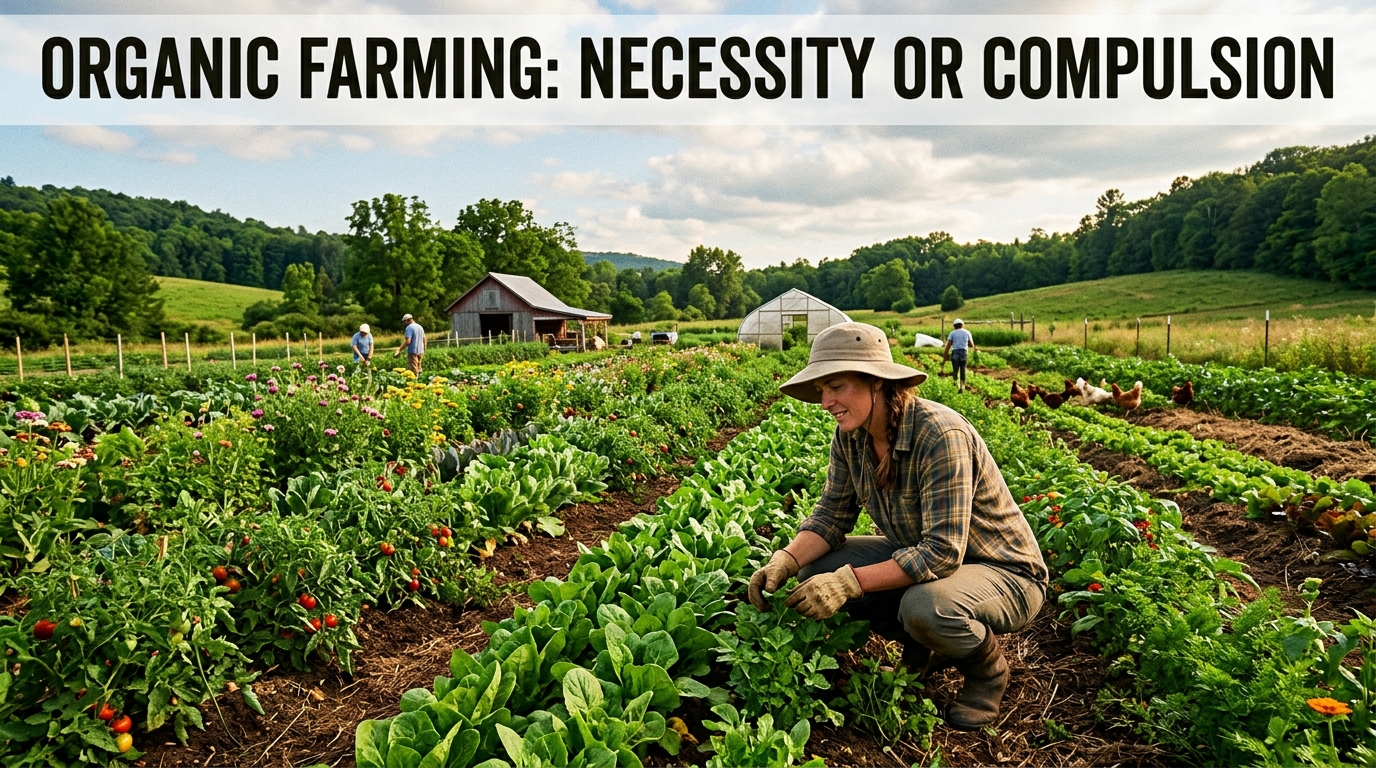
Organic Farming: Necessity or Compulsion
Organic Farming Necessity or Compulsion is an important topic in the context of modern agriculture and sustainability. With rising concerns over soil degradation, health risks, and environmental damage, organic farming is gaining attention as both a necessary choice and a forced response.
Approach to the Essay: Organic Farming: Necessity or Compulsion
To write on the topic “Organic farming: Necessity or compulsion”, we should think in a balanced, analytical, and multidimensional way:
1. Understand the Core Idea
- The topic asks whether organic farming is a choice based on awareness (necessity) or a forced response (compulsion) due to environmental and health crises.
2. Define Key Terms
- Organic farming: Farming without chemical fertilizers, pesticides, and synthetic inputs, using natural methods.
- Necessity: Something that is important and desirable for long-term well-being.
- Compulsion: Something that is forced due to crisis or lack of alternatives.
3. Historical Context
- Traditional farming was mostly organic.
- The Green Revolution introduced chemical-based agriculture for higher yields.
4. Present Situation
- Problems like soil degradation, water pollution, health issues, and climate change.
5. Arguments for “Necessity”
- Environmental protection
- Sustainable agriculture
- Health benefits
- Long-term soil fertility
6. Arguments for “Compulsion”
- Crisis of soil health
- Rising diseases
- Climate pressure
- Loss of biodiversity
7. Multiple Dimensions
- Economic: cost, productivity, farmers’ income
- Social: health and awareness
- Environmental: sustainability
- Political: government policies
- Scientific: productivity vs sustainability debate
8. Challenges
- Lower yield in short term
- Certification issues
- Market access
9. Way Forward
- Balanced approach: integrated farming, policy support, awareness
10. Conclusion
- Organic farming is both a necessity and a compulsion

Essay: Organic Farming: Necessity or Compulsion
“The soil is the great connector of lives, the source and destination of all.”
In recent years, the idea of organic farming has gained a lot of attention. Many people are now concerned about the quality of food they eat and the health of the environment. Organic farming refers to a method of agriculture that avoids the use of chemical fertilizers, synthetic pesticides, and genetically modified organisms. Instead, it uses natural inputs, crop rotation, and biological processes. The question arises whether organic farming is a necessity for sustainable development or a compulsion forced by environmental and health problems.
To understand this issue, we must look at the history of agriculture. In the past, farming was mostly organic by default. Farmers used natural manure, compost, and traditional methods. However, after the Green Revolution, there was a shift towards chemical-based farming. This helped in increasing food production and achieving food security, especially in countries like India. But over time, this method created several problems.
One of the major issues is soil degradation. Continuous use of chemical fertilizers has reduced the fertility of soil. The soil has lost its natural nutrients and microorganisms. This has made farming less sustainable in the long run. Similarly, excessive use of pesticides has caused water pollution and harmed beneficial insects. These environmental problems make organic farming a necessity for protecting natural resources.
Another important aspect is human health. Food grown with chemical inputs may contain harmful residues. These chemicals can enter the human body and cause diseases. There is growing awareness about healthy food and safe consumption. Organic farming produces food that is free from harmful chemicals, which is better for human health. Therefore, from a health perspective, organic farming becomes a necessary choice.
Organic farming also helps in maintaining biodiversity. Modern farming methods often focus on monoculture, where only one crop is grown over a large area. This reduces the variety of plants and animals. In contrast, organic farming promotes diverse crops and protects natural ecosystems. This is important for maintaining ecological balance.
From an environmental perspective, organic farming reduces carbon emissions and helps in fighting climate change. It improves soil health, increases water retention, and reduces pollution. These benefits show that organic farming is essential for a sustainable future. Thus, it can be seen as a necessity for environmental protection.
However, organic farming is not only a necessity. In many ways, it has become a compulsion. The damage caused by chemical farming has reached a level where farmers are forced to adopt alternative methods. For example, in many regions, soil fertility has declined so much that chemical inputs are no longer effective. Farmers have no choice but to shift to organic practices. Similarly, increasing health problems have forced consumers to demand organic food.
The economic dimension of organic farming is complex. On one hand, organic farming reduces the cost of chemical inputs. On the other hand, it may lead to lower yields in the short term. This can affect farmers’ income. Organic products often have higher prices in the market, which can benefit farmers. However, not all farmers have access to these markets. Therefore, economic challenges make organic farming difficult for small farmers.
The political dimension is also important. Governments play a key role in promoting organic farming. Policies such as subsidies, training programs, and certification systems can encourage farmers. In India, several schemes promote organic agriculture. However, there are challenges in implementation. Lack of awareness and proper support limits the growth of organic farming.
From a social perspective, organic farming promotes healthy living and community well-being. It creates awareness about the importance of nature and sustainable practices. It also encourages traditional knowledge and local practices. However, the higher cost of organic food makes it less accessible to poor people. This creates inequality in access to healthy food.
The scientific dimension of the debate is also important. Some experts argue that organic farming alone cannot meet the food needs of a growing population. They believe that a combination of modern technology and organic methods is needed. This has led to the idea of integrated farming, which combines the best of both approaches.
There are several challenges in adopting organic farming. The process of certification is complex and time-consuming. Farmers need proper training and support. There is also a need for better infrastructure and market access. Without these, organic farming cannot grow on a large scale.
The way forward is to adopt a balanced approach. Organic farming should be promoted where it is suitable. At the same time, scientific innovations should be used to improve productivity. Governments should provide support to farmers through policies and incentives. Consumers should also play a role by supporting organic products.
In conclusion, organic farming is both a necessity and a compulsion. It is a necessity because it protects the environment, improves health, and ensures sustainability. It is a compulsion because the damage caused by chemical farming has left us with limited choices. The future of agriculture depends on how we balance productivity with sustainability. Organic farming, along with modern techniques, can provide a path towards a better and healthier world.
“If we take care of the soil, the soil will take care of us.”
UPPCS 2025 Essay:
The Issue of Ethics in a Changing Global Economy
The Implications of Development and the Environment
Indian Women in the 21st Century: From Dreams to Reality
Global Consciousness of the New India
The Future of Literature in the Age of Artificial Intelligence
PKVY: Nurturing Organic Farming in India
