
CSMP IAS : India's Premier Coaching Institute for IAS / PCS
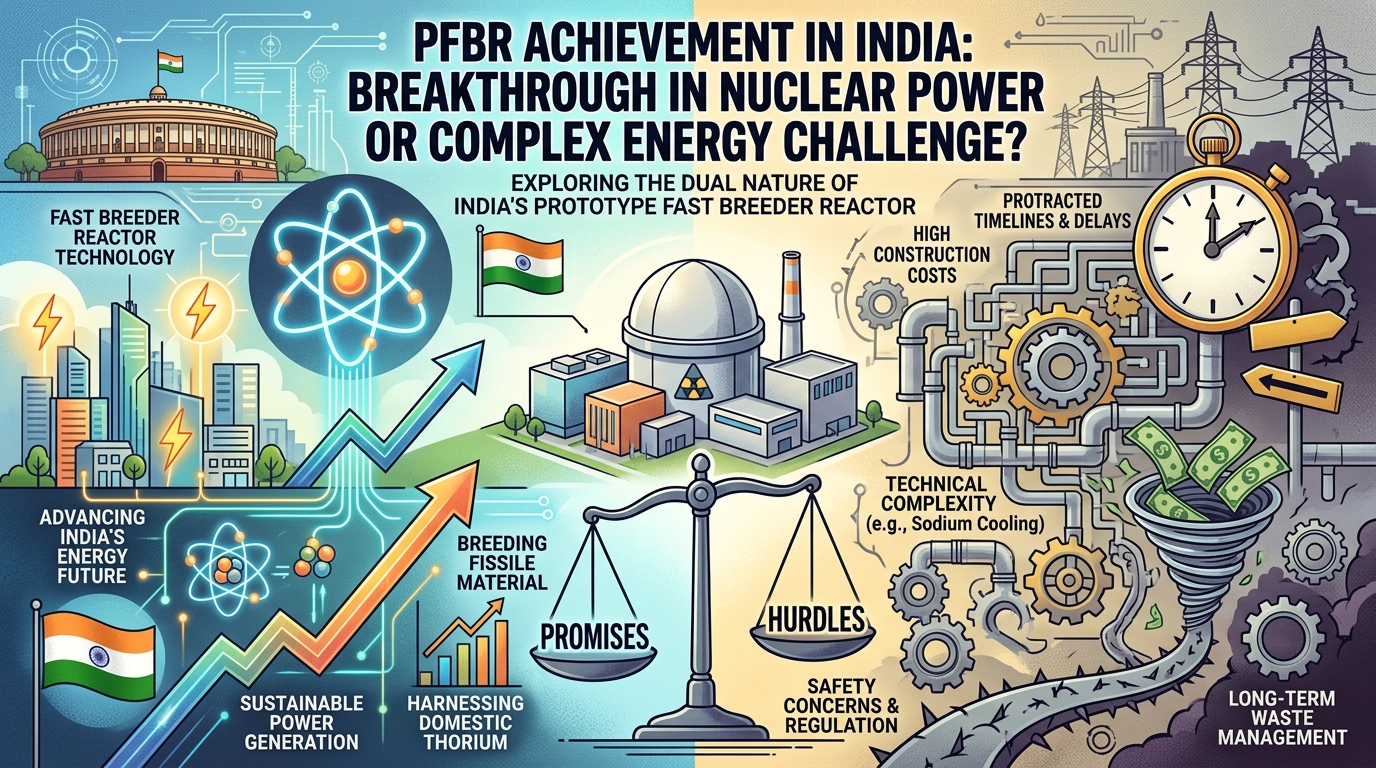
PFBR Achievement in India: Breakthrough in Nuclear Power or Complex Energy Challenge
Why in the News?
- India has achieved a major milestone in its nuclear energy programme as the Prototype Fast Breeder Reactor (PFBR) at Kalpakkam, Chennai has reached criticality.
- This announcement was made by the Prime Minister, marking an important step in India’s nuclear journey.
- Criticality means that the nuclear reaction inside the reactor has become self-sustaining.
- This is the stage where the reactor can maintain a continuous chain reaction without external help.
- This development signals the beginning of the second stage of India’s three-stage nuclear programme, which aims to make India energy secure using its vast thorium reserves.
What are the Key Highlights?
1. What is Criticality in a Nuclear Reactor?
- Criticality is the condition when a nuclear reactor achieves a stable and self-sustaining chain reaction.
- In simple terms, the number of neutrons produced equals the number of neutrons lost.
- This means:
- The reactor does not need external energy to continue the reaction.
- It is a necessary step before generating electricity.
- However:
- After criticality, several tests are conducted at low power.
- Regulatory approval is required before full power operation.
2. What is the Prototype Fast Breeder Reactor (PFBR)?
- The PFBR is a 500 MWe (Mega Watt electric) nuclear reactor.
- It is located at Kalpakkam in Tamil Nadu.
- It is:
- Designed by the Indira Gandhi Centre for Atomic Research (IGCAR).
- Built by Bharatiya Nabhikiya Vidyut Nigam Limited (BHAVINI).
- It is called a Fast Breeder Reactor (FBR) because:
- It produces more nuclear fuel than it consumes.
3. What is a Fast Breeder Reactor? (Core Concept)
- A Fast Breeder Reactor works differently from normal nuclear reactors.
- In normal reactors:
- Fuel is consumed to produce energy.
- In FBRs:
- The reactor creates more fuel while producing energy.
- How it works:
- It uses fast neutrons to convert fertile material into fissile material.
- Example:
- Uranium-238 (fertile) → converted into Plutonium-239 (fissile).
4. What is MOX Fuel?
- The PFBR uses MOX (Mixed Oxide) Fuel.
- It is a mixture of uranium and plutonium oxides.
- This fuel:
- Improves efficiency.
- Helps in recycling nuclear waste.
5. What is the Blanket Material?
- The PFBR core is surrounded by a blanket of Uranium-238.
- This blanket:
- Absorbs neutrons.
- Converts into Plutonium-239, which becomes new fuel.
- In future:
- Thorium-232 will be used in the blanket.
- It will convert into Uranium-233, a key fuel for the third stage.
6. India’s Three-Stage Nuclear Programme
- India’s nuclear programme was designed in the 1950s to achieve energy independence.
Stage 1: Pressurised Heavy Water Reactors (PHWRs)
- Uses natural uranium as fuel.
- Produces plutonium-239 as a by-product.
- India currently operates:
- Around 23 reactors with 7.48 GWe capacity.
Stage 2: Fast Breeder Reactors (FBRs)
- Uses plutonium from Stage 1.
- Converts Uranium-238 into more plutonium.
- PFBR is part of this stage.
Stage 3: Thorium-Based Reactors
- Uses Uranium-233 derived from Thorium-232.
- This stage will fully utilise India’s large thorium reserves.
7. Why is PFBR Important?
- The PFBR acts as a bridge between Stage 1 and Stage 3.
- It helps in producing fuel for future reactors.
- It allows:
- Extraction of 80–100 times more energy from uranium.
8. Role of Sodium as Coolant
- The PFBR uses liquid sodium as a coolant instead of water.
Advantages of Sodium
- Sodium allows fast neutrons to remain active, which is important for breeding fuel.
- It has a high heat capacity, which helps remove heat efficiently.
- It operates at low pressure, making the system safer in some ways.
- It provides better efficiency in electricity generation.
Disadvantages of Sodium
- Sodium is highly reactive.
- It catches fire when exposed to air.
- It reacts violently with water.
- It is opaque, so internal inspection is difficult.
- It requires:
- Special monitoring systems
- High purity conditions
- Advanced safety measures
9. Supporting Infrastructure
- India is also building the Fast Reactor Fuel Cycle Facility (FRFCF).
- It will reprocess spent fuel from FBRs.
- This will help:
- Reuse nuclear fuel
- Reduce waste
- Improve efficiency

What are the Significance?
1. Significance for Energy Security
- The PFBR helps India reduce dependence on imported uranium.
- It supports long-term energy independence.
2. Significance for Efficient Resource Use
- Fast breeder technology allows:
- Extraction of much more energy from the same fuel.
- This makes nuclear energy more efficient and sustainable.
3. Significance for Thorium Utilisation
- India has large thorium reserves, but limited uranium.
- PFBR helps in moving towards thorium-based energy.
4. Significance for Technological Advancement
- The programme strengthens capabilities in:
- Nuclear science
- Reactor design
- Advanced materials
5. Significance for Clean Energy Transition
- Nuclear power produces low carbon emissions.
- It helps in fighting climate change.
6. Significance for Strategic Capability
- It enhances India’s expertise in:
- Nuclear fuel cycle
- Advanced reactor technologies
Challenges
1. Technological Complexity
- Fast breeder reactors are highly complex.
- They require advanced design and precision.
2. Safety Concerns
- Sodium coolant is highly reactive.
- Accidents can lead to fire or explosions.
3. High Cost
- Building and maintaining FBRs is expensive.
- Advanced systems increase capital costs.
4. Long Delays
- The PFBR project took more than 20 years.
- Delays affect planning and cost efficiency.
5. Operational Challenges
- Maintaining sodium purity is difficult.
- Monitoring systems are complex.
6. Regulatory Approvals
- Strict safety checks are required before full operation.
- This slows down deployment.
Way Forward
1. Strengthen Safety Systems
- India should improve:
- Leak detection systems
- Emergency response mechanisms
2. Invest in Research and Development
- Continuous R&D is needed to:
- Improve reactor efficiency
- Reduce risks
3. Expand Nuclear Infrastructure
- India should build more FBRs and related facilities.
- This will strengthen the nuclear programme.
4. Improve Fuel Cycle Management
- Efficient reprocessing systems like FRFCF should be completed on time.
- This will ensure better fuel utilisation.
5. Reduce Costs through Innovation
- New technologies should be developed to lower costs.
- Public-private partnerships can help.
6. Ensure Skilled Workforce
- Training experts in nuclear technology is essential.
- Skilled manpower ensures safe operations.
7. Promote Public Awareness
- Public understanding of nuclear safety should be improved.
- This will increase acceptance of nuclear energy.
Conclusion
India’s progress in advanced nuclear technology reflects its determination to secure a stable and sustainable energy future while building strong scientific capabilities for the long term.
Relevant Articles:
India’s Climate Commitments and NDCs: Balanced Strategy or Slow Progress
Women’s Reservation Act and Delimitation Debate: Balancing Representation and Federal Fairness
Read More:
Sabarimala Case and Religious Freedom Debate: Supreme Court Examines Women’s Entry and Rights
Urban Tuberculosis Crisis in India: Why Health for All Is Still a Distant Goal
India’s 500 MWe Prototype Fast Breeder Reactor Achieves …
