CSMP IAS : India's Premier Coaching Institute for IAS / PCS
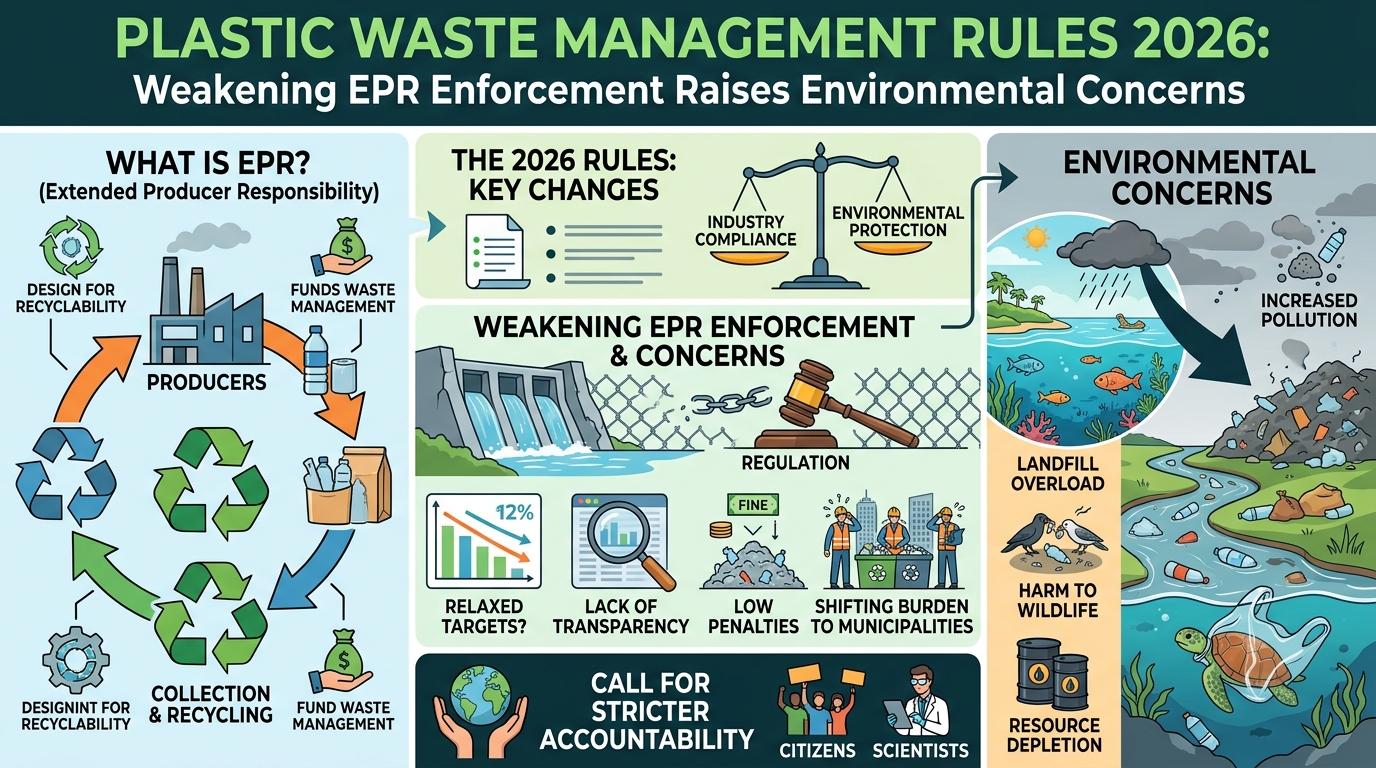
Plastic Waste Management Rules 2026: Weakening EPR Enforcement Raises Environmental Concerns
Table of Contents
The Plastic Waste Management Rules 2026 introduces significant changes in India’s plastic governance framework, shifting focus from strict collection targets to recycled content obligations under Extended Producer Responsibility (EPR). While aimed at promoting a circular economy, the reforms raise concerns about weakening enforcement, increased compliance flexibility, and potential greenwashing risks, making it a critical topic for environmental governance and policy debates.
Why in the News?
- The Government of India announced major amendments to the Plastic Waste Management Rules, 2026 on March 31.
- These rules are an updated version of the Plastic Waste Management Rules, 2016, which have been revised multiple times over the years.
- The reforms focus on strengthening the Extended Producer Responsibility (EPR) framework for plastic waste.
- However, concerns have emerged that India may be shifting away from strict plastic collection targets toward flexible compliance mechanisms.
- The policy debate is centered on whether India is weakening enforcement or adopting a more market-based environmental strategy.
- The issue is important because India generates massive plastic waste that affects rivers, oceans, cities, and landfills.
What are the Key Highlights?
Evolution of Plastic Waste Management Rules in India
- India first introduced the Plastic Waste Management Rules, 2016 to regulate plastic production, usage, and disposal.
- These rules were later amended several times to improve enforcement and introduce new mechanisms.
- The 2026 amendments represent a major shift in policy design and enforcement philosophy.
- The main objective remains the reduction of plastic pollution and promotion of recycling and reuse systems.
Introduction of Extended Producer Responsibility (EPR)
- The concept of Extended Producer Responsibility (EPR) places responsibility on producers for the entire lifecycle of plastic products.
- It applies to:
- Producers of plastic goods
- Importers of plastic materials and packaging
- Brand owners using plastic packaging in products
- Under EPR, companies must ensure that plastic waste generated from their products is:
- Collected
- Recycled
- Properly disposed
- The aim is to shift responsibility from local governments to producers and corporations.
EPR Targets Introduced in 2022
- India introduced strict EPR targets in 2022 to strengthen enforcement.
- These targets required companies to collect and recycle plastic waste as follows:
- 35% in 2021–22 (baseline year)
- 70% in 2022–23
- 100% by 2024–25
- The intention was to create a fully circular plastic economy.
- However, government data shows that actual compliance remains only around 50%–60%.
- This indicates a gap between policy ambition and ground-level implementation.
Key Changes Introduced in Plastic Waste Management Rules 2026
- The 2026 rules introduce a shift in policy focus from collection-based targets to recycled content usage.
- Companies are now required to ensure minimum recycled plastic content in packaging:
- Category I (rigid plastic packaging) must contain at least 30% recycled plastic content.
- This requirement will increase to 60% by 2028–29.
- Similar rules apply to reuse obligations for packaging materials.
- This marks a transition from waste management to resource substitution strategy.
Flexible Compliance Mechanism
- The rules allow companies to carry forward unmet targets for up to three years.
- Companies must compensate the shortfall gradually by meeting at least one-third of the deficit each year.
- This means that a target set for 2025–26 can effectively be met by 2028–29.
- This introduces time flexibility in compliance, reducing immediate pressure on companies.
- Critics argue that this weakens enforcement strength of the EPR system.
Introduction of Trading Certificates System
- The government has introduced a system of plastic credit or trading certificates.
- Companies can:
- Buy certificates instead of directly recycling plastic
- Sell certificates if they exceed recycling obligations
- This creates a market-based compliance mechanism.
- The idea is to allow economic efficiency in meeting environmental goals.
- However, it may reduce actual physical recycling efforts if not regulated properly.
Shift in Policy Focus
- Earlier policy focus was strongly on:
- Collection of plastic waste
- Recycling obligations
- The new framework places greater emphasis on:
- Use of recycled plastic content
- Market instruments like trading certificates
- This shift indicates a move from direct environmental enforcement to indirect market regulation.
Current Plastic Waste Situation in India
- India generates millions of tonnes of plastic waste annually.
- A significant portion remains:
- Uncollected
- Improperly disposed
- Dumped in landfills and water bodies
- Urban areas face increasing pressure on waste management systems.
- River pollution, especially in major rivers, is a growing concern.
- Microplastics have been detected in soil, water, and food chains.
Key Concepts Explained
What are Plastic Waste Management Rules?
- These are legal regulations framed by the government to manage plastic waste.
- They regulate:
- Production of plastic
- Use of plastic packaging
- Collection and recycling of plastic waste
- The goal is to reduce environmental harm caused by plastic pollution.
What is Extended Producer Responsibility (EPR)?
- EPR is an environmental policy where producers are responsible for managing waste generated by their products.
- It includes:
- Collection of used products
- Recycling of materials
- Safe disposal of waste
- Example: A soft drink company must collect and recycle used bottles it sells in the market.
What is the Recycled Content Requirement?
- It is a rule that requires companies to use a minimum percentage of recycled material in production.
- Example: A packaging company must ensure 30% of its plastic comes from recycled sources.
- This reduces dependence on virgin plastic produced from petroleum.
What are Plastic Credit or Trading Certificates?
- These are certificates issued for recycling or waste management activities.
- Companies can trade these certificates in a regulated market.
- This allows flexibility in meeting environmental obligations.
- However, it may create risk of paper compliance instead of real action.
What is Circular Economy in Plastic Management?
- A circular economy means materials are reused and recycled continuously.
- In plastic management, it means:
- Less production of new plastic
- More recycling of existing plastic
- Reduced waste generation

What are the Significance?
Reduction of Environmental Pollution
- Plastic pollution is one of the biggest environmental challenges in India.
- The rules aim to reduce:
- Landfill burden
- River contamination
- Marine plastic waste
- This improves environmental quality and public health.
Promotion of Circular Economy
- The policy supports a shift from linear economy (produce-use-dispose) to circular economy (reuse-recycle-reduce).
- It ensures better utilization of resources and reduces waste generation.
Encouraging Corporate Responsibility
- Companies are made responsible for their environmental impact.
- This reduces dependency on government and municipalities.
- It creates accountability among producers.
Reducing Dependence on Virgin Plastic
- Virgin plastic production depends on fossil fuels like petroleum.
- Using recycled plastic reduces:
- Energy consumption
- Carbon emissions
- Raw material dependency
Market-Based Environmental Solutions
- Trading certificates introduce economic incentives for recycling.
- Companies can trade compliance obligations.
- This creates flexibility and efficiency in implementation.
Boosting Recycling Industry
- Demand for recycled plastic will increase.
- This will support:
- Recycling industries
- Waste collection networks
- Informal waste pickers
Integration with Climate Goals
- Plastic reduction supports India’s broader environmental goals.
- It contributes to:
- Climate change mitigation
- Sustainable development targets
- Clean India Mission objectives
What are the Challenges?
Weak Enforcement of Collection Targets
- Collection targets are not being fully achieved.
- Current compliance levels remain around 50%–60%.
- This weakens the effectiveness of the EPR framework.
Shift Away from Collection Responsibility
- Policy focus is moving from collection to recycled content use.
- This may ignore the problem of uncollected plastic waste in the environment.
Risk of Greenwashing
- Companies may show compliance without real environmental action.
- Purchasing certificates may replace actual recycling activities.
Flexible Compliance Reduces Urgency
- Three-year carry forward reduces immediate accountability.
- Companies may delay compliance without penalties.
Lack of Strong Monitoring Systems
- There is limited real-time tracking of plastic waste.
- Data gaps weaken enforcement and transparency.
Inequality in Recycling Capacity
- Large companies can comply more easily than small firms.
- Informal sector remains under-integrated into the system.
Over-Reliance on Market Mechanisms
- Excess dependence on trading systems may reduce regulatory control.
- Environmental outcomes may depend on market behaviour rather than enforcement.
Infrastructure Limitations
- India still lacks adequate recycling infrastructure.
- Waste segregation at source remains weak in many regions.
Way Forward
Strengthening Collection-Based Targets
- Government should reinforce strict plastic collection obligations.
- Collection must remain central to EPR policy.
Improving Monitoring and Data Systems
- Develop a national digital system for tracking plastic waste.
- Ensure real-time reporting by producers and recyclers.
Strengthening Enforcement Mechanisms
- Introduce penalties for non-compliance.
- Reduce excessive flexibility in deadlines.
Balancing Market and Regulation
- Trading certificates should complement not replace physical recycling.
- Strong regulatory oversight is necessary.
Expanding Recycling Infrastructure
- Invest in modern recycling plants.
- Support urban and rural waste processing systems.
Integrating Informal Sector
- Waste pickers should be formally integrated into the system.
- Provide safety, income security, and recognition.
Promoting Alternative Materials
- Encourage biodegradable and sustainable packaging alternatives.
- Reduce dependence on single-use plastics.
Enhancing Public Awareness
- Educate citizens on waste segregation and recycling.
- Promote behavioural change for waste reduction.
Conclusion
India’s Plastic Waste Management Rules 2026 represent an important policy shift toward corporate responsibility and market-based environmental governance. While the focus on recycled content and trading mechanisms introduces flexibility and innovation, the weakening of strict collection targets raises serious concerns about long-term effectiveness. The success of this framework will depend on strong enforcement, transparent monitoring, infrastructure development, and maintaining a balance between market efficiency and environmental accountability.
Relevant Articles:
Nuclear Energy Expansion in India: SHANTI Act 2025 and India’s 100 GW Nuclear Energy Push
FCRA Amendment Bill 2026 Controversy: Rising Concerns Over NGO Control in India
Read More:
Nuclear Fusion Cost Crisis: Overestimated Experience Rate Raises Investment Risks
RBI Guidelines on Insurance Mis-selling: Fixing Commission-Driven Fraud in India
Circular Economy Framework and Extended Producer …
