
CSMP IAS : India's Premier Coaching Institute for IAS / PCS
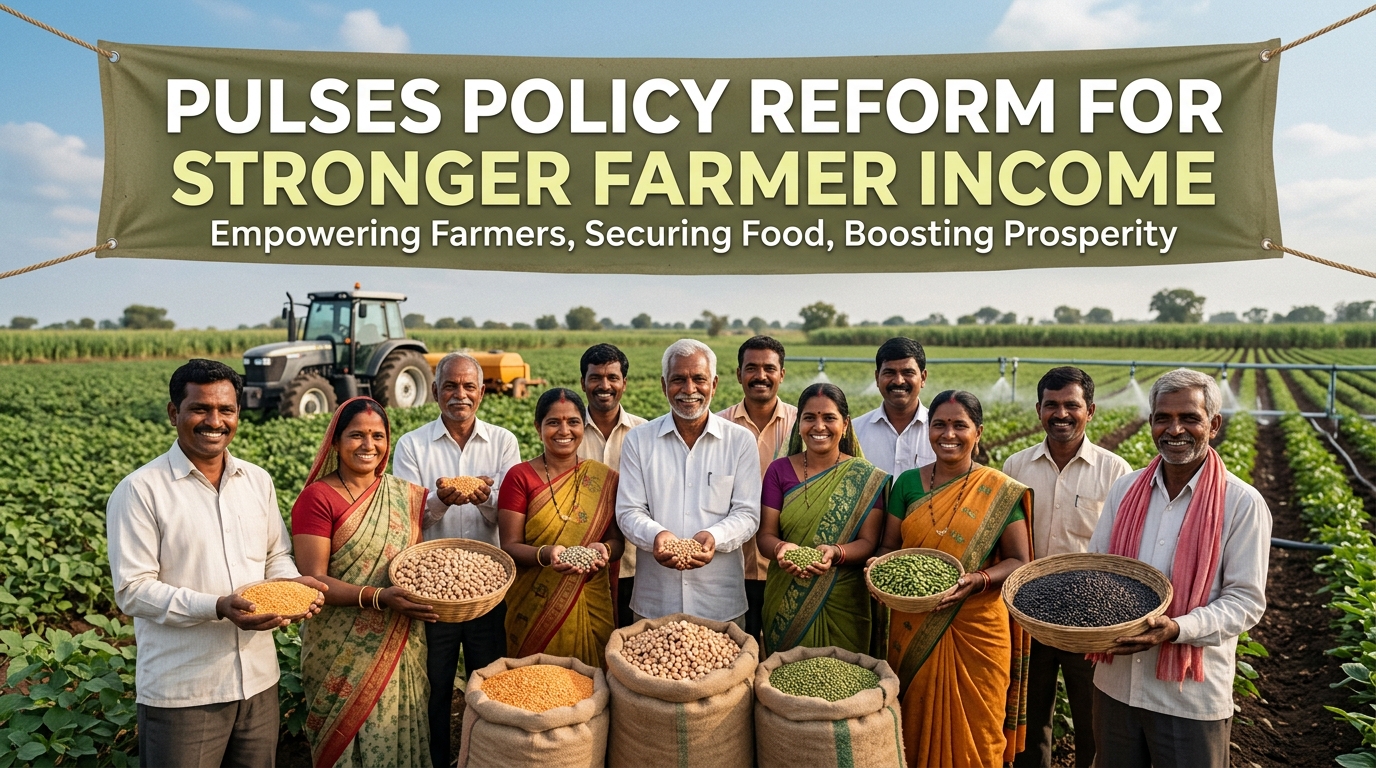
Pulses Policy Reform for Stronger Farmer Income
Table of Contents
Pulses policy reform has gained importance after the Supreme Court highlighted the need to support farmers through better MSP and crop diversification. Strengthening pulses policy reform can improve farmer income, reduce import dependence, and ensure food security.
Why in the News?
- The Supreme Court of India has asked the Union government to review its agricultural policy related to pulses.
- This step was taken to improve the condition of farmers growing pulses and to make farming more balanced.
- The Court emphasized that farmers should be encouraged to shift from wheat and paddy to pulses.
- Wheat and paddy are heavily grown because they have assured government support, but pulses do not get the same benefits.
- The issue came into focus because of large imports of yellow peas, which reduced prices of locally grown pulses.
- This affected the income and livelihood of Indian farmers.
- The case was filed by Kisan Mahapanchayat, showing that farmers are demanding better policies and protection.
What are the Key Highlights?
Policy Framework and Crop Diversification
- The Court asked the government to create a better agricultural policy for pulses.
- A policy framework means a structured plan made by the government to guide farming practices.
- Crop diversification means growing different types of crops instead of focusing on only one or two crops.
- Farmers in India mainly grow wheat and paddy due to assured prices and procurement.
- Diversification reduces risk because if one crop fails, others can support income.
- The Court directed ministries like Agriculture, Commerce, and Consumer Affairs to work together.
- Experts with real farming experience should be consulted, not only academic experts.
Minimum Support Price (MSP) in Pulses Policy Reform
- MSP means the minimum price at which the government buys crops from farmers.
- It protects farmers from selling their produce at very low prices in the market.
- Wheat and rice have strong MSP systems with assured procurement, but pulses do not.
- This creates uncertainty for pulse farmers.
- The Court highlighted that MSP for pulses should cover production costs and give profit.
- Production cost includes seeds, fertilizers, labor, irrigation, and transport.
- Without guaranteed MSP, farmers prefer wheat and rice over pulses.
Pulse Imports and Yellow Peas
- India’s pulse production has decreased due to crop diseases.
- Production dropped from 273 lakh tonnes in 2021-22 to 242 lakh tonnes in 2023-24.
- To meet demand, the government imported yellow peas.
- Yellow peas are a type of pulse used as a substitute in food processing.
- Imported pulses are often cheaper than domestic produce.
- This reduces market prices and harms local farmers.
- The Court said that import policies should be designed carefully to protect domestic farmers.
Committee and Stakeholder Consultation for Pulses Policy Reform
- The Court asked the government to form a committee to study the issue.
- A committee means a group of experts who provide recommendations.
- The committee should include people with ground-level experience.
- Ground-level experience means practical knowledge of farming conditions.
- The committee will focus on:
- Improving MSP policies.
- Ensuring timely purchase of pulses.
- Managing imports in a balanced way.

What are the Significance?
Ensuring Farmers’ Livelihoods
- Farmers’ livelihoods depend on stable income from agriculture.
- Guaranteed MSP can protect farmers from sudden price drops.
- Crop diversification reduces dependence on one crop.
- This spreads risk and increases income stability.
Food Security
- Food security means availability of sufficient and nutritious food for all people.
- Pulses are rich in protein and are essential in the Indian diet.
- Increasing domestic production reduces dependence on imports.
- This ensures stable supply and affordable prices.
Policy Alignment
- Policy alignment means making different policies work together effectively.
- Recommendations of the Commission on Agricultural Costs and Prices support balanced crop production.
- Aligning MSP with import policies ensures fair prices.
- If imports are cheaper than MSP, farmers lose interest in growing pulses.
Challenges
Low Pulse Production
- Pulse production has decreased due to diseases and climate factors.
- Crops are vulnerable to pests and irregular rainfall.
- Domestic production is not enough to meet demand.
- This increases dependence on imports.
Lack of Guaranteed MSP
- Farmers face uncertainty about the price they will get.
- Market prices can fall below production cost.
- Pulses are less attractive compared to wheat and rice.
- This discourages farmers from growing pulses.
Impact of Imports
- Imported pulses like yellow peas are often cheaper.
- This lowers the price of domestic pulses in the market.
- Farmers cannot compete with low-cost imports.
- This reduces their income and motivation.
Coordination Among Ministries
- Multiple ministries handle different aspects of agriculture.
- Lack of coordination leads to delays in decision-making.
- Policies may not be implemented effectively.
- This reduces the impact of government efforts.
Way Forward
Revise Policy Framework
- The government should create a strong policy to promote pulse cultivation.
- It should include financial support, market access, and infrastructure.
Ensure MSP and Timely Sale
- MSP for pulses should be guaranteed and profitable.
- The government should ensure timely procurement of pulses.
- Farmers should not face delays in selling their produce.
- This will build confidence among farmers.
Manage Imports Carefully
- Import policies should protect domestic farmers.
- Imports should be allowed only when necessary.
- Pricing of imports should not harm local markets.
- This will ensure fair competition.
Stakeholder Consultation
- Policies should include inputs from farmers and experts.
- Ground-level knowledge helps in making practical policies.
- Recommendations from research bodies should be considered.
- This improves policy effectiveness.
Promote Crop Diversification
- Farmers should be encouraged to grow pulses and oilseeds.
- Awareness programs and incentives can help in this shift.
- Reducing dependence on wheat and paddy will improve sustainability.
- It will also improve soil health and water use efficiency.
Conclusion
A balanced agricultural system requires both economic support and ecological understanding. Strengthening pulses cultivation can improve nutrition, stabilize rural income, and reduce external dependence. A well-designed approach that connects farmers, markets, and policies will help create a more resilient agricultural future for the country.
Relevant Articles:
Water-Centered Climate Adaptation: A Strong Step from COP 30
Global Oil Crisis and Energy Security Challenges for India
SC Status and Religion Debate in India: Supreme Court Clarifies Reservation Rules
Read Also:
India Heart Attack Care Crisis: Delays in Treatment Increasing Preventable Deaths
Magnetic Field Discovery: New Study Reveals Longer Earth Reversal Duration
HALEU-Thorium Debate: Nuclear Fuel Controversy Challenges India’s Energy Strategy
Shri Shivraj Singh outlines roadmap for pulses self …