
CSMP IAS : India's Premier Coaching Institute for IAS / PCS
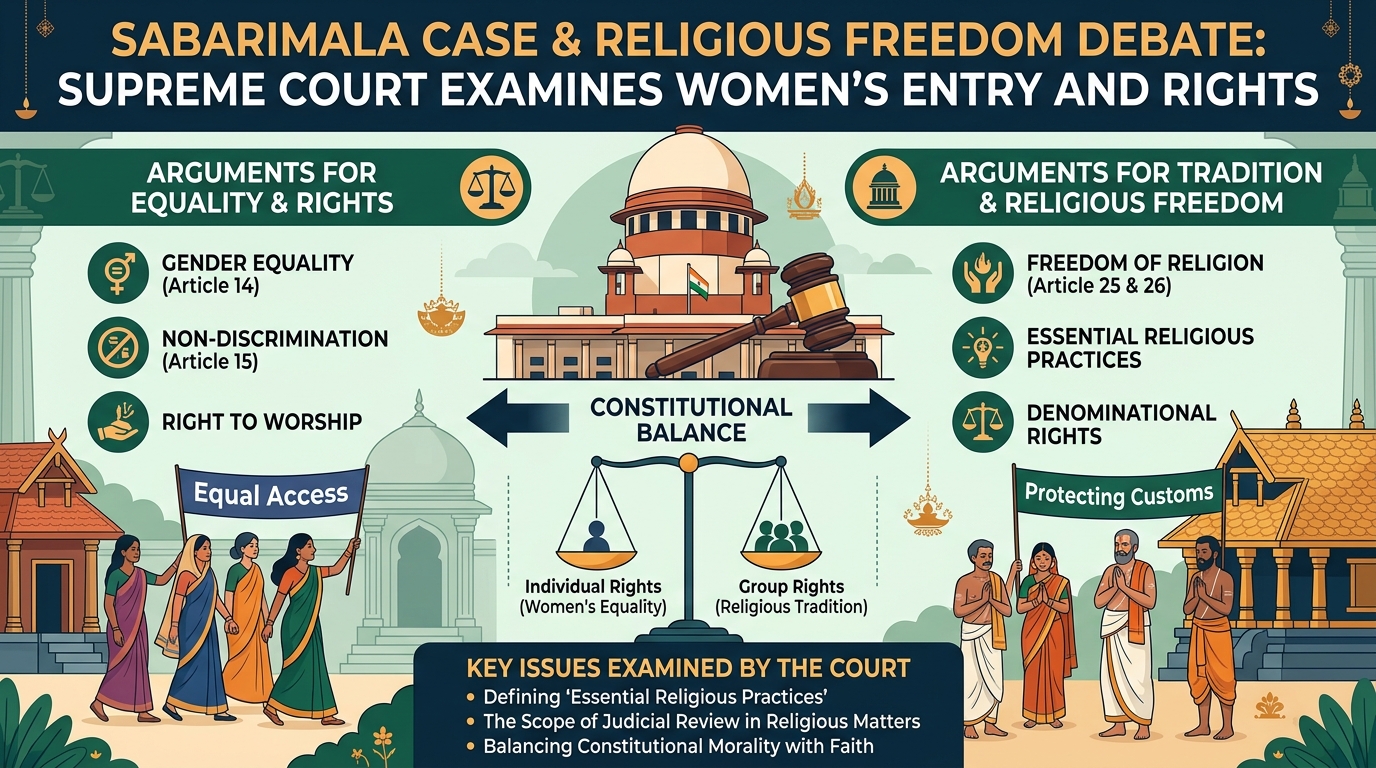
Sabarimala Case and Religious Freedom Debate: Supreme Court Examines Women’s Entry and Rights
Table of Contents
The Sabarimala Case and Religious Freedom Debate has once again come into focus as the Supreme Court of India hears crucial arguments on women’s entry into religious places and the scope of constitutional protections under Articles 25 and 26. This case goes beyond the Sabarimala Temple and raises fundamental questions about gender equality, religious autonomy, and the limits of judicial intervention in India’s diverse society.
Why in the News?
- The nine-judge bench of the Supreme Court of India has started hearing important petitions related to:
- The issue of women’s entry into religious places, especially the Sabarimala Temple.
- The broader interpretation of Articles 25 and 26 of the Constitution dealing with religious freedom.
- This hearing is not just about one temple but about many religions and practices across India.
What are the Key Highlights?
Background of the Sabarimala Case
- In 2018, a five-judge bench allowed women of menstruating age to enter the temple.
- It declared the earlier restriction as unconstitutional.
- In 2019, another bench referred broader issues to a larger bench.
- These issues included:
- Entry of Muslim women into mosques.
- Entry of Parsi women married outside their faith.
- Practices like female genital mutilation in some communities.
- These issues included:
Focus of the Nine-Judge Bench
- The bench will examine:
- Meaning and scope of Article 25 (Freedom of Religion).
- Meaning and scope of Article 26 (Rights of Religious Denominations).
- It will also examine:
- What is an “essential religious practice”.
- What is a “religious denomination”.
Government’s Stand
- The government argued that:
- A strict definition of religion will reduce diversity of Indian religions.
- Hinduism is plural and diverse, not based on a single book or authority.
- It also argued:
- Restricting a specific age group of women is not always discrimination.
- Courts should not reform religion, this is the job of the legislature.
Court’s Observations
- Judges raised important questions:
- Can courts decide what is essential religion?
- Can social evils be hidden under religion?
- Some judges said:
- If something is a social evil, courts can intervene.
- Religion is based on belief, while law is based on logic.
Key Constitutional Concepts
Article 25 – Freedom of Religion
- It gives:
- Freedom to profess, practice, and propagate religion.
- But it is subject to:
- Public order
- Morality
- Health
Article 26 – Rights of Religious Denominations
- It allows religious groups to:
- Manage their own religious affairs.
- But again, subject to:
- Public order, morality, and health
Essential Religious Practices (ERP)
- It means:
- Practices that are core and necessary to a religion.
- Problem:
- Who decides what is “essential”?
- Courts?
- Religious leaders?
- Who decides what is “essential”?
Religious Denomination
- It means:
- A distinct group within a religion having its own beliefs.
- Example:
- Followers of Lord Ayyappa at Sabarimala.

What are the Significance?
1. Balance Between Religion and Equality
- This case will decide:
- How to balance religious freedom with gender equality.
- It will affect:
- Women’s rights in many religions.
2. Defining Role of Judiciary
- It will clarify:
- Whether courts can interfere in religious matters.
- It will shape:
- The scope of judicial review in religious issues.
3. Impact on Multiple Religions
- The judgment will not be limited to one religion.
- It will affect:
- Hindu, Muslim, Parsi, and other communities.
4. Interpretation of Secularism
- India follows positive secularism.
- It respects all religions.
- This case will define:
- How far the State can go in regulating religion.
5. Gender Justice and Social Reform
- It will influence:
- The future of women’s rights in religious spaces.
- It may shape:
- Laws related to social reform.
What are the Challenges?
1. Defining Essential Religious Practices
- It is difficult to decide:
- What is truly essential in a religion.
- Religious texts are often open to interpretation.
2. Conflict Between Rights
- There is a clash between:
- Right to equality (Article 14)
- Right to religion (Article 25)
3. Judicial Overreach vs Judicial Restraint
- Too much intervention:
- May hurt religious freedom.
- Too little intervention:
- May allow discrimination to continue.
4. Diversity of Indian Religions
- India has:
- Huge religious diversity.
- A single rule may:
- Not fit all practices.
5. Sensitivity of Faith
- Religious issues are:
- Highly emotional and sensitive.
- Any decision may:
- Lead to social tensions.
What is the Way Forward?
1. Balanced Interpretation of Constitution
- Courts should:
- Balance freedom of religion and fundamental rights.
- No right should:
- Completely override another.
2. Clear Guidelines on ERP Doctrine
- The Court should:
- Provide clear tests for essential practices.
- This will:
- Reduce confusion in future cases.
3. Role of Legislature
- Parliament should:
- Take initiative for social reform laws.
- Laws should:
- Reflect public opinion and constitutional values.
4. Respect for Diversity
- The approach should:
- Respect pluralism of Indian religions.
- No rigid definition should:
- Harm diversity.
5. Promote Gender Justice
- Reforms should ensure:
- Equal dignity and access for women.
- Change should:
- Come through dialogue and awareness.
Conclusion
This case is not just about one temple but about the future of the relationship between religion and constitutional values in India. The decision will shape how India balances faith, equality, and freedom in a diverse society.
Relevant Articles:
Urban Tuberculosis Crisis in India: Why Health for All Is Still a Distant Goal
Read More:
Brain Science, Ego Dissolution and Self Awareness
Climate Change as a Public Health Crisis in India
SC hearing on Sabarimala women entry highlights
