CSMP IAS : India's Premier Coaching Institute for IAS / PCS
SC Status and Religion Debate in India: Supreme Court Clarifies Reservation Rules
Table of Contents
SC Status and Religion Debate in India has gained attention after the Supreme Court of India clarified rules on Scheduled Caste status and religious conversion. The judgment explains how SC status is linked to specific religions and highlights ongoing debates about extending reservation benefits to Dalit Muslims and Christians, making it an important topic for social justice and constitutional understanding.
Why in the News?
- The Supreme Court of India has recently given an important judgment on the issue of Scheduled Caste (SC) status.
- The judgment discussed whether a person can retain SC status after converting to another religion.
- The Court also examined whether SC status can be given to Dalit Muslims and Dalit Christians.
- This issue is important because it affects access to reservation, social justice, and constitutional rights.
What are the Key Highlights?
Supreme Court Judgment on Conversion and SC Status
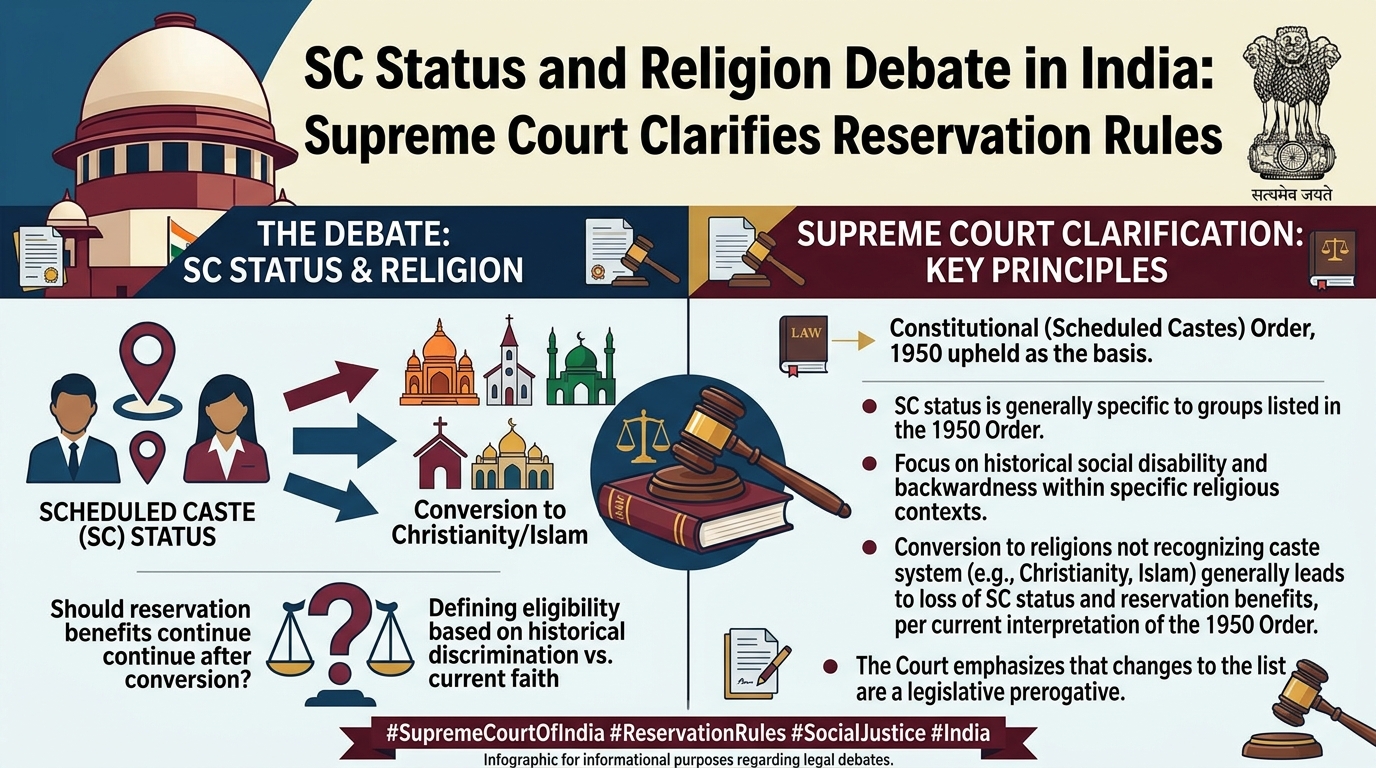
- The Court stated that SC status is linked to specific religions mentioned in the Constitution (Scheduled Castes) Order, 1950.
- These religions are Hinduism, Sikhism, and Buddhism.
- If a person converts to another religion like Islam or Christianity, they lose their SC status.
- This is because the Constitution Order clearly limits SC status to certain religions.
Reason Behind the Rule
- The Court explained that SC status was created to address caste-based discrimination.
- Such discrimination was historically linked to Hindu social structure.
- When a person converts, the assumption is that they leave behind caste-based disabilities.
- Therefore, benefits linked to SC status are removed.
Conditions for SC Status
- The Court clarified that certain conditions must be fulfilled to get SC status.
- A person must belong to a caste listed in the SC Order.
- The person must belong to the specified religions.
- There must be proof of social and educational backwardness.
Issue of Reconversion
- The Court discussed the situation where a person converts back to Hinduism, Sikhism, or Buddhism.
- In such cases, SC status can be restored.
- However, restoration is not automatic.
- The person must prove that they are accepted back into the caste community.
Debate on Dalit Muslims and Christians
- There has been a long-standing demand to extend SC status to Dalit Muslims and Christians.
- Many argue that caste-like discrimination continues even after conversion.
- The government has not yet accepted this demand.
- The issue is still under discussion and review.
Role of Government Committees
- The central government has set up committees to study this issue.
- These committees examine whether SC status should be extended to other religions.
- The findings of such committees will guide future policy decisions.
What are the Significance?
Constitutional Clarity
- The judgment provides clear interpretation of the Constitution (Scheduled Castes) Order, 1950.
- It removes confusion regarding eligibility for SC status.
Social Justice
- The decision highlights the original purpose of SC reservation.
- It ensures that benefits reach those who face caste-based discrimination.
Religious Freedom
- The judgment balances the right to religious freedom with social justice policies.
- It shows that changing religion has legal and social consequences.
Policy Debate
- The issue of Dalit Muslims and Christians remains open for discussion.
- It encourages debate on equality and inclusion in India.
Reservation System
- The ruling protects the structure of reservation policies.
- It ensures that benefits are not extended beyond defined criteria without proper review.
Challenges
Continued Discrimination After Conversion
- Many people argue that caste discrimination continues even after conversion.
- This creates a gap between legal rules and social reality.
Exclusion of Dalit Muslims and Christians
- Dalits who convert to Islam or Christianity lose SC benefits.
- This leads to concerns about fairness and equality.
Proof in Reconversion Cases
- It is difficult for individuals to prove acceptance by the caste community after reconversion.
- This creates legal and social hurdles.
Political and Social Sensitivity
- The issue involves religion, caste, and reservation.
- These are sensitive topics that can create social tensions.
Uniform Policy
- There is no uniform agreement on extending SC status to other religions.
- Different groups have different opinions on the issue.
Way Forward
Legal Reforms
- The government can review the Constitution (Scheduled Castes) Order, 1950.
- Changes can be made if strong evidence supports inclusion of other groups.
Social Research
- Detailed studies should be conducted on discrimination after conversion.
- Data-based decisions will ensure fairness and accuracy.
Inclusive Policy Debate
- All stakeholders should be involved in discussions.
- This includes government, experts, and affected communities.
Awareness
- People should be made aware of legal implications of conversion.
- This will help individuals make informed decisions.
Strengthening Equality Measures
- Policies should focus on reducing discrimination in all forms.
- Social equality should be promoted beyond religion-based categories.
Conclusion
The issue of SC status and religion reflects the complex relationship between law, society, and identity in India. A balanced approach that respects constitutional principles while addressing ground realities is necessary to ensure justice and harmony.
Relevant Articles:
India Heart Attack Care Crisis: Delays in Treatment Increasing Preventable Deaths
Magnetic Field Discovery: New Study Reveals Longer Earth Reversal Duration
HALEU-Thorium Debate: Nuclear Fuel Controversy Challenges India’s Energy Strategy
Read Also:
Captive Power Boost: Electricity Rules Amendment 2025 Strengthens India’s Energy Sector
NavIC Crisis: IRNSS-1F Atomic Clock Failure Weakens India’s Navigation System
Discovery of Euthalia Zubeengargi: New Butterfly Species Highlights India’s Rich Biodiversity
What we know so far about the Supreme Court’s ruling on …