
CSMP IAS : India's Premier Coaching Institute for IAS / PCS
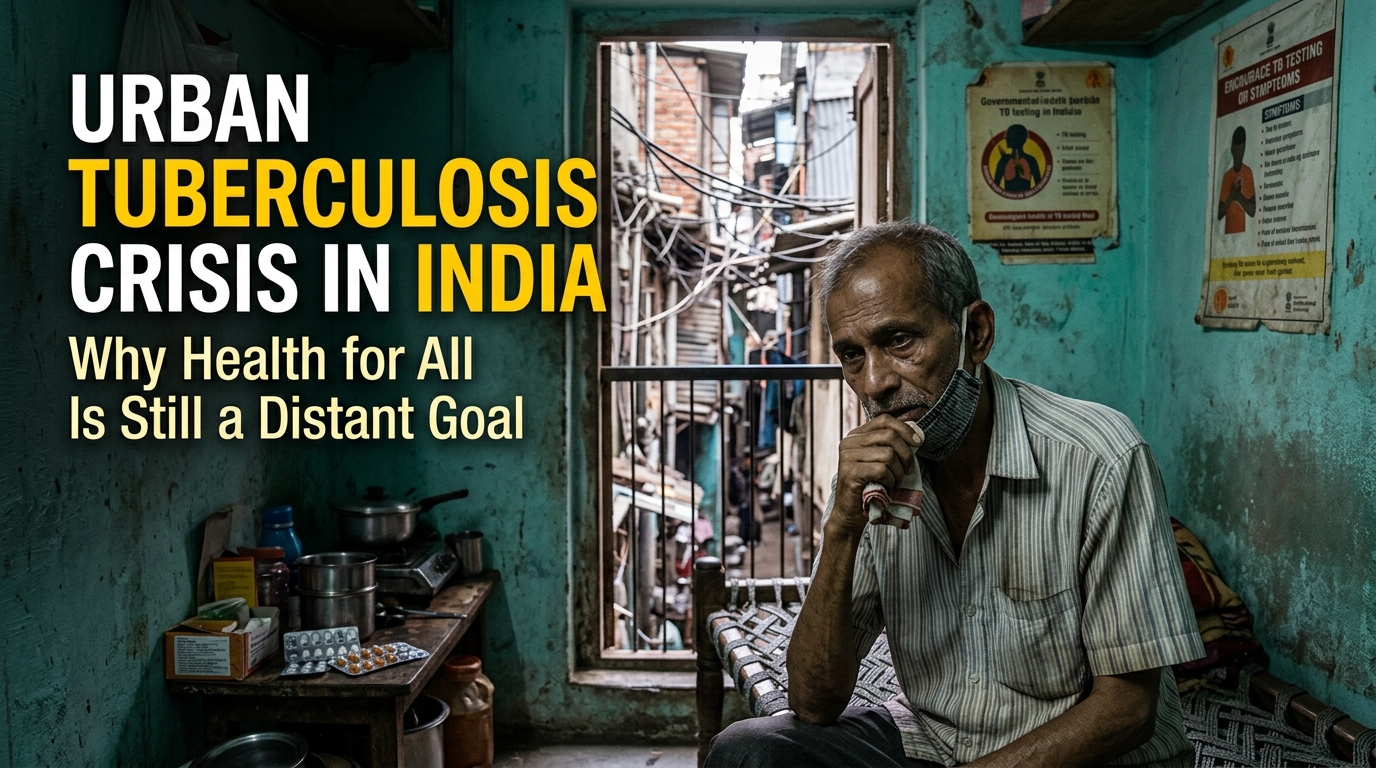
Urban Tuberculosis Crisis in India: Why Health for All Is Still a Distant Goal
The growing Urban Tuberculosis Crisis in India highlights a serious gap in achieving true “Health for All.” Despite better healthcare infrastructure in cities, factors like overcrowding, migration, poor nutrition, and fragmented health systems continue to fuel the spread of TB. This issue reflects deeper structural problems in urban governance, making it essential to rethink public health strategies for inclusive and sustainable development.
Why in the News?
- The issue of Tuberculosis (TB) is highlighted on World Health Day, which focuses on the idea of “Health for All”.
- This day reminds us that health should not be limited to a few people but must reach everyone, especially vulnerable groups.
- India continues to face a serious challenge as it carries the highest burden of TB in the world.
- Nearly one-fourth of global TB cases are found in India.
- Rapid urbanisation is creating new health challenges.
- About 35% of India’s population lives in urban areas, and this number is increasing.
- The article highlights that TB is not just a disease but a reflection of deeper social and economic problems.
- It shows failures in housing, nutrition, healthcare access, and social protection systems.
What are the Key Highlights?
Understanding Tuberculosis (TB)
- Tuberculosis (TB) is an infectious disease caused by a bacterium called Mycobacterium tuberculosis.
- It mainly affects the lungs (pulmonary TB) but can also affect other parts of the body.
- TB spreads through the air when an infected person coughs, sneezes, or talks.
- For example, a worker in a crowded factory can easily spread TB to others in a poorly ventilated room.
- Not everyone who gets infected develops the disease.
- The immune system of healthy people can control the infection.
- TB develops into disease when multiple vulnerabilities come together.
- These include:
- Malnutrition, which weakens immunity.
- Overcrowded housing, which increases exposure.
- Long working hours, which reduce physical strength.
- Co-morbidities like diabetes or HIV.
- Delayed treatment, which worsens the condition.
- These include:
Urban Tuberculosis as a Social Disease
- TB is not only a medical issue but also a social and economic disease.
- It is closely linked with poverty and inequality.
- People living in informal settlements (slums) are more vulnerable.
- For example, families living in one-room houses with poor ventilation face higher risk.
- TB reflects how well a society supports its people.
- High TB rates indicate problems in:
- Public health systems
- Nutrition programmes
- Housing conditions
- High TB rates indicate problems in:
Urbanisation and Health Risks
- Urban areas are often seen as having better healthcare facilities, but they also concentrate risks.
- Key urban risks include:
- Overcrowding, especially in slums and worker housing.
- Poor ventilation, which increases airborne diseases.
- Air pollution, which damages lungs.
- Informal jobs, which lack health benefits.
- For example, migrant construction workers often live in temporary shelters with poor hygiene and limited access to healthcare.
Migrants and Invisible Population
- Migrants are the backbone of city economies.
- They work as:
- Construction workers
- Domestic workers
- Delivery workers
- Street vendors
- They work as:
- However, migrants face multiple barriers:
- Lack of identity documents linked to current residence.
- Lack of access to government schemes.
- Frequent movement between cities and villages.
- This leads to:
- Interrupted TB treatment
- Delayed diagnosis
- Increased spread of disease
Fragmented Healthcare System
- India has a dual healthcare system:
- Public sector (government hospitals)
- Private sector (clinics and hospitals)
- Many people prefer private doctors.
- However, data sharing between private and public sectors is weak.
- This leads to:
- Incomplete patient records
- Break in treatment continuity
- Example:
- A TB patient may visit multiple doctors before getting correct diagnosis, increasing delay and cost.
Missed Opportunities in TB Control
- TB progresses due to failures at multiple stages:
- Early symptoms like cough and fever are often ignored.
- Diagnosis is delayed due to lack of awareness or access.
- Treatment is interrupted due to migration or financial issues.
- Each stage is a missed opportunity for intervention.
- If detected early, TB is curable.
- Failure leads to:
- Severe illness
- Spread of infection
- Drug-resistant TB
Multi-Drug Resistant TB (MDR-TB)
- MDR-TB occurs when TB bacteria become resistant to common medicines.
- Causes:
- Incomplete treatment
- Wrong medication
- Example:
- A patient who stops medicine midway due to migration may develop MDR-TB.
- MDR-TB is:
- More expensive to treat
- More dangerous
- Harder to control
Geography of Health Inequality
- Health services are not equally distributed in cities.
- Areas like:
- Slums
- Peri-urban industrial zones
- Construction sites
often lack healthcare facilities.
- People in these areas face:
- Long travel distances to hospitals
- Loss of daily wages
- This discourages them from seeking care.
Health as a Right
- Health is considered a basic human right.
- This means:
- Everyone should get healthcare, regardless of:
- Income
- Address proof
- Social status
- Everyone should get healthcare, regardless of:
- Current systems often exclude:
- Migrants
- Informal workers
- A true “Health for All” system must include these invisible populations.

What are the Significance?
TB as an Indicator of System Health
- TB acts as a mirror of public health systems.
- High TB cases indicate poor systems.
- It shows failures in:
- Nutrition
- Housing
- Healthcare access
Impact on Economic Productivity
- TB mainly affects the working-age population.
- This reduces workforce productivity.
- Example:
- A factory worker with TB may lose months of work, affecting family income.
Burden on Healthcare System
- TB increases pressure on healthcare facilities.
- Especially with MDR-TB cases.
- Long treatment periods require continuous monitoring.
Social Inequality and Exclusion
- TB highlights inequality in cities.
- Poor and migrants suffer more.
- It shows gaps in:
- Social protection
- Welfare schemes
Public Health Risk
- TB is a communicable disease, so it affects the entire population.
- One untreated patient can infect many others.
- Therefore, TB control is essential for overall public health.
Urban Planning and Governance
- TB reveals failures in urban planning.
- Lack of proper housing and sanitation.
- It shows need for:
- Better infrastructure
- Inclusive policies
What are the Challenges?
Overcrowding
- Many urban residents live in crowded conditions.
- This increases TB transmission.
- Slums lack:
- Space
- Ventilation
Malnutrition
- Poor people often suffer from undernutrition.
- Weak immunity increases TB risk.
- Nutrition schemes may not reach migrants.
Fragmented Healthcare System
- Lack of coordination between:
- Public sector
- Private sector
- This leads to:
- Data gaps
- Treatment delays
Challenge of Migration
- Migrants frequently move.
- This interrupts treatment.
- Lack of documents creates barriers.
Challenge of Awareness
- Many people do not recognize early TB symptoms.
- Delay in seeking care worsens disease.
Drug Resistance
- MDR-TB is increasing due to:
- Improper treatment
- Lack of monitoring
Weak Social Protection
- Lack of:
- Income support
- Job security
- Patients cannot afford to stop working for treatment.
What is the Way Forward?
Strengthening Primary Healthcare
- Governments should improve local health centres.
- Clinics should be available in slums and industrial areas.
- Early diagnosis should be made easy and accessible.
Ensuring Portable Healthcare
- Healthcare benefits should be portable across states.
- Migrants should access treatment anywhere.
- Digital health records can help track patients.
Integrating Public and Private Sectors
- Better coordination between:
- Government hospitals
- Private doctors
- Data sharing should be improved.
Improving Nutrition Support
- TB patients should receive:
- Free nutritious food
- Financial support
- This helps in faster recovery.
Better Urban Planning
- Cities should focus on:
- Affordable housing
- Proper ventilation
- Sanitation
- Healthy living conditions reduce TB risk.
Awareness and Early Detection
- Public campaigns should educate people about:
- TB symptoms
- Importance of early treatment
Strengthening Surveillance Systems
- Better tracking of patients is needed.
- Use of technology can help monitor treatment.
Providing Social Protection
- Patients should get:
- Income support
- Job security during treatment
- This reduces treatment dropouts.
Conclusion
Tuberculosis is not just a disease but a reflection of how society treats its most vulnerable people. It shows whether development is inclusive or limited to a few. Addressing TB requires more than medicines; it requires better living conditions, strong healthcare systems, and policies that include migrants and informal workers. A truly healthy society is one where every individual, regardless of their background, has the opportunity to live a life free from preventable diseases.
Relevant Articles:
Brain Science, Ego Dissolution and Self Awareness
Read More:
Climate Change as a Public Health Crisis in India
China Energy Strategy Success: How China Avoided Global Oil Crisis Impact
India Speeding Towards TB Elimination
