
CSMP IAS : India's Premier Coaching Institute for IAS / PCS
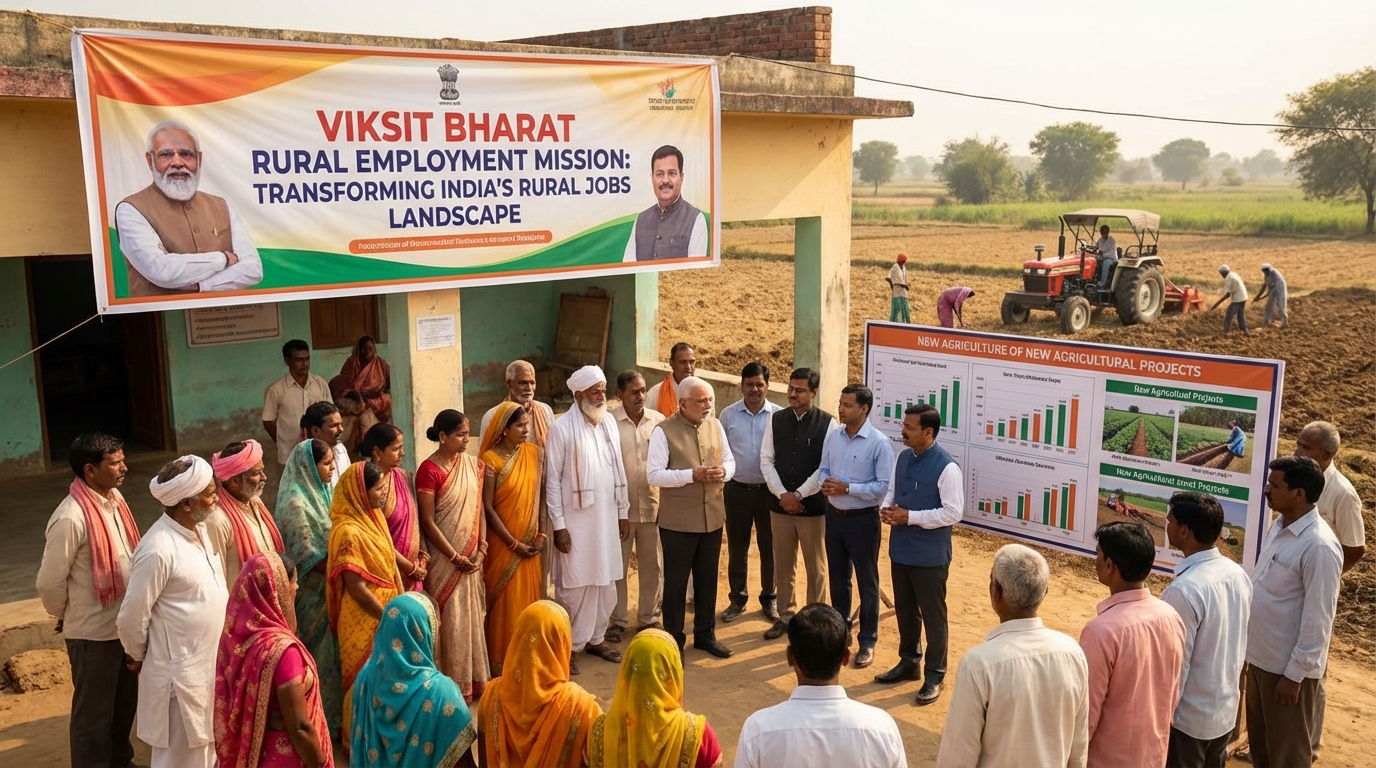
Viksit Bharat Rural Employment Mission: Transforming India’s Rural Jobs Landscape
Table of Contents
The Viksit Bharat – Guarantee for Rozgar and Ajeevika Mission (Gramin) replaces MGNREGA, aiming to modernize India’s rural employment framework. By leveraging technology platforms like DBT Sparsh and Yuktdhara, introducing equitable fund allocation, and categorizing Panchayats for targeted development, the mission promises enhanced transparency, efficiency, and inclusivity in providing employment opportunities to rural workers.
Why in the News?
- The Viksit Bharat – Guarantee for Rozgar and Ajeevika Mission (Gramin) Bill, 2025 was passed by Parliament within two days of its introduction on December 16, 2025.
- This new rural employment law will replace the Mahatma Gandhi National Rural Employment Guarantee Act, 2005 (MGNREGA).
- However, the scheme cannot start immediately because several administrative and policy steps must be completed before its implementation.
- The Ministry of Rural Development is holding regular consultations with State governments to finalise important operational details.
- These discussions include issues such as fund allocation, classification of Panchayats, technological platforms, and rule-making.
What are the Key Highlights?
Replacement of the Earlier Rural Employment Scheme
- The new law replaces the earlier rural employment programme under the Mahatma Gandhi National Rural Employment Guarantee Act, 2005.
- The earlier scheme was introduced by the United Progressive Alliance (UPA) government.
- The new legislation aims to restructure the rural employment framework under the broader Viksit Bharat vision.
Normative Allocation of Funds
- The Act states that the Central government will decide the state-wise allocation of funds every financial year.
- This allocation will be based on objective parameters, which are yet to be finalised.
- The aim is to ensure more equitable distribution of resources among States.
- Debate among States:
- Some States argue that past performance under MGNREGA should be considered.
- Other States argue that current demand for employment, especially in regions with high rural migration, should be prioritised.
Categorisation of Gram Panchayats
- All Gram Panchayats will be classified into Category A, B, or C.
- This classification will be based on development parameters.
- One example mentioned in the law is proximity to urban areas.
- The objective of categorisation is to address the different development needs of Panchayats.
Requirements Before the Scheme Starts
State governments must complete several preparations before implementation.
- Completion of ongoing MGNREGA works
- All unfinished works under the previous scheme must be completed first.
- Enrollment on DBT Sparsh platform
- States must register on DBT Sparsh, a banking platform for direct benefit transfers.
- Under the new scheme, the Centre and the States will share the financial burden, which is a major change from the previous system.
- e-KYC verification of job cards
- Workers’ job cards must undergo electronic Know Your Customer (eKYC) verification.
- Currently, 83% of active workers have completed eKYC verification.
- These job cards will remain valid until they are replaced with smart cards.
- Use of Yuktdhara portal
- States must adopt Yuktdhara geospatial planning portal.
- This portal will be used to prepare the Viksit Gram Panchayat Plan, which will list all planned works for the year.
Rule-Making Process
- The Central government must frame rules under eleven different categories.
- These rules will cover aspects such as social audit and scheme monitoring.
Implementation Timeline
- The scheme may not start by April 1 as originally expected.
- Once the Act is officially notified:
- The notification date will be considered the commencement date.
- States will have six months to implement the scheme.
Budget Allocation
- The Union Budget of India allocated funds for rural employment programmes.
- ₹95,692.31 crore allocated for VB-GRAM G.
- ₹30,000 crore allocated for the remaining MGNREGS works.
- Total allocation: ₹1,25,692.31 crore.
- The government has presented this as a 43% increase compared to the ₹88,000 crore revised estimate for MGNREGS in 2025-26.
What is the Significance?
Reform in Rural Employment Policy
- The new law represents a major reform in India’s rural employment framework.
- It introduces new administrative mechanisms and planning tools.
More Equitable Resource Allocation
- The concept of normative allocation aims to distribute funds more fairly.
- Poorer States that earlier received fewer funds may benefit.
Focus on Local Development Needs
- Categorising Panchayats into A, B, and C categories allows policies to be tailored to different development levels.
Greater Role for Technology
- Platforms like DBT Sparsh and Yuktdhara will improve:
- Transparency
- Financial accountability
- Planning efficiency
Shared Financial Responsibility
- Under the new system, both the Centre and States will share the cost.
- This may increase State participation and responsibility.
Stronger Planning at the Village Level
- The Viksit Gram Panchayat Plan will create a clear annual work plan for villages.
- This can improve coordination and reduce duplication of work.
Challenges
Uncertainty Over Allocation Parameters
- The objective parameters for fund allocation are not yet finalised.
- Different States have conflicting demands, making consensus difficult.
Concerns of High-Performing States
- States that performed well under MGNREGA fear they may lose funding advantages if past performance is not considered.
Demand-Based vs Performance-Based Allocation
- Some States want allocation based on employment demand and migration levels.
- Balancing these factors is a complex policy challenge.
Technological and Administrative Readiness
- All States must adopt multiple digital platforms, which may be difficult for weaker administrative systems.
Incomplete Worker Verification
- 17% of active workers have not yet completed eKYC verification, which could delay implementation.
Inter-Governmental Coordination
- The scheme requires close coordination between the Centre and the States.
- Political and administrative differences may slow the process.
Transition from the Old Scheme
- Ongoing works under the previous scheme must be completed first.
- Managing the transition without disruption is a major challenge.
Way Forward
Finalising Transparent Allocation Criteria
- The Centre should design clear and transparent parameters.
- These parameters should balance:
- past performance
- employment demand
- poverty levels
Strengthening State Consultation
- Regular consultations with States should continue.
- Cooperative federalism can help create mutually acceptable rules.
Improving Digital Infrastructure
- The government should support States in adopting:
- DBT Sparsh
- Yuktdhara portal
- eKYC systems
Ensuring Worker Inclusion
- Special campaigns should ensure 100% eKYC verification of job cards.
- No worker should lose access due to technical issues.
Smooth Transition from MGNREGA
- Remaining works under the earlier programme must be completed quickly and efficiently.
- Workers should not face employment gaps during the transition.
Strengthening Monitoring and Social Audit
- Strong social audit mechanisms must be developed.
- This will help maintain transparency and accountability.
Conclusion
The new rural employment law represents an important attempt to redesign India’s rural development and livelihood support system. Its success will depend on careful planning, cooperation between the Centre and the States, and the effective use of technology to ensure that employment opportunities reach rural workers in a timely and fair manner.
Relevant Articles:
India’s AI Self-Reliance: Sarvam AI Launches Open-Source Large Language Models
Great Nicobar Project: Development, Ecology, and the Question of Justice
Loggerhead Turtle Climate Impact: Alarming Study Reveals Survival Threat
Read Also:
AgriPV in India: Powerful Solar Farming Revolution Unlocks Farmer Growth
India LNG Crisis: West Asia Conflict Threatens Fertilizer Supply
Viksit Bharat- G RAM G Act 2025